Introduction to Strong Light Immunity
In industrial automation, photoelectric sensors are critical for detecting objects, counting, and positioning. However, operational environments often expose these sensors to intense ambient light from sources such as direct sunlight, high-intensity discharge lamps, or welding arcs. This strong light can interfere with the sensor's infrared or visible light signals, leading to false triggers, missed detections, or complete operational failure. For slot type (or through-beam) photoelectric sensors, which rely on a precise light beam between an emitter and a receiver housed in a single unit, immunity to such interference is paramount. This article delves into the methodologies and standards for testing strong light immunity, ensuring reliability in harsh lighting conditions.
Principles of Interference and Sensor Design
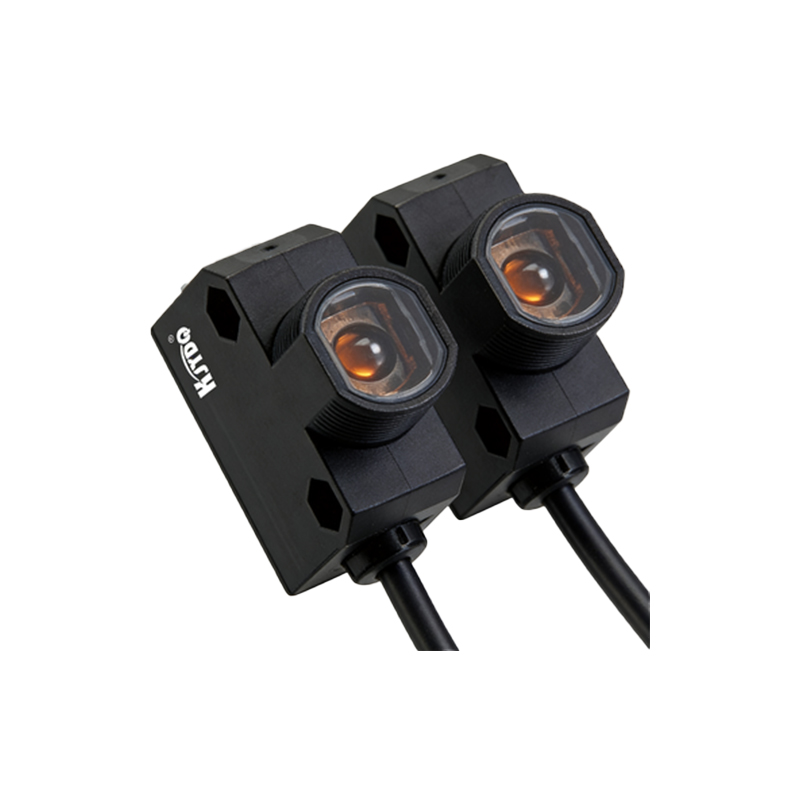
Slot type photoelectric sensors operate by transmitting a modulated light beam from an emitter to a receiver across a gap. An object passing through this gap interrupts the beam, triggering a detection signal. Strong external light can saturate the receiver's photodiode, overwhelming the modulated signal. To combat this, manufacturers employ several design strategies. These include optical filters that block specific wavelengths outside the sensor's operating frequency, high-frequency modulation of the emitted light (often in the kHz range), and synchronous detection circuits that only recognize the modulated signal. The physical slot design itself also offers some inherent shielding from oblique ambient light, but dedicated testing validates these protective measures.
Testing Standards and Environmental Simulation
Standardized testing protocols, such as those outlined in IEC 60947-5-2 for proximity sensors, provide benchmarks for strong light immunity. Key test parameters include illuminance level (measured in lux or klux), light source spectrum (e.g., halogen lamp simulating sunlight), exposure angle, and test duration. A typical high-grade industrial sensor might be tested under 15,000 lux from all directions. The test setup involves placing the sensor in a controlled chamber where intense light is projected onto it while it attempts to detect a standard test object. The sensor must maintain its specified switching function without error throughout the exposure. Data logging equipment records any false outputs or performance degradation.
Laboratory Testing Procedure
A rigorous laboratory test begins with calibrating the light source to the required illuminance at the sensor's receiver surface. The sensor is powered and connected to a monitoring system that records its output state. A test object, usually a standardized opaque card, is cycled through the slot at a defined frequency. The intense light source is then activated, often from multiple angles to simulate diffuse ambient conditions. The test runs for a sustained period, such as one hour, while the monitoring system checks for consistency between the object's actual position and the sensor's output signal. Any discrepancy indicates a failure in strong light immunity. Parameters like sensing distance and response time are also measured under light stress.
Interpreting Results and Performance Grading
Test results determine the sensor's suitability for specific applications. A "pass" means the sensor operated flawlessly under the test conditions. Performance can be graded based on the maximum illuminance withstanded. For instance, a sensor rated for 20,000 lux is suitable for outdoor use or near high-bay lighting, while one rated for 5,000 lux may be confined to indoor environments with controlled lighting. Engineers must cross-reference these results with other environmental ratings like temperature and IP protection. The data sheet should clearly state the strong light immunity level, often as "Ambient light immunity: up to [X] lux (halogen lamp)." This allows for precise selection in system design.
Application Considerations and Selection Guide
When selecting a slot type photoelectric sensor for an application with potential strong light, consider both the test ratings and practical factors. In outdoor settings, direct sunlight can exceed 100,000 lux, so additional protective housings or sunshades might be necessary even with a high-immunity sensor. For indoor applications near welding stations, sensors with a narrow acceptance angle and specific optical filters for blocking arc light spectra are preferable. Always verify the test light source spectrum matches your environment's primary interference source. Consulting application notes from manufacturers and considering redundant sensing systems in critical processes can further enhance reliability.
Future Trends and Technological Advancements
Advancements in optoelectronics and signal processing continue to push the boundaries of strong light immunity. Sensors with adaptive modulation frequencies that can shift away from interference bands are emerging. Digital signal processing (DSP) algorithms can better distinguish between the true signal and noise. Furthermore, the use of polarized light or specific coded light patterns offers new avenues for rejection of ambient light. Standardization bodies are also working on updating test methods to include newer light sources like high-intensity LEDs and lasers. As industrial environments grow more complex, the demand for sensors that are virtually blind to all light except their own will only increase, driving continuous innovation in this field.