Laser displacement sensors are widely used in industrial automation, robotics, and quality control for non-contact, high-precision distance and position measurements. Understanding their core measurement principles is essential for selecting the right sensor and ensuring accurate results. The fundamental operation relies on the triangulation method, though time-of-flight and confocal principles are also employed for specific applications.
The most common principle is laser triangulation. In this method, a laser diode emits a focused beam of visible red light or laser light onto the target surface. The reflected light from this point is then projected onto a position-sensitive detector, typically a CMOS or CCD linear image sensor, at a specific angle. The key is the geometric relationship between the laser emitter, the measured point on the target, and the receiver. When the target's distance changes, the position of the reflected light spot shifts on the detector. A closer target causes the spot to move in one direction on the sensor, while a farther target causes it to move in the opposite direction. The built-in microprocessor calculates the exact displacement value by analyzing this spot position shift using trigonometric algorithms. This method offers very high resolution, often in the micron or sub-micron range, and is ideal for measuring short to medium distances on diffuse surfaces.
For measuring much longer ranges, often over several meters, time-of-flight (ToF) or phase-shift measurement principles are used. Here, the sensor emits a modulated laser pulse or continuous wave. The distance is determined by measuring the time delay between the emitted pulse and the detection of the reflected pulse (ToF), or by analyzing the phase shift between the emitted and received modulated wave. The calculation is based on the constant speed of light. While generally offering slightly lower resolution than triangulation over short distances, ToF sensors excel in long-range applications and can measure on various surface types, including low-reflectivity materials.
Another advanced principle is confocal measurement, often using chromatic confocal technology. This method utilizes a white light source or a multi-wavelength laser. The light is focused through a special lens system that causes different wavelengths to focus at different distances along the optical axis. Only the wavelength that is perfectly focused on the target surface is reflected back efficiently into the detector through a confocal pinhole. By spectrally analyzing the returning light and identifying the dominant wavelength, the sensor determines the exact distance. This technique provides exceptional precision, is largely unaffected by surface angle or material, and can even measure transparent objects like glass or film thickness.
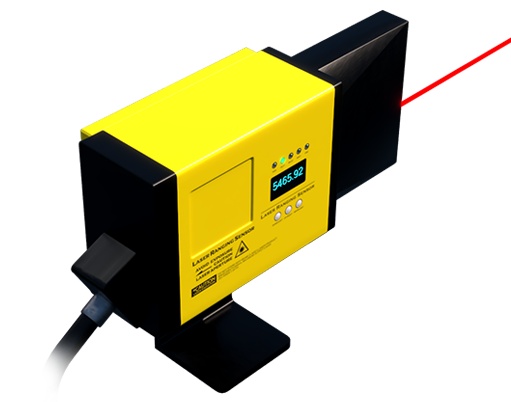
Several factors influence measurement accuracy regardless of the principle. Surface properties are critical. Ideal diffuse, matte surfaces provide stable, scattered reflection. Shiny, mirror-like surfaces can cause specular reflection, directing the beam away from the detector and causing measurement errors or dropouts. Techniques like using diffuse laser light, special filters, or sensor models designed for glossy surfaces mitigate this. Target color and material absorption also affect the intensity of the returned signal; most sensors have automatic gain control to compensate. Environmental conditions like ambient light, dust, fog, or temperature fluctuations can interfere with the laser beam and must be considered during installation.

In practical applications, these principles enable diverse tasks. In automotive manufacturing, triangulation sensors measure panel gaps and flushness. In electronics, confocal sensors inspect solder paste height or wafer thickness. ToF sensors guide automated guided vehicles (AGVs) or measure bulk material levels in silos. The choice of measurement principle directly depends on the required range, resolution, target surface, and environmental conditions.
Modern laser displacement sensors integrate sophisticated electronics for signal processing, filtering, and communication via interfaces like Ethernet/IP, PROFINET, or analog outputs. They represent a perfect fusion of optical physics, precision engineering, and digital computation, providing reliable data that is fundamental to modern automated and quality-assured production. By selecting a sensor based on the correct underlying measurement principle for the application, engineers can achieve the high levels of accuracy, speed, and reliability demanded by today's industries.
