In the world of precision measurement, laser length measurement sensors stand as a cornerstone technology, enabling non-contact, high-accuracy dimensional analysis across countless industries. Unlike traditional mechanical gauges or contact probes, these sensors utilize the properties of coherent light to determine distance, displacement, or position with remarkable speed and resolution. Their ability to measure without touching the target object eliminates the risk of damage, deformation, or wear, making them indispensable for quality control, automation, and research.
The fundamental principle behind most industrial laser length measurement sensors is laser triangulation. A laser diode projects a visible or infrared spot onto the target surface. The reflected light is then focused onto a position-sensitive detector, such as a CCD or CMOS array. As the distance to the target changes, the position of the reflected spot on the detector shifts. This angular shift is precisely calculated by the sensor's internal processor using trigonometric principles to output an exact distance value. For longer ranges, time-of-flight (ToF) principles are often employed, where the sensor measures the time delay between emitting a laser pulse and receiving its reflection.
The advantages of using laser sensors for length measurement are compelling. They offer sub-micron resolution, allowing for the detection of variations invisible to the human eye. Measurement rates can reach into the tens or even hundreds of kilohertz, enabling real-time inspection on fast-moving production lines. Furthermore, their non-contact nature allows measurement of hot, soft, delicate, or vibrating objects that would be impossible to gauge with tactile methods. This includes applications like measuring molten glass, rubber profiles, semiconductor wafers, or high-speed rotating tools.
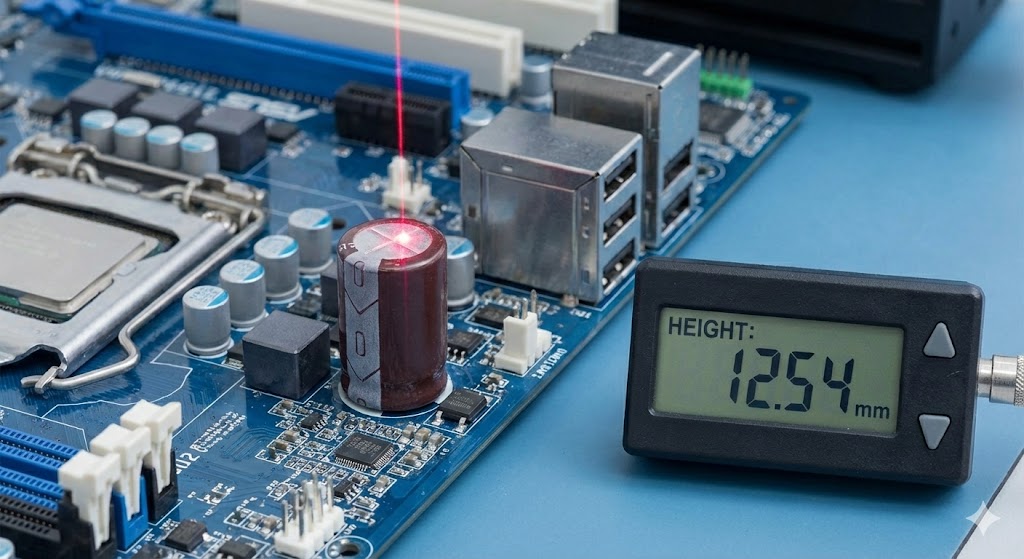
The applications of laser length measurement sensors are vast and varied. In automotive manufacturing, they are used to verify the gap and flush between body panels, measure tire tread depth, and inspect engine component dimensions. In the electronics industry, they ensure the precise thickness of coatings, the coplanarity of chip leads, and the height of solder paste deposits. In metal processing, they monitor the thickness of rolled steel, the diameter of wires, and the profile of extruded materials. They are also crucial in robotics for precise positioning and guidance, and in logistics for parcel dimensioning.
Selecting the right laser length measurement sensor requires careful consideration of several key parameters. The measurement range defines the minimum and maximum distances over which the sensor can operate accurately. The resolution indicates the smallest detectable change in distance. The linearity specifies the deviation of the sensor's output from a perfectly straight line across its range, a critical factor for accuracy. The spot size of the laser affects the minimum feature that can be measured and influences performance on rough or textured surfaces. Response speed or sampling rate must match the dynamics of the application. Environmental factors like ambient light, dust, fog, or temperature swings must also be considered, as they can impact the laser beam and require sensors with robust housings or specific protective filters.
Integration of these sensors into a system is typically straightforward. Most modern sensors provide analog outputs (e.g., 0-10V, 4-20mA) and digital interfaces (e.g., RS-422, Ethernet/IP, PROFINET) for seamless connection to PLCs, data acquisition systems, or industrial PCs. Software tools allow for easy configuration, calibration, and data logging. Proper mounting and alignment are essential for optimal performance, and regular maintenance, primarily keeping the lens clean, ensures long-term reliability.
Looking ahead, advancements in laser technology and processing algorithms continue to push the boundaries. Sensors are becoming smaller, faster, more energy-efficient, and smarter. The integration of embedded intelligence allows for onboard data processing, outlier filtering, and even basic decision-making, facilitating the move towards decentralized Industry 4.0 architectures. Multi-point sensors and laser line profilers, which capture entire cross-sections instead of a single point, are expanding applications into 3D contour and shape analysis.
In conclusion, laser length measurement sensors are a transformative technology for precision metrology. By understanding their operating principles, recognizing their broad applicability, and carefully matching their specifications to the task at hand, engineers and technicians can solve complex measurement challenges, enhance product quality, and optimize manufacturing processes with unprecedented efficiency and reliability.