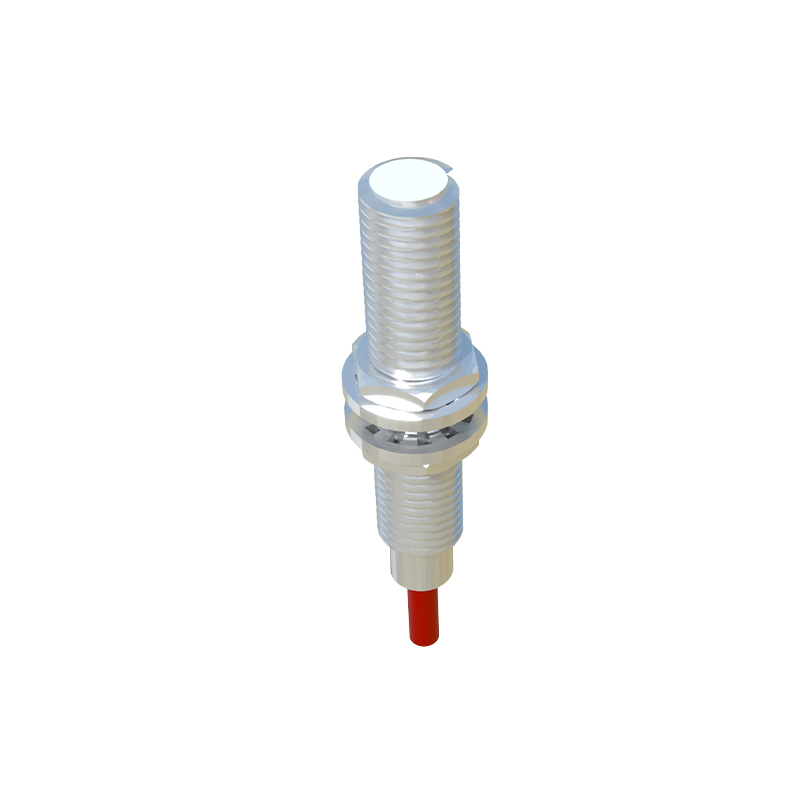
In the realm of industrial automation and machine safety, the ability to detect the presence or absence of an object without physical contact is paramount. DC proximity sensors, a cornerstone of this technology, offer reliable, non-contact detection for a vast array of applications. Unlike their mechanical switch counterparts, these solid-state devices provide long service life, high switching speeds, and immunity to environmental contaminants like dust and oil. Their operation is based on the principle of electromagnetic induction or capacitive change, triggered by the approach of a metallic or non-metallic target.
The core working principle of inductive DC proximity sensors involves an oscillator circuit that generates a high-frequency electromagnetic field at the sensing face. When a conductive metal target enters this field, eddy currents are induced on the target's surface. This causes a load on the oscillator, leading to a reduction in its amplitude. This change is detected by a threshold circuit, which subsequently switches the state of the sensor's solid-state output. The sensor is powered by a Direct Current (DC) supply, typically ranging from 10 to 30 VDC, which defines its operational characteristics. The output from these sensors is also DC, commonly in the form of a PNP (sourcing) or NPN (sinking) transistor switch, making them directly compatible with programmable logic controllers (PLCs) and other DC-based control systems.
Several key types of DC proximity sensors cater to different needs. The standard shielded (flush-mountable) type allows for side-by-side installation without mutual interference and is ideal for detecting small targets. The unshielded (non-flush) type offers a longer sensing range but requires more space around the sensor. Furthermore, analog output sensors provide a continuous voltage or current signal proportional to the distance to the target, enabling precise position monitoring. Specialized variants include cylindrical and rectangular housings, all-metal designs for harsh environments, and sensors with increased switching frequency for high-speed applications.
The advantages of using DC-powered proximity sensors are significant. They exhibit no moving parts to wear out, ensuring exceptional durability and millions of operational cycles. Their fast response time, often in microseconds, is crucial for high-speed counting and positioning tasks. Being entirely sealed, they perform reliably in challenging conditions where dirt, coolant, or vibrations are present. The choice between PNP and NPN outputs provides flexibility for different circuit design requirements in global markets.

Industrial applications for DC proximity sensors are ubiquitous. On assembly lines, they detect parts for robotic pick-and-place operations and verify the presence of components. In material handling, they serve as limit switches to determine the position of pallets, doors, or actuators. They are integral to rotary encoders for speed measurement on motor shafts and conveyors. Safety systems employ them as interlock switches on machine guards. From detecting liquid levels in tanks (using a float with a metallic trigger) to precise edge guiding in printing and packaging machinery, their versatility is unmatched.
Selecting the right DC proximity sensor requires careful consideration of several parameters. The sensing distance, or nominal range, must be suitable for the application, with a safety margin factored in. The target material (steel, aluminum, brass) and size affect the effective sensing distance. Environmental factors like temperature extremes, chemical exposure, and electrical noise influence the choice of housing material and shielding. The required output type (PNP/NPN, NO/NC) and electrical current rating must match the control system's input module. Proper installation is also critical; ensuring correct polarity, adequate clearance from metal surfaces, and protection from physical damage guarantees optimal performance and longevity.
In conclusion, DC proximity sensors are indispensable components in modern industrial control systems. Their non-contact sensing, robust construction, and compatibility with digital control architectures make them a preferred solution for automation engineers worldwide. By understanding their operating principles, types, and key selection criteria, technicians and engineers can effectively implement these devices to enhance machine efficiency, reliability, and safety across countless industries.