Introduction to High-Precision Sensing
In the realm of industrial automation, the demand for precision is unyielding. Among the critical components enabling this precision are proximity sensors, specifically those with an ultra-short sensing range. A 0.05mm proximity switch sensor represents the pinnacle of this technology, designed to detect the presence or absence of an object at an exceptionally close distance. This capability is not merely a technical specification; it is a fundamental requirement in applications where spatial constraints are severe and tolerance margins are virtually nonexistent. These sensors operate on the principle of electromagnetic induction, generating an oscillating electromagnetic field. When a metallic target enters this minute field, eddy currents are induced, causing a change in the sensor's oscillation amplitude. This minute change is precisely measured and converted into a clear electrical output signal, triggering a control action. The 0.05mm specification defines the nominal switching distance, a standardized value under ideal conditions, which underscores the sensor's ability to function reliably in the most demanding micro-positioning tasks.
Core Operating Principles and Technology
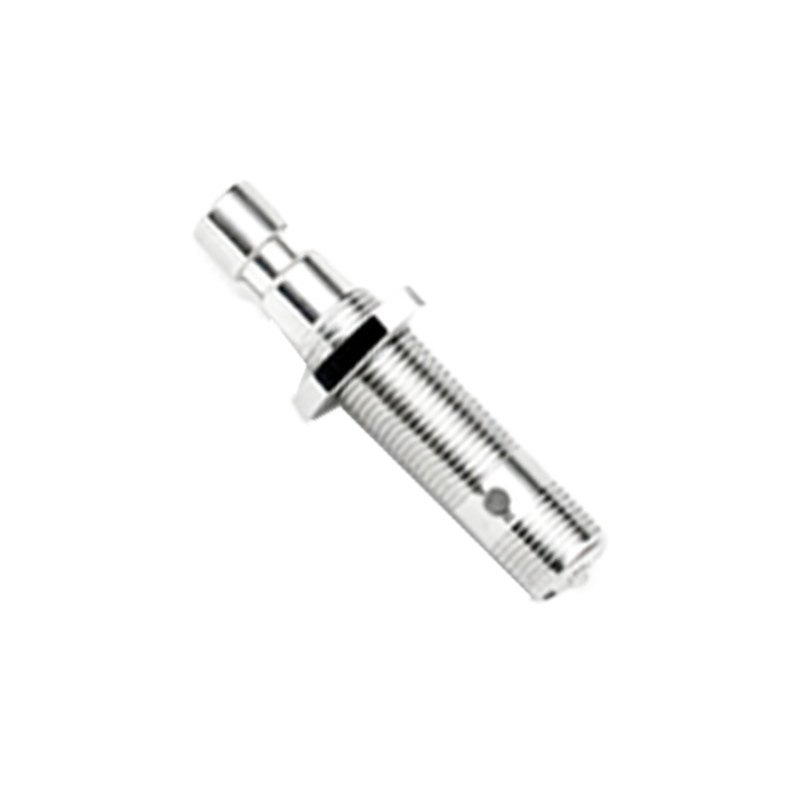
The operation of a 0.05mm inductive proximity sensor hinges on advanced coil design and sophisticated electronic evaluation circuitry. The sensor's face contains a ferrite core with a coil that is part of a high-frequency oscillator circuit. The oscillation is sustained as long as no conductive material is within the active sensing zone. The moment a ferrous or non-ferrous metal object approaches within 0.05mm of the active surface, the electromagnetic field is damped. This damping effect leads to a reduction in the oscillation amplitude. A dedicated threshold circuit continuously monitors this amplitude. Once the damping exceeds a pre-set threshold—corresponding precisely to the 0.05mm sensing point—the circuit switches the output state. This technology ensures that the sensor provides a binary signal with exceptional repeatability and minimal hysteresis, meaning the switch-on and switch-off points are remarkably consistent, even over millions of cycles.
Critical Design and Material Considerations
Achieving and maintaining a reliable 0.05mm sensing distance imposes stringent requirements on design and materials. The sensor housing is typically constructed from stainless steel (e.g., V4A/AISI 316L) or nickel-plated brass to provide robust mechanical protection and resistance to harsh industrial environments, including coolants and cleaning agents. The sensing face is a critical area; it must be perfectly flat and often incorporates a wear-resistant coating to prevent degradation from repeated physical contact or abrasion by targets. Internally, the coil windings are precision-made, and the electronic components are selected for thermal stability to counteract the effects of ambient temperature fluctuations, which could otherwise alter the effective sensing distance. Furthermore, the design must ensure electromagnetic compatibility (EMC), preventing interference from nearby motors, frequency converters, or other sensors, which is crucial for maintaining signal integrity at this microscopic scale.
Primary Applications in Industry
The application spectrum for 0.05mm proximity sensors is specialized and vital for high-end manufacturing. They are indispensable in precision machining centers for tool wear monitoring and breakage detection, where a deviation of a few microns can compromise part quality. In semiconductor and electronics manufacturing, these sensors are used for wafer handling, chip placement, and verifying the presence of microscopic components on circuit boards. Robotics, especially in assembly arms requiring delicate force feedback and precise end-effector positioning, relies on these sensors for accurate feedback at the point of operation. Additionally, they play a key role in quality control systems, such as gauging fixtures that verify the thickness of thin foils, the presence of minute seals, or the precise closure of micro-mechanical devices. In each case, the sensor acts as the definitive "yes/no" checkpoint for a process parameter measured in hundredths of a millimeter.
Installation, Alignment, and Calibration Best Practices
The performance of a ultra-short-range sensor is profoundly influenced by correct installation. Mounting must be rigid and vibration-free to prevent any deviation in the air gap between the sensor and the target. The target itself must meet specific criteria: it should be a square of ferrous or non-ferrous metal (typically steel) with a side length at least equal to the sensor's face diameter, and it must approach the sensor head perpendicularly to ensure consistent damping of the electromagnetic field. Even a slight angular misalignment can significantly reduce the effective sensing distance. While these sensors are generally not user-calibratable, initial setup involves careful adjustment using precision gauges to establish the exact 0.05mm gap. Environmental factors such as the presence of different metal types in the background or adjacent machinery must also be considered during installation to avoid false triggering.