Introduction to Sensing Technologies
In industrial automation and control systems, the selection of appropriate sensing devices is critical for ensuring operational efficiency, safety, and reliability. Two prominent categories of non-contact sensors widely utilized across various sectors are laser photoelectric sensors (often referred to as laser through-beam or laser opposed sensors) and proximity switches. While both serve the fundamental purpose of object detection without physical contact, their underlying principles, performance characteristics, and ideal applications differ significantly. This article provides a detailed technical exploration of these two sensor types, offering insights to guide engineers and technicians in making informed selection decisions based on specific application requirements.
Operating Principle of Laser Photoelectric Sensors
Laser photoelectric sensors operate on the principle of light beam interruption. The system consists of two separate units: a laser transmitter and a receiver. The transmitter emits a focused, coherent beam of laser light, which is directed towards the receiver unit. When an object passes between the two units, it interrupts the light beam. The receiver detects this interruption and triggers an output signal. This through-beam configuration offers several advantages, including very long sensing ranges—often up to several hundred meters—and high precision. The focused nature of the laser beam provides excellent resolution, allowing for the detection of very small objects. Furthermore, these sensors are largely immune to environmental factors like target color, reflectivity, or surface finish, as they simply detect the presence or absence of the beam. Common applications include high-speed counting on production lines, edge guidance in web processing, and safety light curtains for perimeter guarding.
Operating Principle of Proximity Switches

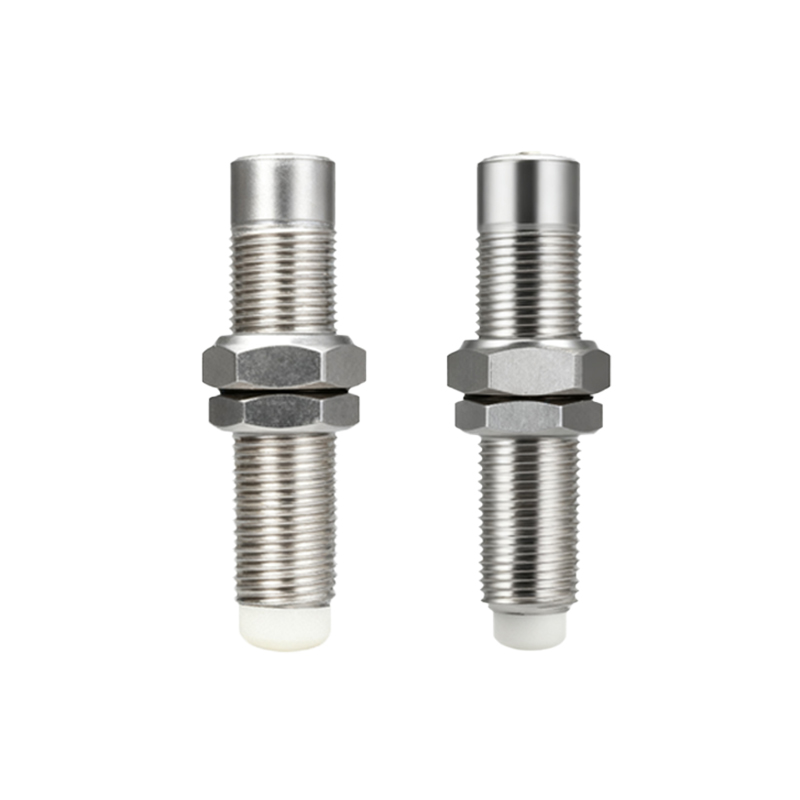
Proximity switches, or proximity sensors, detect the presence of a metallic or, in some cases, non-metallic object within a defined sensing range without any physical contact. The most common types are inductive and capacitive proximity sensors. Inductive proximity switches generate an electromagnetic field from an oscillator circuit. When a metallic object enters this field, it induces eddy currents within the object, causing a change in the oscillation amplitude. This change is detected by the sensor's circuitry, which then switches its output state. Capacitive proximity switches can detect both metallic and non-metallic materials (like plastics, wood, or liquids) by sensing changes in capacitance caused by the target object entering the electrostatic field of the sensor. Proximity switches typically have much shorter sensing ranges, from a few millimeters to about 60 millimeters, and are known for their robustness, fast response times, and insensitivity to dust, dirt, and ambient light.
Key Performance Comparison
A direct comparison highlights the distinct operational envelopes of each sensor. Sensing Range: Laser photoelectric sensors excel in long-range applications, from a few centimeters to over 200 meters. Proximity switches are designed for short-range detection, typically below 60mm. Target Material: Laser sensors are generally material-agnostic; any opaque object that interrupts the beam will be detected. Inductive proximity switches are specifically for ferrous and non-ferrous metals, while capacitive types can handle a wider range of materials. Environmental Tolerance: Proximity switches are highly resistant to contaminants like dust, oil, and moisture, making them ideal for harsh industrial environments. Laser sensors can be affected by heavy airborne particulates, fog, or steam that may scatter or block the beam, though models with modulated laser light offer improved resistance to ambient light interference. Precision and Resolution: The pinpoint accuracy of a laser beam allows for detecting extremely small objects or precise positioning, outperforming the broader sensing field of a proximity switch. Cost and Complexity: Laser photoelectric systems, requiring alignment of two separate units, are generally more complex to install and calibrate and have a higher initial cost than self-contained proximity switches.
Application-Specific Selection Guidelines
Choosing between a laser photoelectric sensor and a proximity switch depends entirely on the application's specific parameters. For long-distance detection, precise small-part detection, or when the target material varies, a laser through-beam sensor is the superior choice. Examples include monitoring objects on a high-bay racking system, detecting broken wires or threads in textile machinery, or ensuring proper spacing between vehicles on an automated guided vehicle (AGV) pathway. Conversely, select a proximity switch for short-range detection of metallic objects in dirty or wet conditions, such as sensing the position of a hydraulic cylinder rod end, detecting metal caps on bottles, or confirming the presence of a machine tool in a CNC lathe. For non-metallic object detection at close range, a capacitive proximity switch would be appropriate, such as monitoring fluid levels in a non-metallic tank or detecting plastic packaging.
Installation and Maintenance Considerations
Proper