Introduction to Photoelectric Sensors
Photoelectric sensors are indispensable components in modern industrial automation, providing non-contact detection of objects based on the modulation of light. These devices operate by emitting a beam of light, typically from an LED or laser diode, and detecting changes in the received light intensity caused by the presence, absence, or characteristics of a target object. Their ability to sense a wide variety of materials—including metals, plastics, glass, and liquids—over considerable distances and at high speeds makes them superior to mechanical limit switches and other contact-based sensing methods. The core principle involves an emitter, a receiver, and associated electronics that process the signal to produce a discrete output, such as a switching signal for a PLC. Their robustness, reliability, and versatility have cemented their role in applications ranging from packaging and material handling to assembly verification and safety systems.
Through-Beam Sensors
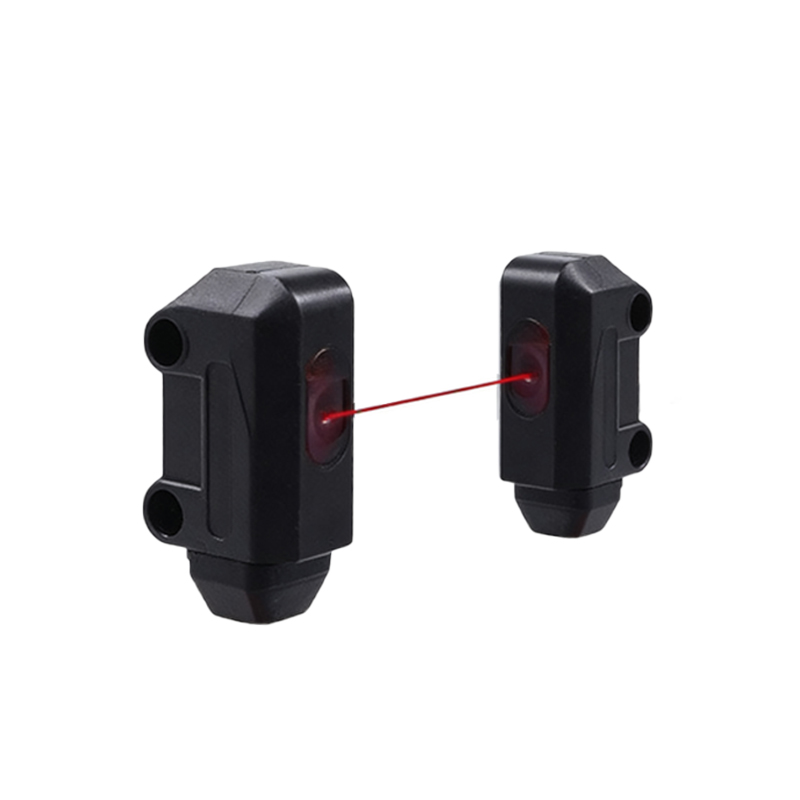
Through-beam sensors, also known as opposed-mode sensors, consist of two separate units: a transmitter and a receiver positioned directly opposite each other. The transmitter projects a continuous beam of light to the receiver. Detection occurs when an object interrupts this beam, causing a significant drop in the received light intensity. This configuration offers the longest sensing ranges among photoelectric types, often exceeding 100 meters, and provides the highest excess gain, meaning it is highly immune to environmental factors like dust, dirt, or target surface characteristics. It is ideal for detecting opaque objects of any color or surface finish and is commonly used for counting, break detection on conveyor lines, and door open/close monitoring. The primary drawback is the need for precise alignment of two separate components and separate wiring for each unit.
Retroreflective Sensors
Retroreflective sensors house both the emitter and receiver in a single housing. They operate by projecting light toward a specialized reflector, often a corner-cube prism or tape, which reflects the light directly back to the receiver. An object is detected when it breaks this reflected beam. This design simplifies installation compared to through-beam sensors, as only one device needs wiring and alignment is with a passive reflector. Sensing ranges are substantial, though typically less than through-beam models. A key consideration is the potential for false triggers from shiny objects that might reflect light back like the reflector. To combat this, many retroreflective sensors employ polarization filters; the emitter's light is polarized, and the receiver has a cross-polarized filter, so it only recognizes light that has been depolarized by the specific retroreflector, ignoring reflections from ordinary shiny surfaces.
Diffuse Reflective Sensors
Diffuse reflective sensors, or proximity-mode sensors, also integrate the emitter and receiver into one unit. However, they do not use a separate reflector. Instead, they detect the presence of an object by measuring the amount of light diffusely reflected off the target's surface back to the receiver. This makes them exceptionally easy to install, as they only require a single device pointed at the target. Their effective range is the shortest of the three main types and is heavily dependent on the target's size, color, and surface texture—light-colored, matte surfaces reflect well, while dark or glossy surfaces are more challenging. They are perfect for applications where space is limited or where mounting a reflector or receiver is impractical, such as detecting objects on a conveyor or sensing the level of material in a bin. Advanced versions, known as background suppression or fixed-field sensors, use triangulation to detect objects only within a precise, defined distance, ignoring the background.
Key Performance Parameters
Selecting the correct photoelectric sensor requires careful analysis of several critical parameters. Sensing Range is the maximum distance at which the sensor can reliably detect a standard target. Excess Gain quantifies the amount of extra light energy available beyond the minimum required for operation, indicating immunity to lens contamination or difficult targets. Response Time defines how quickly the sensor's output switches after detecting an object, crucial for high-speed applications. Light Source is typically a red or blue visible LED, infrared LED, or laser diode; laser models offer precise, small-spot detection over long ranges. Output Type can be discrete (PNP/NPN transistor, relay) or analog (4-20 mA, 0-10 V), while Connection methods include pre-wired cables or quick-disconnect connectors. Environmental ratings for Ingress Protection (IP) and temperature are vital for durability in harsh industrial conditions.
Specialized Sensor Variants
Beyond the core types, specialized photoelectric sensors address niche challenges. Color Mark Sensors detect specific color contrasts or marks on packaging or labels, often using a red, green, and blue (RGB) light source. Luminescence Sensors detect the presence of materials that glow under UV light, useful for security label verification. Fiber Optic Sensors utilize flexible fiber optic cables to guide light to and from a remote amplifier, enabling sensing in extremely hot, cold, or space-constrained environments. Contrast Sensors are optimized to detect minute differences in grayscale or contrast. Distance Measuring Sensors, often laser-based, provide an analog output proportional to the distance to the target, used for precise positioning or dimension checking. Understanding these variants allows engineers to solve complex sensing problems.
Application Considerations and Selection
Successful implementation hinges on a thorough application analysis. Engineers must define the Target characteristics: material, color, size, and surface. The Required Sensing Distance and required mounting positions will narrow the choice between through-beam, retroreflective, or diffuse types. The Operational Environment—presence of dust, moisture, vibration, or ambient light—dictates the necessary housing material, IP rating, and potential need for specialized filters. The required Speed of detection determines the necessary response time. Finally, the Electrical Interface must match the control system's input requirements. By systematically evaluating these factors against sensor specifications, the optimal photoelectric solution can be selected to ensure reliable, maintenance-free operation on the factory floor.