Introduction to Photoelectric Sensor Terminology
In the realm of industrial automation and control systems, photoelectric sensors are indispensable components for detecting the presence, absence, or position of objects without physical contact. Among the various specifications and parameters that define a sensor's performance and suitability for an application, the designations "L" and "D" are frequently encountered. These letters are not arbitrary; they represent critical, standardized characteristics related to the sensor's optical design and beam properties. A precise understanding of L and D is fundamental for engineers to select the correct sensor, ensure reliable operation, and optimize system performance. This guide delves into the technical meaning of these parameters, their practical implications, and their role in sensor datasheets and application notes.
Defining "L" - The Light Source Characteristic
The letter "L" in photoelectric sensor terminology typically stands for "Light Source" or, more specifically, refers to sensors equipped with a "Light-emitter" or "Laser" source. This designation is crucial as it distinguishes the type of light generation technology used. Standard photoelectric sensors often use an LED (Light Emitting Diode) as a light source, providing a reliable and cost-effective solution for many applications. However, sensors marked with "L" frequently indicate the use of a laser diode. Laser-based sensors emit a highly concentrated, coherent beam of light. This results in several key advantages: a very small, precise spot size, excellent visibility for alignment purposes, and the ability to detect extremely small objects or achieve longer sensing distances with high accuracy. The "L" specification alerts the engineer to the presence of this more focused and powerful light source, which is essential for applications requiring high precision.
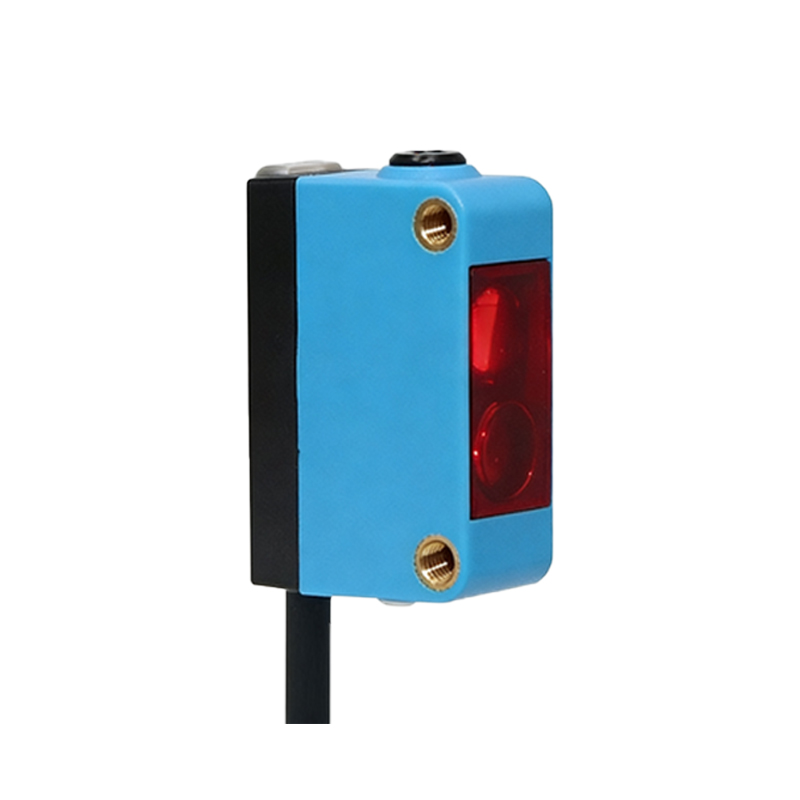
Defining "D" - The Detection Method Characteristic
Conversely, the letter "D" is most commonly associated with "Diffuse-reflective" or "Distance-settable" sensing modes. In the context of common sensor model nomenclature, "D" overwhelmingly refers to the diffuse-reflective operating principle. A diffuse-reflective sensor houses both the light emitter and the receiver in a single housing. It detects an object when the emitted light beam strikes the object's surface and a portion of the diffusely reflected light is scattered back to the receiver. This mode is popular for its simplicity of installation, as it requires only one device and no separate reflector. However, its sensing distance and performance can be influenced by the color, texture, and reflectivity of the target object. Some advanced sensor families also use "D" to denote "Background Suppression" or "Distance-settable" variants, which use triangulation to measure distance and ignore objects beyond a set point, but the core association remains with the diffuse reflective principle.
The Practical Interplay of L and D in Sensor Models
In a complete sensor model number or series name, L and D often appear together or in combination with other letters (like T for Through-beam, or R for Retro-reflective). For instance, a model might be listed as "-LD" or feature "L" in the series code and "D" in the type code. A common interpretation is a "Laser, Diffuse-reflective" sensor. This combination is particularly powerful. It leverages the precise, visible beam of a laser source with the convenient single-unit installation of the diffuse-reflective method. Such a sensor is ideal for tasks requiring accurate detection of small components, precise positioning, or operation in environments where alignment of separate emitter and receiver units is impractical. Engineers must consult the manufacturer's specific catalog or datasheet to confirm the exact meaning, as coding conventions can vary slightly between brands like Omron, Keyence, Sick, or Banner.
Key Application Considerations and Selection Criteria
Choosing between a standard LED sensor and an "L" (laser) type, and between a through-beam, retro-reflective, or "D" (diffuse) type, depends entirely on the application requirements. For long-range detection or dirty environments, a through-beam (T) setup with separate units is often most robust. For medium-range detection of objects with varying surfaces, a standard diffuse (D) sensor may suffice. However, when the application demands high precision—such as detecting the edge of a wafer, verifying the presence of a tiny screw, or ensuring exact positioning in electronics assembly—a Laser Diffuse (L-D) sensor becomes the preferred choice. Factors to weigh include required sensing distance, object size and reflectivity, environmental conditions (ambient light, dust, vibration), required response time, and, of course, budget, as laser-based sensors typically command a higher price point.
Interpreting Datasheets and Technical Specifications
A sensor's datasheet is the ultimate authority for its capabilities. When evaluating a sensor with L and D characteristics, engineers should pay close attention to specific parameters. For the "L" (laser) aspect, key specs include laser class (e.g., Class 1 or 2 for safety), spot diameter at a given distance, and maximum sensing range. For the "D" (diffuse) aspect, critical data includes the standard sensing distance (often defined for a standard white target), the sensing distance curve for different colors and materials, and the background suppression distance if applicable. The combination of these specs will clearly define the operational envelope. Misinterpreting these values can lead to selection errors, such as choosing a sensor with a spot size too large to detect a small object or one whose sensing distance diminishes too much on a dark target.
Conclusion and Best Practices for Implementation
In summary, "L" and "D" are concise codes that convey significant technical information about a photoelectric sensor's light source and operating mode, respectively. "L" generally signifies a laser light source for precision, while "D" denotes a diffuse-reflective detection method for installation convenience. A firm grasp of these concepts enables engineers to navigate product catalogs efficiently and make informed selection decisions. The best practice is always to cross-reference the model code with the official manufacturer documentation, perform application testing with actual target objects under real conditions when possible, and consider environmental factors that could affect the laser beam or the reflectivity reading. By meticulously applying this knowledge, engineers can ensure robust, reliable, and precise object detection in any automated system.