Introduction to Photoelectric Sensors
Photoelectric sensors are indispensable components in modern industrial automation, playing a critical role in object detection, positioning, and quality control. These devices operate on a simple yet powerful principle: they emit a beam of light (visible, infrared, or laser) and detect changes in the received light signal caused by the presence, absence, or specific characteristics of a target object. The core components typically include a light source (emitter), a photodetector (receiver), and supporting signal processing circuitry. Their non-contact nature makes them ideal for applications where physical touch could damage the product or the sensor itself, such as detecting fragile items, hot surfaces, or rapidly moving objects. Compared to mechanical limit switches or proximity sensors, photoelectric sensors offer superior detection ranges, faster response times, and greater flexibility in sensing diverse materials, including glass, plastic, metal, and liquids. Their reliability and precision have cemented their position across countless industries, from packaging and material handling to automotive assembly and pharmaceutical production.
Through-Beam Sensors
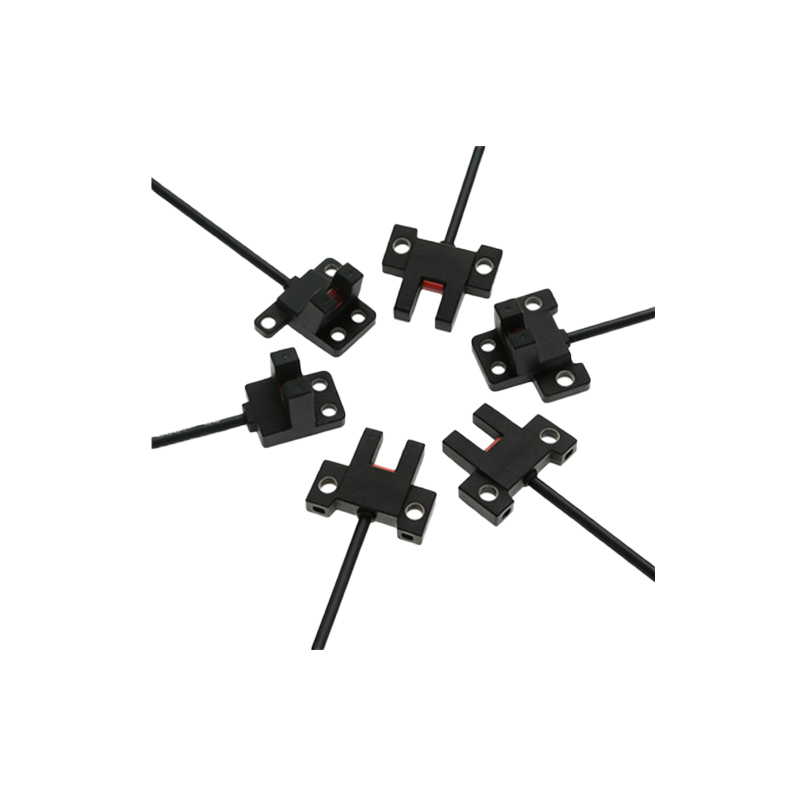
Through-beam sensors, also known as opposed-mode sensors, represent the most robust and long-range photoelectric sensing solution. This configuration consists of two separate units: a transmitter and a receiver, positioned directly opposite each other. The transmitter continuously emits a light beam, which is received by the counterpart unit. An object is detected when it interrupts this beam, causing a complete loss of signal at the receiver. This method provides the highest excess gain, meaning it can tolerate significant amounts of dust, dirt, or misalignment while still functioning reliably. Detection is extremely accurate and is largely independent of the object's surface color, texture, or reflectivity. Typical applications include detecting large objects on conveyors, monitoring breakages in material webs, ensuring safety in access gates, and counting items on high-speed production lines. The primary drawback is the need for precise alignment during installation and the requirement to wire and mount two separate devices, which can increase initial setup complexity and cost.
Retroreflective Sensors
Retroreflective sensors offer a practical compromise between detection range and installation simplicity. In this type, both the emitter and receiver are housed in a single unit. The sensor emits a light beam towards a specially designed reflector, often a corner-cube prism or tape, which reflects the light directly back to the receiver. Detection occurs when an object blocks this reflected beam. This design simplifies wiring and mounting compared to through-beam sensors, as only one device and a reflector need to be installed. However, the detection range is generally shorter, and the excess gain is lower. A key consideration with retroreflective sensors is the potential for false triggers from shiny objects. A shiny target might reflect enough light back to the receiver, mimicking the reflector and causing the sensor to fail to detect the object. To combat this, many modern retroreflective sensors utilize polarization filters. The emitted light is polarized, and the reflector depolarizes it. The receiver's filter only accepts depolarized light, ensuring it ignores direct reflections from glossy surfaces.
Diffuse Reflective Sensors
Diffuse reflective sensors, or proximity-mode sensors, are the most compact and easiest to install, as they require only a single unit and no separate reflector. The emitter and receiver are co-located. The sensor detects an object when the emitted light reflects off the target's surface and scatters back (diffuses) to the receiver. The intensity of the returned light depends heavily on the object's color, surface finish, material, and distance. Light-colored, matte surfaces reflect well, while dark, shiny, or absorbent surfaces are more challenging to detect. This sensitivity to target properties is both a strength and a limitation. It allows for applications like color marking detection, label sensing, or distinguishing between materials. However, it also requires careful tuning of the sensing distance and sensitivity threshold. Advanced versions, known as background suppression or fixed-field sensors, use triangulation or other optical techniques to detect objects only within a specific, defined distance, effectively ignoring the background. This makes them excellent for detecting objects on a conveyor belt regardless of the belt's color or detecting objects at a precise height.
Specialized Photoelectric Sensor Types
Beyond the three fundamental modes, several specialized photoelectric sensors address niche but critical applications. Fiber optic sensors utilize flexible fiber optic cables to guide light to and from a remote sensing point. The amplifier (containing the light source and detector) can be mounted away from harsh environments involving extreme temperatures, chemicals, or vibration, while only the small, durable cable tip is exposed. This makes them perfect for confined spaces or hostile conditions. Color sensors differentiate between colors by analyzing the reflected light's wavelength composition, crucial in sorting, quality verification, and printing. Contrast sensors detect the difference in contrast between a mark and its background, widely used for label registration and barcode detection. Luminescence sensors detect the presence of materials (like certain adhesives, oils, or security markings) that fluoresce under specific light, such as UV light. Finally, distance-measuring sensors, often using laser triangulation or time-of-flight principles, provide precise, continuous measurement of an object's distance, used in dimensioning, profiling, and level control.
Key Selection Criteria and Industry Applications
Selecting the appropriate photoelectric sensor requires a systematic evaluation of the application parameters. First, define the sensing mode based on required range, target characteristics, and environmental constraints. Next, consider the sensing range, ensuring an adequate operating margin. The light source type is crucial: red LED for general purpose, infrared for longer range or immunity to ambient light, laser for precise small-spot detection, and blue or green LEDs for better detection of dark or red objects. The housing material (typically metal or plastic) must withstand the environment, considering factors like washdowns (IP67/IP69K ratings), chemicals, or physical impact. Output type (PNP/NPN, analog, IO-Link) must match the control system. Response time must be fast enough for the object's speed. In practice, through-beam sensors dominate long-range safety and counting; retroreflective is common in packaging and palletizing; diffuse sensors are ubiquitous in assembly and material presence detection; and specialized sensors enable advanced automation in electronics, food & beverage, and logistics, ensuring efficiency, safety, and quality.