Introduction to Through-Beam Photoelectric Sensing
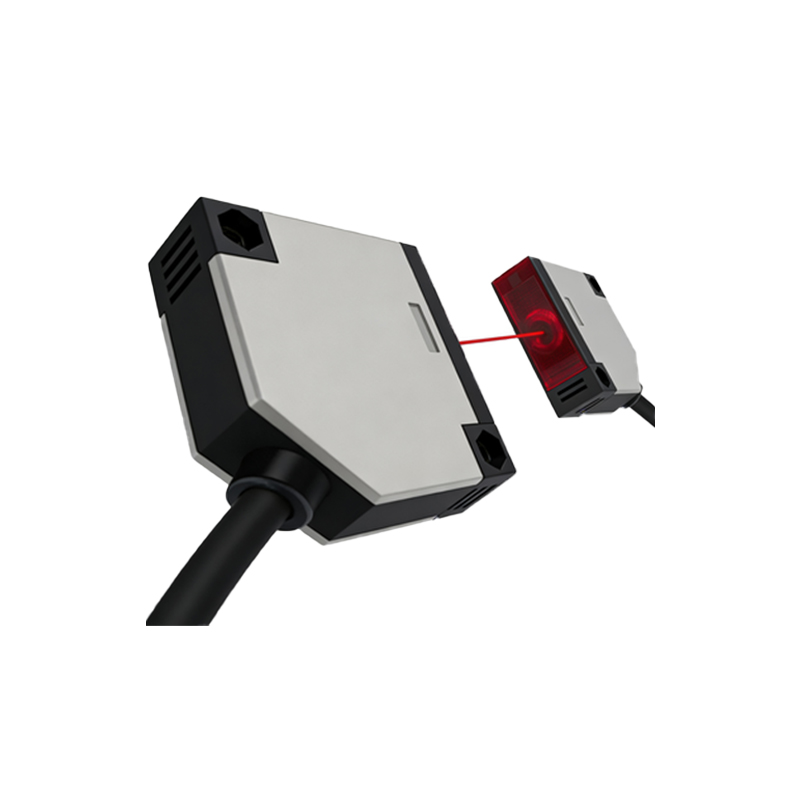
Through-beam photoelectric sensors, also known as opposed-mode sensors, represent one of the most fundamental and reliable sensing technologies in industrial automation. This sensor type operates on a straightforward principle: a separate emitter unit projects a beam of light—typically infrared, visible red, or laser—directly to a receiver unit positioned opposite. The primary function is to detect the presence or absence of an object that interrupts this continuous beam. Due to their distinct physical separation of emitter and receiver, through-beam sensors offer the longest sensing ranges and highest excess gain among photoelectric variants. They are renowned for exceptional reliability in challenging environments, making them a cornerstone for safety systems, object counting, and high-speed detection tasks across diverse sectors including packaging, material handling, and automotive manufacturing.
Core Operating Principle and Components
The operational heart of a through-beam sensor lies in its two-component system. The emitter contains a light source, usually an LED (Light Emitting Diode) or a laser diode, which generates a modulated beam. This modulation, often at a specific frequency, allows the receiver to distinguish the signal from ambient light, significantly enhancing noise immunity. The receiver, equipped with a phototransistor or photodiode, is tuned to detect this specific modulated light. When an object passes between the two units, it blocks the beam, causing a drastic drop in the light intensity received. This change triggers the sensor's output switch, sending a signal to a programmable logic controller (PLC) or other control system. The physical separation allows for a very strong initial signal, enabling detection of even very small, transparent, or low-reflectivity objects that might challenge other sensor types.
Key Advantages and Performance Characteristics
Through-beam sensors provide several unmatched advantages. First is their superior sensing distance, which can extend up to several hundred meters for high-power laser models, far exceeding the range of diffuse or retro-reflective sensors. Second, they offer the highest level of excess gain—a measure of a sensor's ability to detect an object despite signal attenuation from dirt, dust, or mist. This makes them exceptionally robust in dirty industrial environments. Third, their accuracy and repeatability are extremely high because detection is based on a simple beam break, not the reflectivity of an object's surface. This leads to consistent performance regardless of an object's color, texture, or material composition. Finally, they are ideal for high-speed applications, as their response time is typically very fast.
Common Industrial Applications and Use Cases
The robustness and reliability of through-beam sensors make them suitable for a vast array of applications. In packaging lines, they are used for precise bottle or can counting, label detection, and cap presence verification. In material handling and logistics, they serve as safety curtains on automated guided vehicles (AGVs), detect oversized parcels on conveyor belts, and monitor bin levels. Within the automotive industry, they are critical for part positioning in robotic assembly and checking for the presence of components. They are also extensively used in security systems as intrusion detectors, in printing for paper break detection, and in woodworking for lumber positioning. Any application requiring long-range, highly reliable detection of object presence is a prime candidate for through-beam technology.
Critical Selection Criteria for Engineers
Selecting the appropriate through-beam sensor requires careful consideration of several parameters. Sensing range is paramount; engineers must choose a model whose rated distance exceeds the actual installation gap. The light source type is another key decision: infrared LEDs are common and cost-effective for general use, visible red LEDs aid in alignment, and laser diodes provide a precise, narrow beam for long-range or small-part detection. The housing material, typically metal or plastic, must withstand the environmental conditions, including exposure to chemicals, washdowns (IP67/IP69K ratings), or extreme temperatures. Output type (PNP/NPN, analog, or relay) must be compatible with the control system. Additionally, special features like built-in timers, teach-in functionality for sensitivity adjustment, or synchronization to prevent crosstalk in multi-sensor setups may be necessary.
Installation, Alignment, and Maintenance Best Practices
Proper installation is crucial for optimal performance. The emitter and receiver must be securely mounted and precisely aligned on opposite sides of the detection path. Many sensors feature alignment indicators (visual or audible) to simplify this process, especially for long-range setups. It is vital to ensure the beam path remains unobstructed during operation and is not susceptible to vibration that could misalign the units. Regular maintenance involves keeping the lenses clean from dust, oil, or debris that could attenuate the light beam. While through-beam sensors are durable, periodic checks for alignment and signal strength are recommended as part of a preventive maintenance schedule to avoid unexpected downtime.
Comparison with Other Photoelectric Sensor Modes
It is instructive to contrast through-beam sensors with other common modes. Diffuse (proximity) sensors house the emitter and receiver in a single unit, detecting light reflected from the target itself. They are simpler to install but have shorter ranges and are sensitive to the target's color and surface. Retro-reflective sensors use a single unit and a separate reflector, offering a good compromise on range and installation ease, but they can be fooled by shiny objects that reflect the beam directly. Through-beam sensors, while requiring two separate units and careful alignment, provide the ultimate in range, reliability, and environmental immunity, justifying their use in the most demanding applications where failure is not an option.