Fundamental Operating Principles
Proximity and displacement sensors are non-contact electronic devices designed to detect the presence, absence, or position of an object without physical contact. Their operation is primarily based on electromagnetic or capacitive field interactions. A proximity sensor typically detects the mere presence of an object within a defined sensing range, often providing a simple on/off signal. A displacement sensor, while similar in foundational technology, is engineered to provide a continuous, precise measurement of the exact distance between the sensor's face and the target object. This distinction is crucial for applications requiring high-resolution positioning feedback. The core principle involves generating an electromagnetic or electrostatic field from the sensor's active surface. When a target object enters this field, it causes a detectable change in the field's properties—such as amplitude, frequency, or phase shift. This change is then converted by internal circuitry into a usable electrical output signal, proportional to the distance or confirming the object's presence.
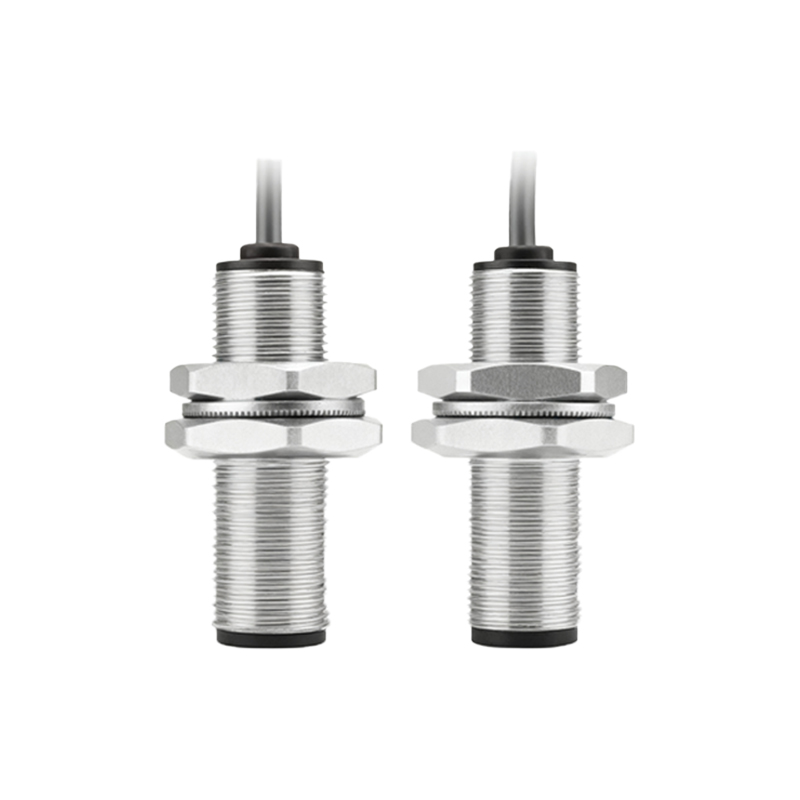
Inductive Proximity Sensors
Inductive sensors are among the most common types used in industrial automation. They operate on the principle of electromagnetic induction. The sensor contains a coil wound around a ferrite core, which is part of an oscillator circuit. When an alternating current passes through the coil, it generates an oscillating electromagnetic field at the sensing face. This field induces small eddy currents in any nearby conductive metal target. The energy loss due to these eddy currents dampens the oscillation amplitude. An evaluation circuit monitors this amplitude change. Once the damping reaches a preset threshold, it triggers a switch in the output state, typically from a solid-state transistor. These sensors are robust, immune to environmental contaminants like dust or oil, and are exclusively used for detecting metallic objects, primarily ferrous metals like steel and iron, though special versions exist for non-ferrous metals.
Capacitive Proximity Sensors
Capacitive sensors function by detecting changes in capacitance. The sensor's active face acts as one plate of a capacitor, with the target object acting as the other plate, and the medium between them (often air) as the dielectric. The sensor's internal oscillator circuit is tuned to a specific capacitance value. When an object—whether conductive or non-conductive (like plastic, wood, or liquid)—enters the sensing field, it alters the dielectric constant and thus the capacitance of the system. This change in capacitance affects the oscillator's amplitude. A subsequent circuit detects this amplitude shift and switches the output accordingly. A key advantage of capacitive sensors is their ability to sense a wide variety of materials, making them ideal for applications such as level detection of liquids or granules, and detecting non-metallic objects through thin container walls.
Eddy Current Displacement Sensors
For high-precision, non-contact displacement and position measurement, eddy current sensors are a premier choice. They operate on a refined application of the inductive principle. A high-frequency alternating current in the sensor's probe coil generates a concentrated magnetic field. When this field encounters a conductive target, it induces circular eddy currents on the target's surface. These eddy currents generate their own opposing magnetic field, which interacts with the field from the probe. This interaction changes the impedance of the probe coil in a manner that is precisely proportional to the distance between the probe and the target. Sophisticated electronics measure this impedance change and convert it into a highly linear, analog voltage or current output (e.g., 0-10 VDC or 4-20 mA). They offer exceptional resolution, high frequency response, and are unaffected by non-conductive materials between the probe and target, such as oil or dirt.
Key Performance Parameters and Selection Criteria
Selecting the appropriate sensor requires careful analysis of several parameters. The nominal sensing distance, or rated operating distance, is the standard value for which the sensor is designed under defined conditions. The actual sensing distance can vary with target material, size, and temperature. Hysteresis is the difference between the switch-on point as the target approaches and the switch-off point as it recedes, preventing output chatter. Repeatability defines the sensor's ability to consistently detect a target at the same point. For displacement sensors, linearity, resolution, and frequency response are critical. Environmental factors such as ambient temperature, presence of cutting fluids, washdown requirements, and electrical noise immunity (EMI/RFI) must also be considered. The output type—PNP/NPN, analog, or IO-Link—must be compatible with the control system.
Typical Industrial Applications
The applications for these sensors are vast and critical to modern manufacturing. Inductive sensors are ubiquitously used for end-of-travel detection on cylinders, part presence verification on conveyors, and rotary speed sensing