Laser rangefinder sensors are widely used in industrial automation, robotics, surveying, and safety systems due to their high precision and non-contact measurement capabilities. However, a common issue encountered by users is "digital jumping" or unstable readings, where the displayed distance value fluctuates erratically without any actual change in the target position. This phenomenon can compromise system accuracy, reliability, and overall performance. Understanding the root causes and implementing effective solutions is crucial for maintaining optimal sensor functionality.
One primary cause of digital jumping is environmental interference. Laser sensors operate by emitting a light beam and measuring the time or phase shift of the reflected signal. Ambient light sources, such as direct sunlight, strong artificial lighting, or other laser emissions, can introduce noise into the sensor's receiver. This noise competes with the true return signal, leading to misinterpretation and unstable readings. Similarly, airborne particles like dust, smoke, or steam can scatter the laser beam, causing signal attenuation or false reflections. Operating in environments with significant temperature variations or air turbulence can also affect the beam's path and the sensor's electronic components, contributing to reading instability.
Sensor-related factors are another major contributor. Low-quality or aging components, particularly the laser diode or photodetector, may produce inconsistent output. Electrical noise within the sensor's circuitry, often from power supply fluctuations or poor grounding, can disrupt signal processing. The sensor's internal algorithms for filtering and averaging data might be insufficient for highly dynamic or noisy environments. Additionally, incorrect configuration settings, such as an inappropriate response time, filtering level, or measurement mode for the application, can exacerbate jumping. Mechanical issues, like loose connections, vibrations affecting the sensor mount, or a dirty optical window, also lead to unreliable signals.
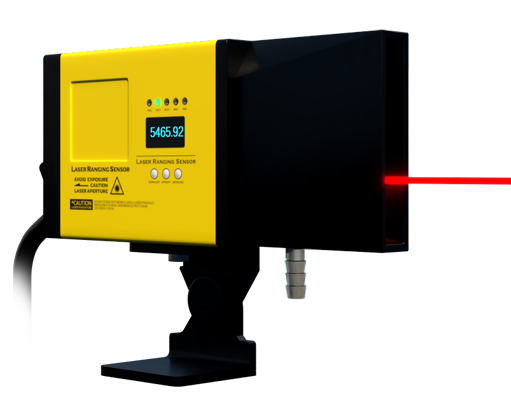
The target surface characteristics significantly influence measurement stability. Highly reflective, glossy, or transparent surfaces (e.g., glass, polished metal) can cause specular reflection, where most of the laser beam deflects away from the sensor instead of returning directly. This results in a weak or lost signal, forcing the sensor to guess the distance, which manifests as jumping. Conversely, dark, absorptive, or irregular surfaces (e.g., black rubber, coarse fabric) scatter the beam, reducing signal strength. Angled surfaces can reflect the beam away from the sensor, while moving targets require sensors with sufficiently fast response times to track changes accurately.

To mitigate digital jumping, a systematic approach is recommended. Begin by optimizing the operating environment. Shield the sensor from strong ambient light using physical barriers, hoods, or filters. Ensure the air path is clear of obstructions and particles. Stabilize the temperature and minimize air currents if possible. For the sensor itself, verify stable, clean power supply with proper grounding. Use shielded cables to reduce electromagnetic interference. Regularly clean the lens with appropriate materials. Select a sensor with specifications suited for the environment—higher IP ratings for dust/moisture, robust filtering algorithms, and adequate response speed.

Adjusting sensor settings is often effective. Enable or increase the digital filtering or averaging function within the sensor's software or controller. This processes multiple samples to output a stable median or average value, though it may slightly increase response time. Set an appropriate response time; too fast may capture noise, while too slow can miss real changes. For problematic surfaces, apply surface treatments like matte paint or tape to create a diffuse reflective spot. Adjust the sensor's angle relative to the target to avoid direct specular reflection, typically aiming for a perpendicular incidence. For moving targets, ensure the sensor's update rate exceeds the target's speed.
If jumping persists, consider hardware upgrades. Sensors with higher laser classes (e.g., Class 2) offer better signal-to-noise ratios. Models featuring background noise suppression technology or specialized algorithms for transparent object detection are available. For critical applications, dual-technology sensors combining laser and ultrasonic methods can provide redundancy. Finally, implement software-based solutions in the host controller, such as advanced smoothing algorithms, outlier rejection, or data validation checks, to further stabilize the output stream.
In conclusion, digital jumping in laser rangefinder sensors is a multifaceted problem stemming from environmental conditions, sensor limitations, and target properties. By methodically diagnosing the cause—observing when and how jumping occurs—and applying targeted corrective measures, users can significantly enhance measurement stability. Regular maintenance, proper sensor selection, and optimal configuration are key to ensuring reliable, accurate performance, thereby safeguarding the efficiency and precision of the systems they support.