Introduction to E221 Proximity Sensors
Proximity sensors are fundamental components in modern industrial automation, and the E221 series represents a robust and reliable category within this field. These non-contact sensors are designed to detect the presence or absence of metallic objects without any physical contact. The E221 models are typically inductive sensors, renowned for their durability, high switching frequency, and resistance to harsh environmental conditions like dust, oil, and coolant. They operate on a simple principle: an electromagnetic field generated by the sensor's coil is disturbed by the approach of a conductive metal target. This disturbance is detected by the sensor's circuitry, triggering a switching signal. This makes the E221 an indispensable tool for applications ranging from position detection and counting to speed monitoring and end-of-travel control in machinery.
Key Technical Specifications and Operating Principles
The performance of an E221 proximity sensor is defined by several critical parameters. The sensing range, or nominal sensing distance (Sn), is a primary specification, typically ranging from a few millimeters to several centimeters, depending on the specific model and target material. It's crucial to note that the effective sensing distance can vary with the target's metal type; for instance, steel provides the standard range, while non-ferrous metals like aluminum or copper may reduce it. The E221 sensors usually feature a built-in LED indicator for status monitoring. They are available in various output configurations, including NPN (sinking) and PNP (sourcing) transistor outputs, as well as Normally Open (NO) or Normally Closed (NC) logic, allowing for seamless integration into diverse control systems, particularly PLCs (Programmable Logic Controllers).
Design Features and Environmental Robustness
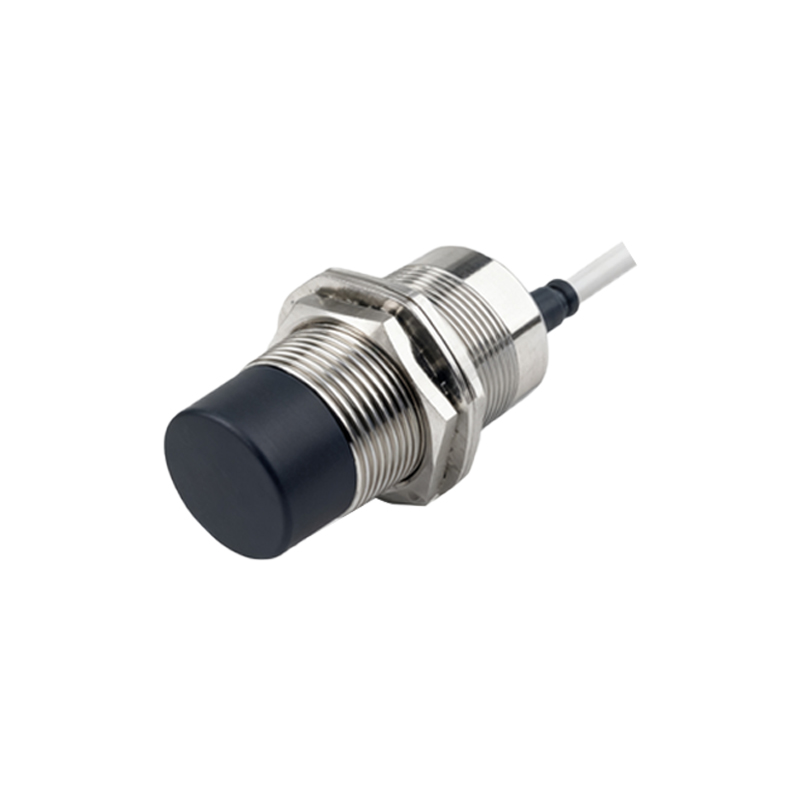
A hallmark of the E221 series is its rugged construction. The sensing face is often made of a specialized plastic or ceramic material to protect the internal coil. The housing is typically constructed from nickel-plated brass or high-grade stainless steel (e.g., V4A/AISI 316), offering excellent resistance to corrosion, mechanical stress, and chemical exposure. Many models in this series are fully potted or encapsulated, making them immune to vibration and shock. Furthermore, they commonly possess high Ingress Protection (IP) ratings, such as IP67 or IP69K, indicating complete protection against dust and the ability to withstand high-pressure, high-temperature water jets. This robustness ensures reliable operation in demanding environments like automotive manufacturing, food processing, and metalworking.
Wiring and Electrical Integration
Correct wiring is essential for the safe and effective operation of E221 sensors. Most standard models are 3-wire devices, requiring a DC power supply (commonly 10-30V DC). The wires are color-coded: brown for positive supply (+V), blue for negative supply (0V), and black for the switched output signal. For 2-wire AC/DC models, wiring is simplified but requires careful consideration of the residual current and voltage drop. It is imperative to consult the specific datasheet for the model in use. Proper shielding of cables and maintaining separation from high-voltage power lines are recommended practices to prevent electrical noise interference, which could cause erratic switching behavior.
Application Scenarios in Industrial Automation
The versatility of E221 proximity sensors lends them to a vast array of applications. In conveyor systems, they are used for object detection, counting, and sorting. On machine tools, they serve as precise limit switches to determine the position of slides, turrets, or tool changers. In robotic cells, they ensure end-effectors are in the correct starting position or verify part presence in a gripper. They are also critical in safety circuits, though not as primary safety devices, by monitoring guard door positions. Their fast response time makes them suitable for high-speed counting and speed detection on rotating shafts using gear teeth or encoder disks as targets.
Installation Considerations and Best Practices
Proper installation is key to maximizing sensor performance and lifespan. A fundamental rule is to maintain adequate clearance around the sensor. Lateral clearance (distance from the side of the sensor to any metal object) and frontal clearance (distance to metal beyond the sensing face) must be respected as per manufacturer guidelines to prevent false triggering. Flush-mountable models can be installed metal-to-metal, while non-flush models require a specific non-metallic zone around the sensing face. Ensuring the target approaches the sensor head perpendicularly and is within the specified size recommendations will guarantee consistent and reliable detection. Regular maintenance, primarily cleaning the sensing face of debris, is a simple yet effective practice.
Troubleshooting Common Issues
Even with robust design, issues can arise. Common problems include failure to detect a target, constant ON state, or intermittent