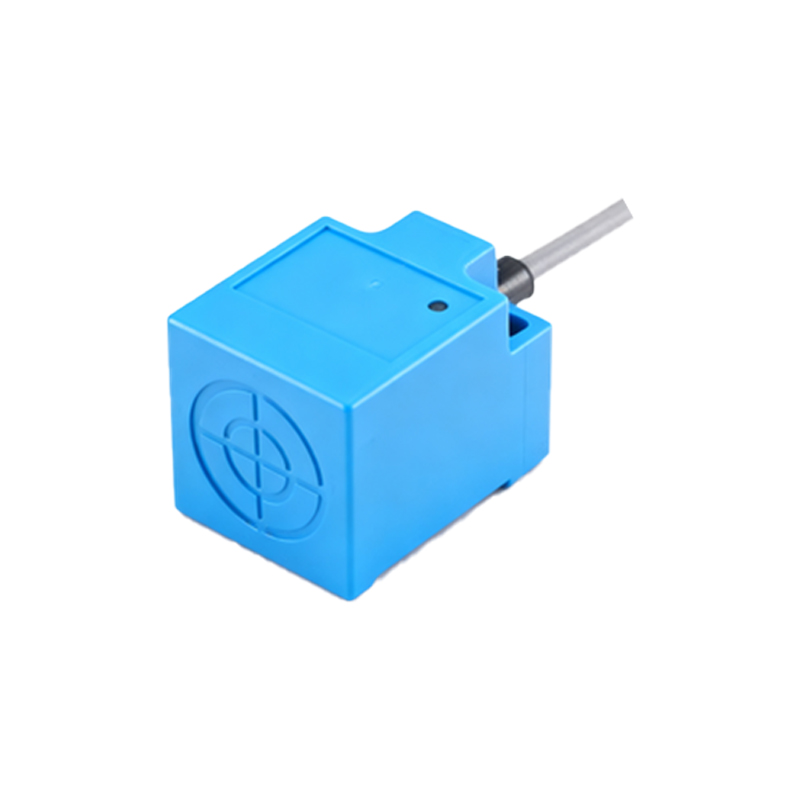
In the realm of industrial automation and smart device design, the ability to detect the presence, absence, or position of an object without physical contact is fundamental. Among the diverse array of sensing solutions, the square proximity sensor has carved out a significant niche. Characterized by its distinct rectangular or square form factor, this sensor offers unique advantages in installation, sensing field shape, and integration into modern machinery. Unlike their cylindrical counterparts, square sensors provide a flat mounting surface that is often easier to seal and install in tight or panel-mounted applications.
The core technology behind most square proximity sensors is based on electromagnetic fields. Inductive sensors, the most common type, generate an oscillating electromagnetic field from a coil housed within their square casing. When a metallic object enters this field, it induces eddy currents within the target, which dampens the oscillator's amplitude. The sensor's internal circuitry detects this change and triggers a solid-state switch, sending a signal to a programmable logic controller (PLC) or other control system. This entire process occurs with remarkable speed and reliability, enabling high-cycle operations on production lines. For non-metallic object detection, capacitive square proximity sensors are employed. These sensors can detect materials like wood, plastic, liquids, and granular substances by measuring changes in capacitance caused by the target object altering the sensor's electrostatic field.
The square design is not merely an aesthetic choice; it confers several practical benefits. The flat face allows for flush mounting in metal brackets or panels without the need for complex bracketry, saving space and reducing installation time. The sensing field of a square sensor often projects from the front face in a more rectangular pattern compared to the conical field of a cylindrical sensor. This can be advantageous for detecting objects with specific orientations or for creating a wider but shallower detection zone. Furthermore, the shape lends itself to better environmental sealing. Gaskets and O-rings can be more effectively fitted to the straight edges, providing higher Ingress Protection (IP) ratings against dust, water, and coolants, which is critical in harsh industrial environments like machining centers, food processing, and automotive assembly.
Applications for square proximity sensors are vast and varied. In material handling, they are used to detect the position of pallets on conveyors or to count boxes. In automated machinery, they verify the correct positioning of metal parts before a machining operation or robotic weld. Their robust construction makes them ideal for use in CNC machine tools to monitor tool changer positions or spindle orientation. Beyond heavy industry, these sensors find roles in building automation, controlling doors and elevators, and even in consumer appliances for features like liquid level detection or door-open indications.
Selecting the right square proximity sensor requires careful consideration of several parameters. The sensing distance, or nominal range, is specified for a standard target (usually mild steel) and is typically shorter than equivalent cylindrical sensors due to the coil geometry. The mounting style—whether flush (embedded in metal) or non-flush—significantly affects the effective sensing range; flush mounting reduces the range. The housing material, often nickel-plated brass, stainless steel, or PBT plastic, must be chosen based on the chemical and physical exposures. Output type (NPN sinking, PNP sourcing, or analog) and connection method (pre-wired cable or quick-disconnect) are also crucial for compatibility with the control system.
In conclusion, the square proximity sensor represents a versatile and robust solution for non-contact object detection. Its geometric design addresses specific installation and performance needs that cylindrical sensors cannot always meet. As automation systems become more compact and demands for reliability increase, the functional advantages of the square form factor—ease of sealing, straightforward mounting, and a tailored sensing field—ensure its continued prevalence. Engineers and system integrators leverage these sensors to create more efficient, reliable, and intelligent automated systems, forming an invisible yet critical network that keeps modern industry in motion.