Laser displacement sensors have become indispensable tools across manufacturing, robotics, and quality control for their non-contact, high-precision measurement capabilities. However, a common and significant challenge in industrial environments is the presence of water mist, fog, or condensation. This environmental factor can severely compromise sensor performance, leading to measurement errors, data instability, and even system failure. Understanding the interaction between laser light and airborne water particles is crucial for maintaining reliable operations.
The core principle of a triangulation-based laser displacement sensor involves projecting a focused laser spot onto a target surface. The reflected light is then captured by a receiving lens at a known angle and focused onto a position-sensitive detector, such as a CCD or CMOS array. The position of the light spot on this detector correlates directly to the distance to the target. Water mist interferes with this process in several fundamental ways. Firstly, it scatters and absorbs the laser beam. As the coherent light passes through the mist, countless tiny water droplets cause the beam to diffuse, reducing its intensity and clarity before it even reaches the target. This results in a weaker return signal. Secondly, the mist acts as a reflective surface itself. The laser light can reflect off the water droplets in the air, creating background noise that is also detected by the receiver. This noise can obscure the actual signal from the target surface, causing the sensor to pick up a "phantom" distance to the mist layer rather than the true target. The outcome is often erratic readings, increased noise, or a complete loss of signal if the mist density is too high.
The impact is not uniform and depends on several variables. The density and droplet size of the water mist are primary factors. A fine, dense fog will cause more severe scattering and attenuation than light, occasional condensation. The wavelength of the laser also plays a role. While all visible and near-infrared wavelengths are affected, some specific wavelengths might be absorbed slightly less by water vapor, though this is often a minor consideration for standard industrial sensors. The distance between the sensor and the target is critical; longer measurement paths give the mist more opportunity to interfere with the beam. Finally, the reflectivity and color of the target surface compound the issue. A dark, low-reflectivity target already returns a weak signal, which water mist can diminish to an undetectable level.
To mitigate these issues, a multi-faceted approach is necessary, combining environmental control, sensor protection, and technological selection. The most effective solution is to control the environment itself. This can involve installing enclosures or air curtains around the measurement area to keep mist away, using localized heaters or dry air purges to dissipate condensation, or improving overall ventilation in the facility. When environmental control is insufficient, protecting the sensor is the next line of defense. Installing a protective window in front of the sensor lens is common. However, it is vital to use an optically flat, anti-reflective coated window to minimize its own impact on the laser beam. These windows must be kept clean and free of condensation, sometimes requiring integrated heating elements or air blowers. For applications with persistent mist, specialized sensors with higher laser power can sometimes "burn through" light interference by providing a stronger return signal. Sensors with advanced algorithms for background suppression and noise filtering can also help distinguish the true target signal from noise caused by scattered light.
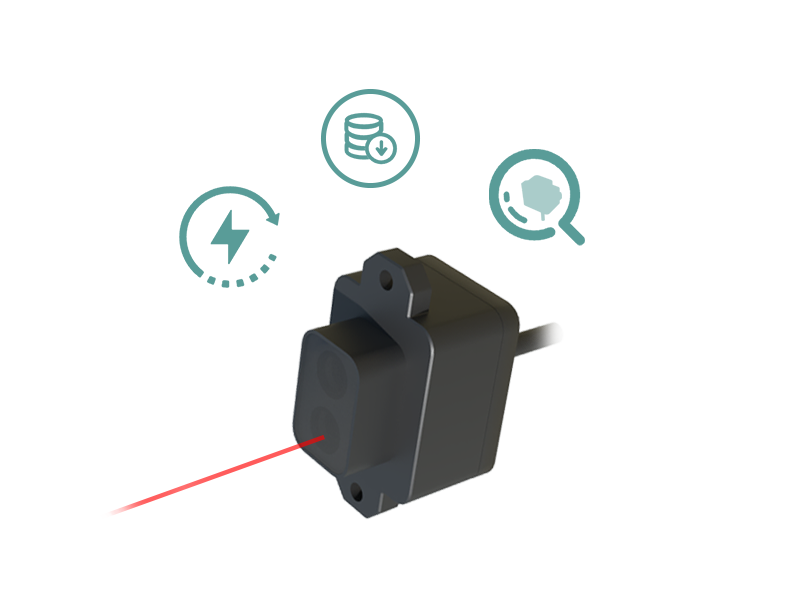
In conclusion, water mist presents a tangible obstacle to the reliable function of laser displacement sensors by scattering the laser beam and creating optical noise. While it degrades accuracy, understanding the mechanisms allows for practical countermeasures. Success hinges on assessing the specific environmental conditions and implementing a tailored strategy, often involving environmental management, physical protection for the sensor, and selecting hardware with features designed for challenging conditions. Proactive planning for potential mist and condensation ensures continuous precision and avoids costly downtime in automated processes.