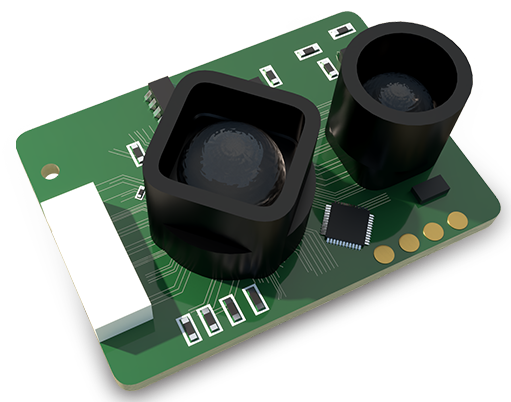
In today's fast-paced industrial landscape, the demand for accurate, reliable, and non-contact measurement solutions has never been greater. Laser displacement sensors have emerged as a critical technology, enabling precise distance and position measurement across a vast array of applications. These sophisticated devices operate on a fundamental principle: they project a focused laser beam onto a target surface and analyze the reflected light to calculate the exact distance to that point. This process, often utilizing triangulation or time-of-flight methods, occurs in microseconds, providing real-time data essential for automation, quality control, and robotics.
The core advantage of laser displacement sensors lies in their non-contact nature. Unlike traditional mechanical probes or contact gauges, they eliminate the risk of damaging delicate surfaces or influencing the measurement through physical force. This makes them ideal for inspecting soft materials, hot objects, fast-moving production lines, or vibrating components. For instance, in semiconductor manufacturing, they measure wafer thickness and warpage without any physical touch. In automotive assembly, they ensure precise gap and flush measurements between body panels. Their high sampling speed allows for 100% inline inspection, catching defects that would be missed by slower, manual sampling methods.
Modern laser sensors offer remarkable specifications, with resolutions down to the sub-micron level and measurement ranges spanning from a few millimeters to several meters. Key performance parameters include linearity, repeatability, and spot size. A smaller laser spot enables measurements on edges or tiny features, while a high repeatability ensures consistent results over millions of cycles. Environmental robustness is another hallmark; many industrial-grade sensors are housed in rugged enclosures with high ingress protection ratings, allowing them to perform reliably in harsh conditions with dust, coolant mist, or significant ambient light interference.
Integration into automated systems is straightforward. These sensors typically provide analog voltage or current outputs, as well as digital interfaces like Ethernet/IP, PROFINET, or RS-232, allowing seamless communication with Programmable Logic Controllers (PLCs) and industrial computers. Advanced models incorporate onboard intelligence for data processing, enabling functions like peak-hold for transparent objects, tolerance window checking, and outputting simple pass/fail signals to control machinery directly.
The applications are virtually limitless. Beyond manufacturing, laser displacement sensors are pivotal in aerospace for profiling turbine blades, in civil engineering for monitoring structural deformation, and in consumer electronics for ensuring the flatness of smartphone displays. They are the unseen eyes guiding robotic arms for precise pick-and-place operations and verifying the dimensional accuracy of 3D-printed parts. As Industry 4.0 and smart factory concepts advance, the role of these sensors in providing the essential data for digital twins and predictive maintenance will only expand.
Selecting the right sensor requires careful consideration of the target material, required accuracy, measurement range, and environmental factors. A glossy or transparent surface may require a sensor with a specialized controller to handle diffuse reflection, while a dark, absorbent material might need a more powerful laser source. Ultimately, by delivering micron-level precision at high speed without contact, laser displacement sensors have become an indispensable tool, driving efficiency, quality, and innovation in modern industrial processes. Their continued evolution promises even greater capabilities, solidifying their position at the heart of precision measurement.