Capacitive proximity sensors are versatile and widely used non-contact sensing devices in industrial automation and various other fields. Unlike their inductive counterparts which detect only metals, capacitive sensors can detect a vast range of materials, including liquids, plastics, glass, wood, and granular substances, making them exceptionally flexible. At its core, a capacitive proximity switch operates on the principle of capacitance change.
The fundamental working principle involves the sensor forming one plate of a capacitor, with the target object acting as the other plate. The sensor's internal oscillator generates an electrostatic field. When a target enters this detection field, it alters the dielectric constant of the space between the sensor and the target, leading to a change in the circuit's capacitance. This change in capacitance subsequently causes a shift in the oscillator's amplitude. A threshold circuit monitors this amplitude, and when it reaches a predetermined level, it triggers a solid-state output switch, signaling the presence of the object.
A standard capacitive sensor comprises several key components: the sensing face or electrode, the oscillator circuit, the trigger circuit, and the output switching device. Many models feature a sensitivity adjustment potentiometer, allowing engineers to fine-tune the sensing range and ignore background materials or container walls—a critical function known as "shielding." Shielded sensors have a focused field at the front, ideal for flush mounting in metal. Unshielded types have a larger, lateral field, suitable for non-metallic housings.
The applications for capacitive sensors are extensive. In packaging, they detect the presence of plastic or glass bottles, even through thin cardboard. In liquid processing, they monitor fill levels in non-metallic tanks, distinguishing between empty and full states based on the dielectric constant of the liquid. In woodworking, they sense wood chips or boards. They are also crucial in detecting powdery or granular materials in silos, controlling aggregate flow in construction, and verifying the presence of labels or foil seals. Their ability to sense through non-conductive walls makes them perfect for hygienic or sealed applications.
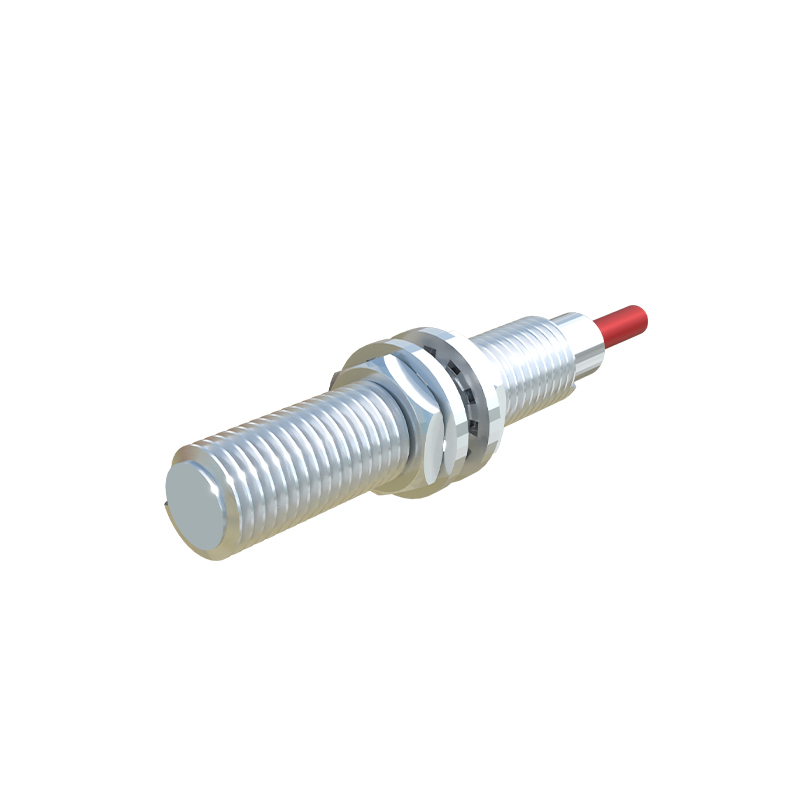
Selecting the right capacitive sensor requires careful consideration of several parameters. The sensing distance, typically specified for a metal target, is reduced for materials with lower dielectric constants. The target material itself dictates the effective range; for instance, water has a very high constant, while dry wood is much lower. Environmental factors like humidity, dust, and temperature extremes must be accounted for, with sensors rated accordingly (e.g., IP67 for washdown environments). Output type (PNP/NPN, NO/NC) must match the control system's PLC or input card. The housing material (typically brass, stainless steel, or PBT plastic) is chosen based on chemical exposure and physical stress.
Installation and tuning are straightforward but vital. Ensure the sensor is mounted securely, considering the reduced sensing distance for non-metallic targets. Use the sensitivity adjustment to set the trigger point reliably, avoiding false triggers from background objects. For level detection, angle the sensor slightly to prevent material buildup on the face. Regular maintenance involves cleaning the sensing face from contaminants like grease or moisture film, which can alter performance.
In comparison to other technologies, capacitive sensors fill a unique niche. Inductive sensors are more stable and have longer ranges for metals but are blind to non-metals. Ultrasonic sensors offer longer ranges for all materials but are more complex and costly for simple presence detection. Photoelectric sensors are excellent for long-range detection but can be fooled by color, transparency, or environmental contaminants like dust and fog.
In conclusion, capacitive proximity sensors are indispensable tools for modern industrial automation. Their unique ability to detect virtually any material through non-contact means provides solutions for challenging sensing tasks involving non-metallic objects, level control, and presence detection through barriers. A clear understanding of their operating principle, key specifications, and application considerations enables engineers and technicians to deploy them effectively, enhancing system reliability, efficiency, and flexibility across countless industries from food and beverage to pharmaceuticals and material handling.