In the realm of precision measurement and automation, two-dimensional laser ranging sensors have emerged as indispensable tools. Unlike their one-dimensional counterparts that measure distance along a single line, 2D sensors capture a full profile or contour by rapidly scanning a laser line across a target surface. This capability unlocks a vast array of applications, from industrial robotics to autonomous navigation.
The core operating principle of a 2D laser sensor is based on time-of-flight or triangulation. In the time-of-flight method, the sensor emits a laser pulse and precisely measures the time it takes for the reflection to return. By knowing the speed of light, it calculates the distance to each point in its scan line. Triangulation-based sensors, often used for higher precision at shorter ranges, project a laser line onto a target. A receiver lens at a known angle images the laser line; the deformation of this line on the target surface allows a processor to calculate distance profiles using geometric principles. The sensor then assembles these sequential distance measurements into a dense cloud of 2D coordinate points, effectively creating a cross-sectional "slice" of the scanned environment.
The advantages of using 2D laser sensors are significant. They provide non-contact measurement, eliminating wear and tear on both the sensor and the target. They offer high accuracy and repeatability, often down to sub-millimeter levels, and can operate at very high speeds, capturing thousands of profiles per second. This makes them ideal for dynamic processes. Furthermore, their performance is generally consistent regardless of ambient light conditions, and they can measure a wide variety of surface materials, though highly reflective or absorbent surfaces may require specific calibration.
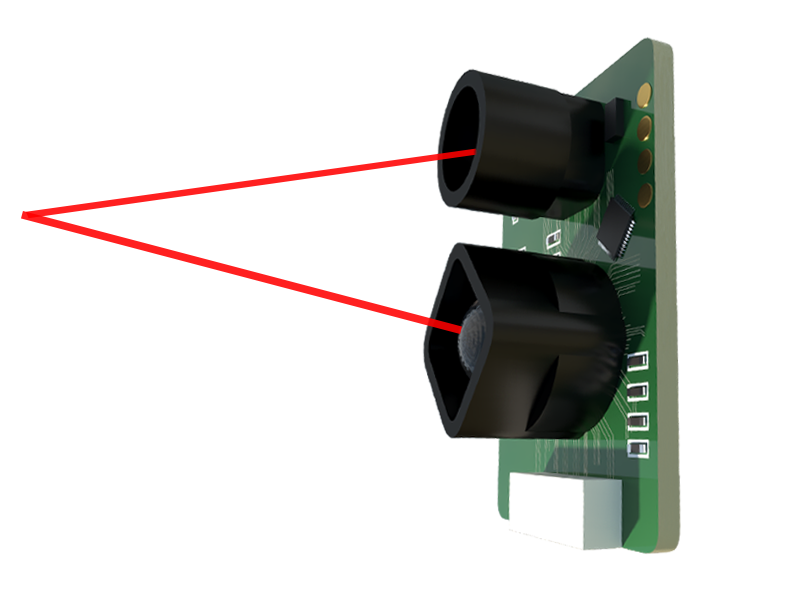
The applications for 2D laser ranging sensors are diverse and growing. In industrial automation, they are pivotal for robot guidance, allowing robotic arms to locate and pick irregularly shaped objects from bins. They perform critical contour and dimension checks in quality control, ensuring manufactured parts meet exact specifications. In logistics, they measure the volume of packages on conveyor belts for optimal storage and shipping cost calculation. Beyond the factory floor, these sensors are the primary "eyes" for many autonomous mobile robots and automated guided vehicles, creating real-time 2D maps for obstacle avoidance and navigation. They are also used in traffic monitoring, forestry, and even in security systems for intrusion detection.
Selecting the right 2D laser sensor requires careful consideration of several key parameters. The measuring range defines the minimum and maximum distances the sensor can operate within. The scanning angle, often up to 270 degrees or more, determines the field of view. Angular resolution dictates the spacing between individual measurement points within a scan, affecting the detail of the profile. The scanning frequency, measured in Hertz, indicates how many profiles are captured per second; a higher frequency is necessary for fast-moving objects or vehicles. Environmental ratings like IP67 are crucial for operation in dusty or wet industrial settings. Finally, the interface—common options include Ethernet, EtherCAT, or analog outputs—must be compatible with the existing control system.
When integrating a 2D sensor, proper mounting is essential to ensure an unobstructed field of view. The scanning plane must be aligned correctly relative to the target. For challenging surfaces, such as shiny metals or dark materials, adjusting the sensor's sensitivity or using filters may be necessary. Data from the sensor is typically processed by a programmable logic controller or a dedicated industrial PC, where software algorithms interpret the point cloud to extract meaningful information like object presence, position, height, or profile deviation.
Looking ahead, the evolution of 2D laser ranging technology continues. Trends include the development of sensors with even higher resolution and faster scan rates, enabling more detailed and real-time perception. Multi-echo technology allows a sensor to receive several return signals from a single pulse, enabling it to "see through" partial obstructions like foliage or rain. The integration of artificial intelligence directly at the sensor level for edge computing is also on the rise, allowing for smarter, initial data processing and reduced load on central systems. As industries push further towards full automation and intelligent systems, the role of the reliable and versatile 2D laser ranging sensor will only become more central, providing the essential dimensional data that machines need to understand and interact with the physical world.