Coaxial laser displacement sensors represent a critical category of non-contact measurement tools in modern industrial automation and precision engineering. Unlike traditional triangulation-based sensors, coaxial sensors emit a laser beam and receive its reflection along the exact same optical axis. This fundamental design principle eliminates the cosine error inherent in triangulation methods, where the emitter and receiver are at an angle. Consequently, coaxial sensors deliver exceptionally high accuracy and stability, particularly when measuring shiny, mirror-like, or highly reflective surfaces that often cause significant measurement errors for other optical techniques.
The core technology typically involves a laser diode, a beam splitter, and a high-resolution position-sensitive detector (PSD) or CMOS/CCD imaging element. The laser beam is focused onto the target surface through the objective lens. The reflected light travels back along the same path, is directed by the beam splitter onto the detector, and forms a spot. Any change in the target's distance causes a shift in the position of this spot on the detector. Sophisticated internal algorithms calculate this shift to determine the precise displacement or distance with resolutions that can reach the sub-micron level. This coaxial optical path makes the measurement largely independent of the target's inclination within a certain range, a key advantage for measuring curved or uneven surfaces.
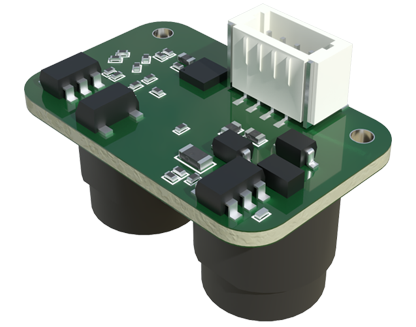
Key performance parameters for evaluating these sensors include measuring range, resolution, linearity, spot size, and sampling speed. The measuring range is often limited, typically from a few millimeters to several tens of millimeters, but within this range, linearity error can be remarkably low. The spot size is usually very fine, allowing for measurements on small features or edges. High-end models offer sampling rates in the tens or even hundreds of kilohertz, enabling dynamic vibration analysis or high-speed production line inspection.
The applications of coaxial laser displacement sensors are vast and span multiple industries. In semiconductor manufacturing, they are indispensable for wafer warpage measurement, chip coplanarity inspection, and bonding height control. In the automotive sector, they precisely gauge the thickness of critical components like piston rings, measure the profile of camshafts and crankshafts, and inspect the surface quality of polished metal parts. The electronics industry relies on them for measuring solder paste height, component lead coplanarity, and the flatness of displays and circuit boards. Furthermore, they are used in precision machining for tool setting and wear monitoring, in research laboratories for material science experiments, and in quality control for transparent objects like glass thickness measurement, where special models with confocal chromatic aberration principles are sometimes employed.

Selecting the right coaxial laser displacement sensor requires careful consideration of several factors. First, the material and surface condition of the target are paramount. While excellent for reflective surfaces, some standard coaxial models may struggle with perfectly diffuse or absorptive surfaces; understanding the sensor's required minimum light intensity is crucial. Second, the required accuracy, resolution, and speed must match the application's demands. Third, environmental conditions such as ambient light, temperature fluctuations, and potential contamination must be factored in, as they can affect performance. Fourth, the physical size and mounting options of the sensor head must be compatible with the installation space. Finally, the compatibility and functionality of the controller unit and software interface for data output and analysis are essential for system integration.
In comparison to other displacement sensing technologies like confocal, interferometric, or eddy current sensors, coaxial laser sensors offer a unique balance of high precision on reflective surfaces, robustness, and relatively straightforward integration. Their main limitations often involve a shorter working distance and a higher sensitivity to surface translucency or color variation compared to confocal sensors. Proper installation is critical; ensuring the sensor is perpendicular to the target surface within its allowable tilt angle maximizes accuracy. Regular calibration using certified gauge blocks is recommended to maintain long-term measurement integrity.

As Industry 4.0 and smart manufacturing advance, the role of precise metrology grows. Coaxial laser displacement sensors, with their unparalleled capability for reliable, high-speed, and ultra-precise non-contact measurement on challenging surfaces, will continue to be a cornerstone technology. Future developments may focus on miniaturization, enhanced multi-sensor networking capabilities, integration with AI for predictive quality analysis, and improved performance on a broader spectrum of surface types, further solidifying their position in the metrology toolkit.