In the realm of industrial automation, robotics, and advanced measurement systems, laser sensors have become indispensable tools. Their ability to provide non-contact, high-precision, and high-speed detection makes them superior to many traditional sensing technologies. This article serves as a comprehensive guide to understanding laser sensors, their working principles, key types, and practical applications.
At its core, a laser sensor operates by emitting a focused beam of coherent light—laser light—towards a target object. The sensor then detects the interaction of this light with the object. The specific method of detection defines the primary types of laser sensors. The most common categories are laser triangulation sensors, time-of-flight (ToF) sensors, and laser contrast sensors.
Laser triangulation sensors are renowned for their exceptional accuracy in distance and displacement measurement. The principle is geometric. The sensor emits a laser spot onto the target surface. The reflected light is focused onto a position-sensitive detector (like a CCD or CMOS array) by a receiving lens. The position of the light spot on the detector shifts depending on the distance to the target. By calculating this shift using trigonometric triangulation, the sensor determines the exact distance with micron-level resolution. These sensors are ideal for applications requiring precise profile measurement, thickness gauging, and vibration analysis.
Time-of-Flight (ToF) laser sensors measure distance by calculating the time it takes for a laser pulse to travel to the target and back. The formula is straightforward: Distance = (Speed of Light × Time of Flight) / 2. Modern ToF sensors use sophisticated electronics to measure these incredibly short time intervals. They are excellent for longer-range measurements, from a few centimeters up to several hundred meters, though typically with slightly lower accuracy than triangulation sensors at short ranges. Common uses include vehicle LiDAR, bulk level monitoring in silos, and obstacle detection for mobile robots.
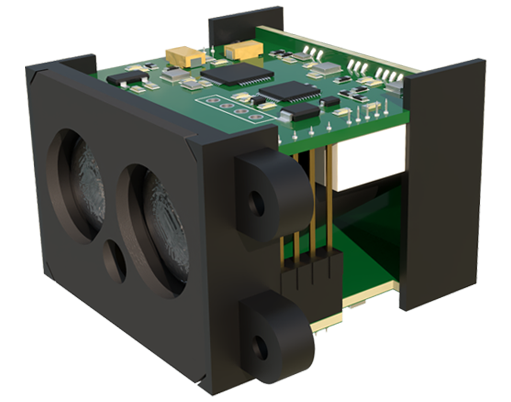
Laser contrast sensors, also known as laser scanners or background suppression sensors, are designed for reliable object detection regardless of color or surface finish. They evaluate the intensity of the reflected light. By setting a threshold, the sensor can distinguish between the presence of an object (high reflection) and the background (low reflection), or vice versa. This makes them perfect for detecting transparent objects like glass bottles, identifying labels on packaging, or ensuring precise edge detection in printing machinery.
The advantages of laser sensors are numerous. Their non-contact nature prevents damage to both the sensor and the target, which is crucial for delicate materials. They offer very high response speeds, capable of taking thousands of measurements per second. Furthermore, their small, focused laser spot allows for precise measurement of very small features or objects.
When selecting a laser sensor for an application, several critical parameters must be considered. Measuring Range defines the minimum and maximum distances over which the sensor can operate accurately. Resolution is the smallest change in distance the sensor can detect. Linearity Error indicates the deviation from a perfect straight-line response across the measuring range. Spot Size affects the minimum feature size that can be measured. Environmental factors are also paramount; sensors may require protective housings for harsh conditions with dust, moisture, or extreme temperatures. The type of output (analog voltage/current, digital switch, or serial data) must be compatible with the control system, such as a PLC.
In practice, laser sensors are ubiquitous. In automotive manufacturing, they measure body panel gaps and inspect weld seams. In electronics, they verify component placement on circuit boards. In logistics, they read barcodes from a distance and sort packages. In pharmaceutical packaging, they verify fill levels in vials. Their versatility continues to grow with advancements in miniaturization and smart sensor technology integrating onboard diagnostics and IO-Link communication.
In conclusion, laser sensors provide a powerful solution for a vast array of measurement and detection challenges. Understanding the fundamental differences between triangulation, ToF, and contrast methods is the first step in selecting the right tool. By carefully evaluating the requirements for range, accuracy, speed, and environmental robustness, engineers can leverage laser sensor technology to enhance automation, improve quality control, and drive innovation across countless industries.