Time-of-Flight (ToF) laser sensors represent a pivotal technology in the realm of distance measurement and 3D imaging, fundamentally transforming automation, robotics, and quality control processes. At its core, the principle is elegantly straightforward: the sensor measures the time it takes for a modulated laser pulse or wave to travel from the emitter to a target object and back to the receiver. This elapsed time, directly proportional to the distance, is calculated using the constant speed of light.
The operational cycle begins with the emission of a precisely modulated laser signal. Modern ToF sensors typically use near-infrared laser diodes for eye safety and optimal performance. The modulation can be in the form of short pulses (pulsed ToF) or a continuous wave with modulated intensity (continuous-wave ToF). In pulsed ToF systems, a high-speed timer is started the instant a laser pulse is emitted. The pulse reflects off the target, and a sensitive photodetector, often an avalanche photodiode (APD) or single-photon avalanche diode (SPAD), captures the returning light. The timer stops upon detection, and the time delta is converted into distance using the formula: Distance = (Speed of Light × Time of Flight) / 2. The division by two accounts for the round-trip journey of the light.

Continuous-wave ToF (CW-ToF) employs a different, yet equally sophisticated, approach. The intensity of the laser beam is modulated at a known frequency, typically tens to hundreds of MHz. The reflected wave returns with a phase shift relative to the emitted wave. This phase shift is directly related to the time delay and, consequently, the distance. By comparing the phase of the emitted and received signals, the sensor's internal circuitry computes the distance with high accuracy. This method is particularly effective for shorter ranges and can achieve sub-millimeter precision.
The heart of a ToF sensor's accuracy lies in its timing circuitry. Time-to-digital converters (TDCs) of exceptional precision are employed to measure these nanosecond-scale intervals. Even a one-nanosecond error translates to approximately 15 centimeters of distance error, underscoring the critical need for high-speed electronics and stable clock sources. Furthermore, ambient light rejection is a significant challenge. Sophisticated optical filters are used to allow only the specific wavelength of the laser to pass through to the detector. Additionally, correlation techniques in CW-ToF or gated detection in pulsed ToF help isolate the sensor's own signal from background illumination.
The applications of ToF laser sensors are vast and growing. In industrial automation, they are indispensable for object detection, positioning, and bin-picking in robotic arms, enabling flexible and precise handling. They form the basis of collision avoidance systems in autonomous guided vehicles (AGVs) and drones. In logistics, ToF cameras are used for volume measurement of packages, optimizing storage and shipping. The technology is also crucial in automotive systems for advanced driver-assistance systems (ADAS), including adaptive cruise control and pedestrian detection. Beyond industry, ToF sensors enable gesture recognition in consumer electronics and are integral to the depth-sensing capabilities of various 3D scanning and augmented reality devices.
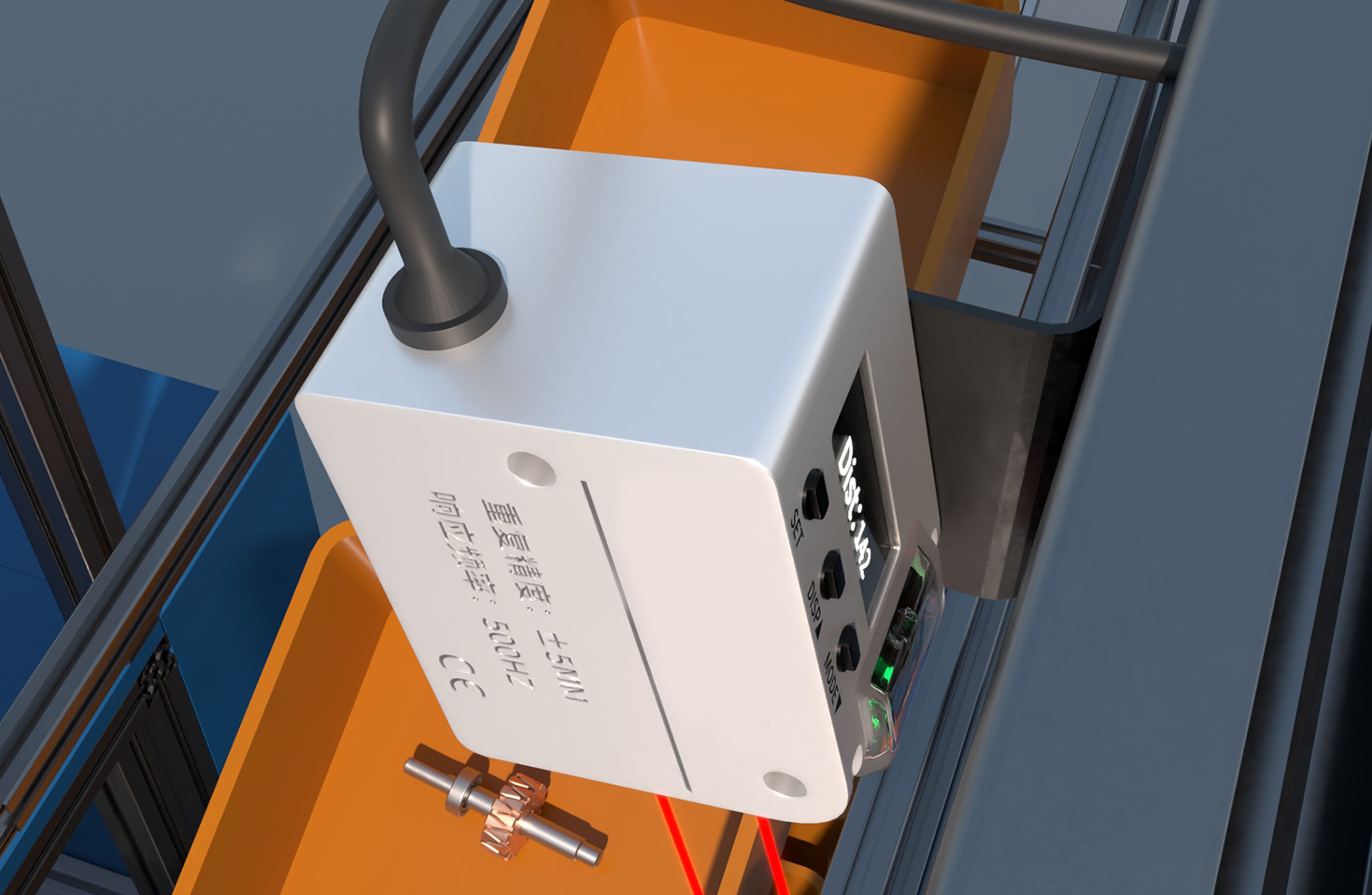
Compared to traditional ultrasonic or infrared proximity sensors, ToF laser sensors offer superior accuracy, longer range, and faster response times. Unlike triangulation-based laser sensors, ToF systems maintain accuracy over distance without baseline-related limitations, as their measurement is time-based, not angle-based. However, challenges persist. Highly reflective or absorbent surfaces can cause measurement errors due to signal saturation or weak returns. Multi-path interference, where light reflects off multiple surfaces before returning, can also distort readings. Ongoing advancements in sensor fusion, SPAD arrays, and computational algorithms are continuously mitigating these issues, pushing the boundaries of resolution, range, and robustness.
In conclusion, the principle of Time-of-Flight laser sensing—measuring the flight time of light—is a powerful concept driving innovation across multiple industries. Its implementation, combining optics, high-speed electronics, and signal processing, delivers reliable, contactless distance data that is foundational to the next generation of intelligent systems. As component costs decrease and performance escalates, the integration of ToF technology into industrial and commercial applications is set to expand dramatically, solidifying its role as a cornerstone of precise spatial awareness.