In the realm of high-precision industrial metrology, the laser tracker stands as a cornerstone technology. At its heart lies a sophisticated sensor system, a marvel of optical and electronic engineering that enables real-time, three-dimensional coordinate measurement with micron-level accuracy. This article delves into the core principles, key components, and critical applications of the laser tracker sensor, providing a comprehensive overview for engineers and professionals in manufacturing, aerospace, automotive, and energy sectors.
The fundamental operation of a laser tracker sensor is based on interferometry or absolute distance measurement (ADM) combined with precise angular encoders. A laser beam is emitted from the tracker's central unit towards a movable retroreflector, typically a spherically mounted retroflector (SMR), held against the object being measured. The sensor's primary function is to continuously and accurately determine the changing distance and the two angles (horizontal and vertical) to this target. As the SMR moves, the laser beam is reflected back to the tracker. The sensor system, comprising highly sensitive photodetectors and interferometers or an ADM module, detects the returning light. Any minute change in the path length of the laser beam, caused by the SMR's movement, creates an interference pattern or modulates the signal. The sensor electronics interpret these changes to calculate the precise change in distance with extraordinary resolution, often down to a fraction of a micrometer.
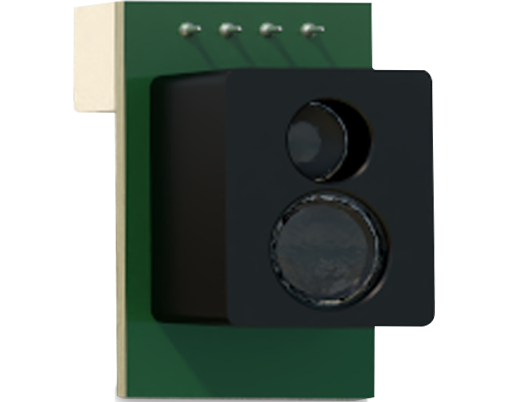
Simultaneously, the tracker's two high-accuracy angular encoders—one for the horizontal axis (azimuth) and one for the vertical axis (elevation)—constantly measure the orientation of the laser beam. These encoders are integral sensor components, providing angular data with arc-second precision. By combining the precisely measured distance (from the interferometer/ADM) with the two precisely measured angles, the tracker's onboard processor can compute the 3D coordinates (X, Y, Z) of the SMR's center in real-time, thousands of times per second. This continuous stream of coordinate data allows for dynamic tracking of tool paths, assembly verification, and alignment of large-scale components.
The performance of a laser tracker sensor is defined by several key parameters. Measurement accuracy, often specified as a volumetric performance metric like ±(X µm + Y µm/m), is paramount. This defines the maximum permissible error within the tracker's working volume, which can span over 100 meters. Dynamic measurement speed, or sampling rate, determines how quickly the sensor can update coordinate data, essential for capturing motion or vibration. Environmental robustness is another critical factor; advanced sensors incorporate compensation mechanisms for atmospheric effects (temperature, pressure, humidity) on the laser's wavelength and are designed to withstand typical shop-floor conditions of dust, vibration, and variable lighting.
Modern laser tracker sensors are increasingly integrated with other technologies. Many now feature integrated video cameras or "vision" systems that aid in initial target acquisition and tracking. Some incorporate wireless communication modules for seamless data transfer to metrology software. The most significant advancement is the trend towards absolute measurement sensors. While traditional interferometric sensors require an unbroken beam and can only measure relative displacement, modern Absolute Distance Meter (ADM) sensors can measure the absolute distance to a target even if the beam is broken, drastically improving operational efficiency on busy factory floors.

The applications of this precise sensor technology are vast and transformative. In aerospace, laser trackers are indispensable for aligning airframe assemblies, installing wings, and verifying the contour of large composite structures. Automotive manufacturers rely on them to calibrate robotic welding cells, inspect full vehicle body-in-white geometries, and align assembly jigs. In power generation, they ensure the precise alignment of turbine shafts and generators, a process critical for efficiency and longevity. Furthermore, they are used for reverse engineering, as-built documentation of large structures, and guiding automated machinery in real-time.
In conclusion, the sensor within a laser tracker is a sophisticated fusion of optics, precision mechanics, and digital signal processing. It transcends being a simple measuring device to become an enabling technology for digital manufacturing, quality assurance, and large-scale assembly. As industries continue to demand higher precision, greater automation, and more integrated data flows, the evolution of laser tracker sensor technology will remain at the forefront, driving improvements in product quality, production efficiency, and engineering capability across the global industrial landscape.