Laser distance measurement sensors have become indispensable tools across various industries, from manufacturing and robotics to construction and autonomous vehicles. At the heart of their remarkable accuracy and reliability lie sophisticated algorithms that process raw optical data into precise distance readings. This article delves into the core algorithmic principles that empower modern laser sensors, exploring how they achieve high performance in diverse applications.
The fundamental operation begins with the emission of a laser pulse or modulated continuous wave toward a target. The sensor then detects the reflected signal. The primary challenge is to accurately determine the time-of-flight (ToF) or phase shift between the emitted and received light. Simple timing circuits are insufficient for sub-millimeter precision, necessitating advanced digital signal processing (DSP) algorithms.
For pulsed ToF systems, the algorithm's first task is to identify the returning pulse within noisy data. Techniques like constant fraction discrimination (CFD) are employed to pinpoint the pulse's arrival time independent of its amplitude. Subsequently, statistical methods, including averaging multiple measurements and applying Kalman filters, are used to suppress noise from ambient light and sensor jitter, enhancing repeatability.
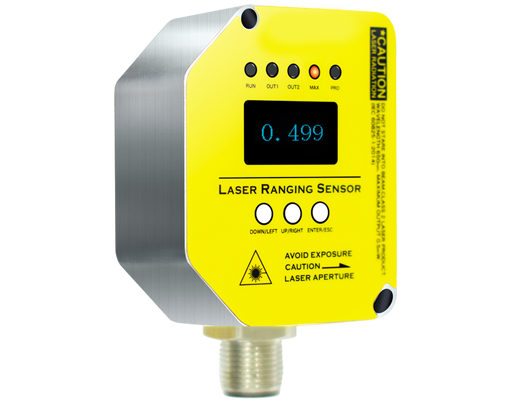
In phase-shift measurement systems, which often use modulated continuous-wave lasers, the core algorithm performs a discrete Fourier transform (DFT) or a correlation analysis to extract the phase difference with high resolution. This phase difference is directly proportional to the distance. Advanced implementations use multiple modulation frequencies to resolve ambiguity in measurements over longer ranges and to improve accuracy. Environmental corrections are also algorithmically applied, compensating for factors like air temperature and pressure, which affect the speed of light.
A critical advancement is the integration of real-time error correction algorithms. These algorithms can detect and compensate for common issues such as speckle noise from rough surfaces, mixed pixels at edges, or interference from other light sources. Machine learning approaches are now being incorporated, where neural networks are trained on vast datasets to recognize patterns and anomalies, enabling the sensor to provide reliable readings even on challenging surfaces like transparent glass or black, low-reflectivity materials.
Furthermore, modern sensors often include algorithms for data fusion and object tracking. In robotic applications, for instance, a sensor might not only measure distance but also use clustering algorithms to identify and track multiple objects within its field of view, feeding crucial data to navigation and control systems. The efficiency of these algorithms directly impacts the sensor's update rate and, consequently, the system's overall responsiveness.

The development of these algorithms requires a deep understanding of optics, electronics, and software engineering. Optimization is key, as processing must be fast enough for real-time operation, often on embedded systems with limited computational power. Engineers continually refine these algorithms to push the boundaries of precision, speed, and robustness, enabling laser sensors to perform in increasingly demanding and dynamic environments. From ensuring the precise alignment of components on a microchip assembly line to enabling the safe navigation of self-driving cars, the silent work of these advanced algorithms is foundational to technological progress. Their ongoing evolution promises even greater capabilities, solidifying the role of laser distance measurement as a cornerstone of industrial automation and intelligent systems.
