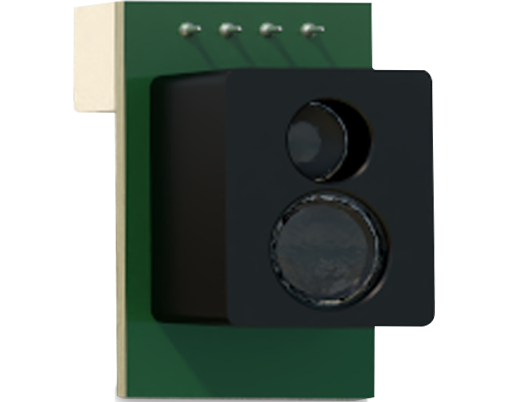
Laser displacement sensors are critical components in modern industrial automation, offering non-contact, high-precision measurement capabilities. These devices operate by projecting a laser beam onto a target surface and analyzing the reflected light to determine distance or position changes with micron-level accuracy. The fundamental principle relies on triangulation or time-of-flight methods, with triangulation being predominant for short to medium ranges due to its superior resolution. In triangulation-based sensors, a laser diode emits a focused beam that strikes the target, and the reflected light is captured by a receiving lens at a specific angle, focusing it onto a position-sensitive detector. Any displacement of the target alters the light spot position on the detector, enabling precise distance calculation through geometric relationships.
The advantages of laser displacement sensors are manifold. Their non-contact nature eliminates mechanical wear and prevents damage to delicate surfaces, making them ideal for measuring soft, hot, or rapidly moving objects. They provide exceptionally high sampling rates, often exceeding 100 kHz, allowing real-time monitoring in dynamic processes such as vibration analysis or assembly line inspection. Furthermore, their compact design and minimal beam spot size enable measurements in confined spaces and on small features. Common industrial applications include thickness gauging of materials like metal sheets or plastic films, profile scanning for quality control, precision positioning in robotics, runout measurement of rotating shafts, and surface defect detection. For instance, in automotive manufacturing, these sensors ensure precise gap and flush measurements between body panels, while in electronics, they verify component coplanarity and solder paste height.
Selecting the appropriate laser displacement sensor requires careful consideration of several parameters. Measurement range, resolution, linearity, and spot size are primary factors. A sensor with a 10mm range might achieve 0.1µm resolution, whereas a 500mm range model may offer 50µm resolution. Environmental conditions such as ambient light, temperature fluctuations, and target surface characteristics (color, texture, reflectivity) significantly impact performance. Highly reflective or transparent materials often necessitate sensors with automatic gain control or specialized filters. Modern sensors integrate advanced features like multi-point measurement, analog/digital outputs (e.g., Ethernet/IP, PROFINET), and embedded software for data logging and analysis. Regular calibration using certified reference standards is essential to maintain accuracy, and proper installation—avoiding vibration, dust, and optical interference—ensures long-term reliability.
Despite their robustness, challenges persist. Measuring dark, absorptive surfaces can weaken signal strength, while glossy surfaces may cause specular reflection errors. Innovations like blue-violet lasers improve absorption on organic materials, and confocal chromatic sensors offer solutions for transparent layers. The integration of AI algorithms for adaptive parameter tuning and IoT connectivity for predictive maintenance represents the future trajectory. As Industry 4.0 advances, laser displacement sensors are evolving into smart sensing nodes, providing not only raw data but also diagnostic insights, thereby enhancing overall system intelligence and operational efficiency in sectors ranging from aerospace to pharmaceuticals.
In conclusion, laser displacement sensors are indispensable tools for precision metrology, driving quality and efficiency in automated production. Their continuous technological evolution promises even greater adaptability and integration within smart factories, solidifying their role as foundational elements in industrial measurement systems. Engineers must stay abreast of these developments to leverage their full potential, ensuring optimal selection, application, and maintenance tailored to specific operational demands.
