In the realm of industrial automation and control systems, proximity sensors are indispensable components for non-contact object detection. Among the various types, diffuse reflective proximity sensors stand out for their versatility and widespread application. This article delves into the fundamental principles, key characteristics, and practical considerations of these essential devices.
At its core, a diffuse reflective proximity sensor operates on a simple yet effective principle. It integrates both a light source, typically an infrared LED, and a photodetector, such as a phototransistor or photodiode, within a single housing. The emitter projects a beam of light towards a target area. When an object enters this detection zone, the light strikes its surface. Unlike retro-reflective sensors that require a dedicated reflector, diffuse sensors rely on the natural, scattered reflection (diffuse reflection) from the object's surface. A portion of this diffusely reflected light is captured by the integrated receiver. The sensor's internal circuitry then processes this signal. When the intensity of the received light exceeds a pre-set threshold, the sensor's output state changes, signaling the presence of the object.
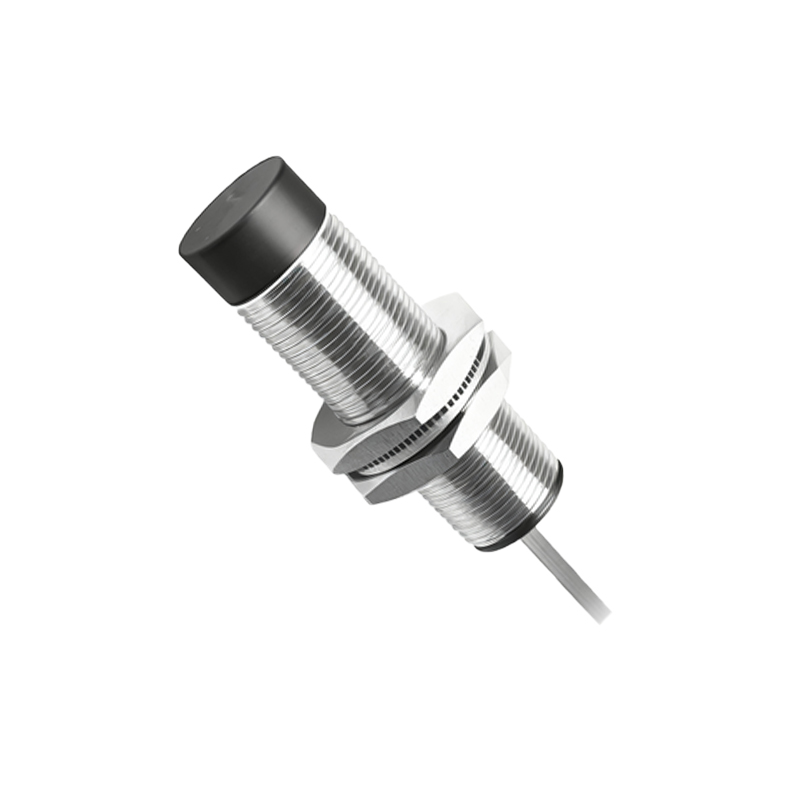
This operational method defines several key characteristics. First, it is a one-part system, requiring only the sensor and the object, which simplifies installation. Second, the effective sensing range is heavily dependent on the object's properties. Key factors include color, material, surface texture, and size. Light-colored, matte-finished objects reflect more light and can be detected at greater distances. Conversely, dark, shiny, or absorbent materials reflect less light, significantly reducing the reliable sensing range. Manufacturers specify a standard sensing distance, often using a matte white test card, but real-world performance must be validated with the actual target object.
Diffuse sensors offer several advantages that make them a popular choice. Their compact, self-contained design allows for easy integration into machinery with limited space. They are cost-effective for applications where the object itself can serve as the reflective surface, eliminating the need for separate reflectors or emitters and receivers mounted opposite each other. They excel at detecting the presence, absence, or passage of objects on conveyor belts, in packaging machines, and in material handling systems. Common applications include counting bottles, detecting stacked sheets, verifying part placement, and monitoring fill levels in transparent or opaque containers.
However, engineers must carefully consider their limitations to ensure reliable operation. The primary challenge is background interference. Since the sensor responds to any reflected light, distant, highly reflective surfaces or ambient light (like sunlight or strong workshop lighting) can cause false triggers. Modern sensors incorporate features to mitigate this. Modulated LED light (pulsing at a specific high frequency) and corresponding tuned receivers allow the sensor to distinguish its own signal from constant ambient light. Polarization filters can help reject specular reflections from shiny surfaces. Another consideration is the material dependency, as mentioned, which necessitates careful selection and testing.
When selecting a diffuse reflective proximity sensor, several specifications are critical. The sensing distance is paramount and must be derated for non-ideal targets. The response time determines how fast the sensor can detect objects in high-speed applications. Output type is another key decision; options include digital (PNP/NPN transistor) or analog (current or voltage proportional to distance), with some models offering programmable switching points. Housing material (often metal or plastic) must suit the environmental conditions, including resistance to chemicals, washdowns, or physical impact. Many sensors feature built-in indicators (LEDs) for power and output status, aiding in setup and troubleshooting.
Installation and alignment are straightforward but require attention. The sensor should be mounted securely to minimize vibration. The angle relative to the target object is important; a perpendicular orientation typically yields the strongest signal. It is crucial to avoid positioning the sensor where the background is within its theoretical range for the given object, or to use sensors with background suppression technology. Background suppression (BGS) or foreground suppression (FGS) models use triangulation principles to define a precise detection window, ignoring objects beyond or before a set distance, greatly enhancing reliability in complex environments.
In conclusion, diffuse reflective proximity sensors are a fundamental and flexible solution for object detection. Their simplicity, compactness, and cost-effectiveness make them a workhorse in countless automation scenarios. Success hinges on a thorough understanding of their operating principle, a clear assessment of the target object's properties, and careful consideration of the installation environment. By accounting for factors like color dependence and potential background interference—and utilizing advanced features like modulation and background suppression—engineers can deploy these sensors to create robust, efficient, and reliable automated systems.