Laser obstacle avoidance sensors are a critical component in modern robotics, autonomous vehicles, and smart industrial systems. These devices enable machines to perceive their surroundings, detect potential collisions, and navigate safely without human intervention. At their core, these sensors operate on the principle of Time-of-Flight (ToF) or triangulation, using laser light to measure distances with high precision.
The fundamental operation begins with a laser diode emitting a focused beam of infrared or visible light toward a target area. This beam is typically modulated or pulsed to enhance accuracy and reduce interference from ambient light. When the laser light strikes an object in its path, it reflects back toward the sensor. A photodetector or receiver within the sensor captures this reflected light. The key measurement is the time interval between the emission of the laser pulse and the detection of its reflection. Since the speed of light is constant (approximately 299,792 kilometers per second in a vacuum), the sensor's internal processor can calculate the distance to the object using the formula: Distance = (Speed of Light × Time Delay) / 2. The division by two accounts for the round-trip journey of the light. This method, known as Time-of-Flight, is favored for its long-range capability and rapid response, making it suitable for dynamic environments like self-driving cars or drones.
Alternatively, some laser sensors employ triangulation, especially for shorter ranges or higher precision needs. In this approach, the laser emitter and receiver are positioned at a known angle to each other. When the laser spot hits an object, the reflected light reaches the receiver at a specific angle. By analyzing the geometric relationship between the emitter, receiver, and the reflection point, the sensor computes the distance. Triangulation-based sensors often achieve sub-millimeter accuracy, ideal for industrial automation or robotic arms handling delicate tasks.
Beyond basic distance measurement, advanced laser obstacle avoidance systems integrate multiple data points to create a detailed environmental map. By scanning the laser beam across a field of view—using rotating mirrors, MEMS (Micro-Electro-Mechanical Systems), or phased arrays—the sensor generates a point cloud or depth map. This allows it to identify not just the presence of an obstacle, but also its shape, size, and relative motion. For instance, in robotic vacuums, such sensors help distinguish between walls, furniture legs, and loose objects, enabling efficient cleaning paths. In autonomous vehicles, they combine with cameras and radar to classify pedestrians, vehicles, and road hazards.
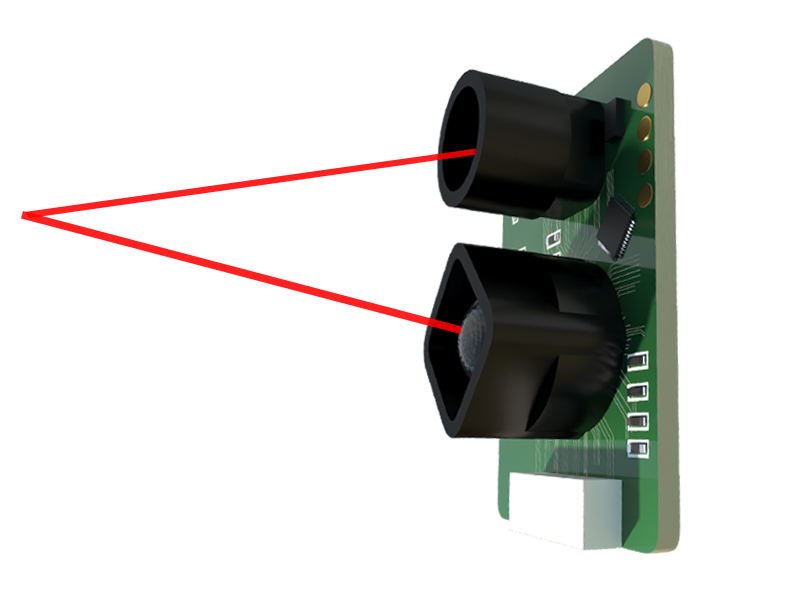
The performance of these sensors depends on several factors. Wavelength selection is crucial; infrared lasers (e.g., 905 nm or 1550 nm) are common due to their eye-safety and minimal atmospheric absorption. Power output and beam divergence affect range and resolution, with narrower beams offering finer detail. Environmental conditions like fog, rain, or highly reflective surfaces can challenge accuracy, prompting the use of signal processing algorithms to filter noise. Modern sensors often incorporate machine learning to improve object recognition and reduce false positives.
Applications span diverse fields. In logistics, laser sensors guide AGVs (Automated Guided Vehicles) through warehouses, avoiding collisions with workers and inventory. In consumer electronics, they enable gesture control in devices. For drones, they provide real-time terrain following and obstacle evasion during flight. The healthcare sector uses them in robotic surgery for precise instrument positioning. As technology advances, miniaturization and cost reduction are driving adoption in smart home gadgets and wearable tech.
In summary, laser obstacle avoidance sensors rely on precise light measurement techniques to deliver reliable spatial awareness. By converting laser reflections into actionable distance data, they empower machines to operate autonomously and safely. Ongoing innovations in optics, computing, and AI continue to enhance their capabilities, paving the way for more intelligent and responsive automated systems in our daily lives.