Eddy current proximity sensors are fundamental components in modern industrial automation, offering non-contact, high-precision detection of metallic objects. Their operation is rooted in electromagnetic principles, providing reliability in harsh environments where mechanical wear or contamination is a concern. This article delves into the core working mechanism, key characteristics, and typical applications of these sensors.
At the heart of an eddy current sensor lies an oscillator circuit that generates a high-frequency alternating current. This current flows through a coil housed within the sensor's probe, creating a corresponding alternating magnetic field that extends from the probe tip into the surrounding space. When a conductive target, typically a metal object, enters this magnetic field, electromagnetic induction occurs. According to Faraday's Law of Induction, the changing magnetic flux induces circulating currents, known as eddy currents, on the surface of the target. These eddy currents, in turn, generate their own magnetic field, which opposes the original field produced by the sensor coil, as described by Lenz's Law.
This opposition effect alters the impedance of the sensor's coil. The impedance is a combination of the coil's inductance and resistance. The presence of the target and the resulting eddy currents cause measurable changes in this impedance—primarily a decrease in inductance and an increase in effective resistance. The sensor's integrated electronics continuously monitor this impedance shift. As the target moves closer, the interaction strengthens, causing a greater change in impedance. The electronic circuitry converts this change into a usable output signal, which is typically a proportional DC voltage, current (e.g., 4-20 mA), or a digital switch signal. This output provides precise information about the target's presence or its distance from the probe face.
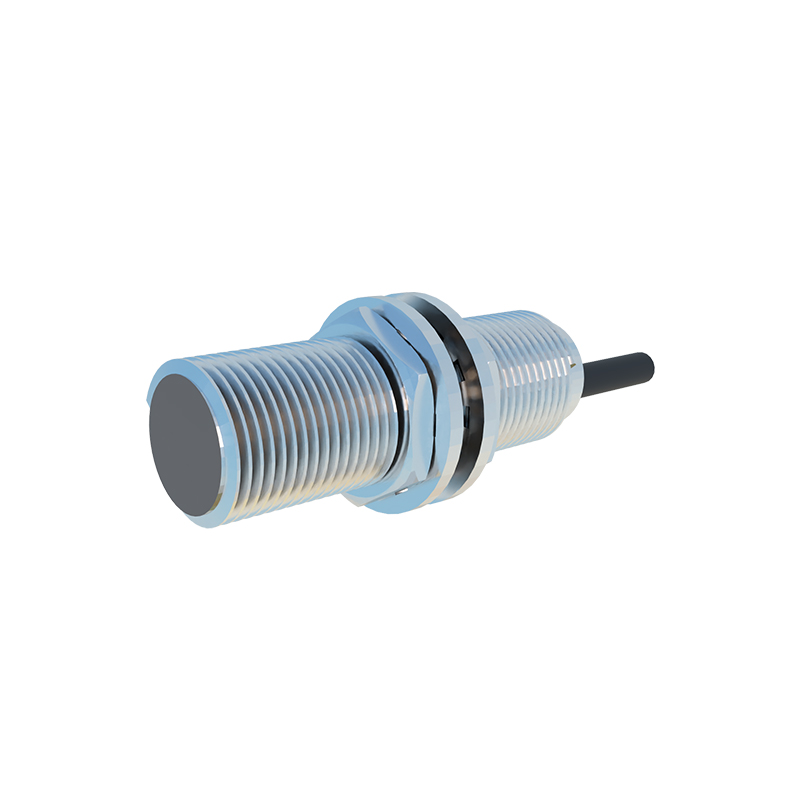
Several factors influence the sensor's performance and must be considered during selection and installation. The first is target material. Eddy currents are most readily induced in materials with high electrical conductivity, such as copper, aluminum, and silver. Ferromagnetic materials like iron and steel also work well, but their magnetic permeability adds complexity, often requiring sensor calibration for the specific material to ensure accuracy. The second factor is target size and shape. For optimal performance, the target should be at least the same size as the sensor's sensing face and be flat and thick enough to allow full eddy current formation. Thin or small targets can reduce the effective sensing range. The third critical factor is the operating frequency. Higher-frequency sensors are more sensitive to thin targets and non-ferrous metals but may have a shorter range. Lower-frequency models offer longer ranges and are better suited for detecting ferrous materials.
The design of eddy current sensors confers significant advantages. Their non-contact nature eliminates mechanical wear on both the sensor and the target, ensuring a long operational life. They are highly responsive, capable of detecting very high-speed motion or vibration, making them ideal for applications like rotational speed monitoring or vibration analysis on shafts. Furthermore, they are inherently robust. The sensing coil is usually encapsulated in a rugged housing, making them resistant to dust, oil, moisture, and other common industrial contaminants. They can function effectively in extreme temperatures and high-pressure environments where other sensor types might fail.
Typical industrial applications are vast. They are extensively used for precise position and displacement measurement in machine tools, monitoring runout and deflection in turbines and motors, and gauging thickness of metal sheets or coatings. As limit switches, they provide accurate end-position detection in cylinders or automated guides. In the automotive industry, they are crucial for crankshaft and camshaft position sensing in engines. They also play a vital role in condition monitoring, detecting cracks in metal structures or imbalances in rotating machinery by measuring minute vibrational displacements.
In conclusion, the eddy current proximity sensor is a versatile and robust solution for metallic object detection and displacement measurement. Its principle, based on electromagnetic induction and impedance variation, allows for high-resolution, non-contact operation in demanding conditions. Understanding the interplay between target material, sensor frequency, and application requirements is key to selecting and implementing these sensors effectively, ensuring optimal performance and reliability in automated systems.