In the realm of precision measurement and industrial automation, laser dual-frequency ranging sensors represent a significant technological advancement. These sophisticated devices utilize the principles of interferometry, specifically employing two distinct laser frequencies to achieve highly accurate distance measurements. Unlike traditional single-frequency laser sensors, the dual-frequency approach offers enhanced stability, reduced sensitivity to environmental disturbances, and superior performance in challenging conditions. The core operating principle involves generating two coherent laser beams with slightly different frequencies. These beams are directed toward the target. The reflected light from the target is then combined with a reference beam, creating an interference pattern. The phase difference between the two frequencies in this interference pattern is directly proportional to the distance to the target. By precisely measuring this phase shift, the sensor calculates the absolute distance with remarkable resolution, often in the sub-micrometer range. This method, often based on heterodyne or synthetic wavelength interferometry, effectively mitigates issues common to single-wavelength systems, such as signal ambiguity over long distances and errors induced by air turbulence or thermal fluctuations.
The industrial applications for laser dual-frequency ranging sensors are vast and critical. In semiconductor manufacturing, they are indispensable for wafer alignment, lithography stage positioning, and mask measurement, where nanometer-level accuracy is non-negotiable. Within the aerospace sector, these sensors facilitate the precise assembly of large structures, contour profiling of aircraft components, and alignment of satellite instrumentation. The field of precision machining and coordinate measuring machines (CMMs) relies on them for real-time tool positioning, dimensional inspection, and geometric error compensation. Furthermore, in scientific research, they are pivotal for gravitational wave detection experiments, telescope mirror alignment, and other fundamental physics applications requiring extreme metrological precision.
Key advantages driving their adoption include long measurement range, often extending to several tens of meters or more, while maintaining high accuracy. They exhibit excellent long-term stability, meaning calibration drift is minimal over time. Their dynamic measurement capability allows for tracking moving targets at high speeds, which is essential for vibration analysis or robotic guidance. Modern iterations integrate advanced digital signal processing (DSP) units, enabling real-time data analysis, noise filtering, and direct communication with industrial control systems via EtherCAT, PROFINET, or other industrial Ethernet protocols.
When selecting a laser dual-frequency ranging sensor for a specific application, engineers must consider several parameters. Measurement range and resolution are primary factors. The wavelength of the laser, typically in the visible red or near-infrared spectrum, affects the beam's visibility and its interaction with different materials. Data output rate determines how quickly distance updates are provided, crucial for high-speed processes. Environmental robustness, including resistance to dust, coolants, and varying ambient light, is vital for harsh factory floor conditions. Finally, the mechanical design, including beam diameter and optional integrated air purge for optical windows, must align with the installation constraints.
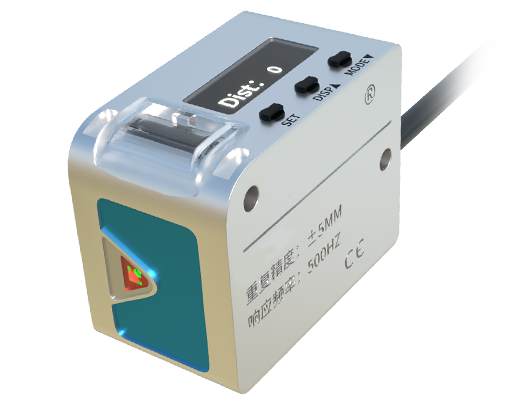
Despite their higher initial cost compared to simpler technologies like ultrasonic or single-point laser triangulation sensors, the total cost of ownership is often justified by the unparalleled accuracy, reliability, and process improvement they enable. They reduce scrap rates, enhance product quality, and increase throughput in automated production lines. As Industry 4.0 and smart manufacturing evolve, the integration of these high-precision sensors with IoT platforms and predictive maintenance systems will further expand their role. Future developments may focus on miniaturization, cost reduction, and the integration of multi-axis measurement capabilities into a single compact unit. In conclusion, laser dual-frequency ranging sensors are a cornerstone technology for modern high-precision engineering, offering a unique combination of range, accuracy, and stability that is essential for pushing the boundaries of manufacturing and scientific discovery.
