In the realm of industrial automation, precision, reliability, and durability are non-negotiable. Among the myriad components that ensure seamless operation, proximity sensors stand as critical sentinels, detecting the presence or absence of objects without physical contact. The Omron E2B-M12N08 is a prominent example of such technology, a robust inductive proximity sensor designed for demanding environments. This article delves into its specifications, operational principles, typical applications, and key advantages, providing a thorough technical overview for engineers and maintenance professionals.
The E2B-M12N08 is an M12 cylindrical, shielded (flush-mountable), inductive proximity sensor. Its core function is to detect metallic objects, primarily ferrous metals like iron and steel, with a rated sensing distance of 8mm. The "N" in its model number typically denotes a DC 3-wire configuration with an NPN open-collector output, a common standard in many PLC (Programmable Logic Controller) input modules, particularly in regions like Europe and Asia. This sensor operates on a DC supply voltage, commonly in the range of 10-30 VDC, ensuring compatibility with standard industrial control voltages.
The operating principle is based on electromagnetic induction. The sensor's face contains a coil that is part of an oscillating circuit. When a metallic object enters the sensor's electromagnetic field, eddy currents are induced in the target. This causes a change in the oscillation amplitude or frequency within the sensor's circuit. The sensor's built-in detection circuit monitors this change and triggers a solid-state switch (the NPN transistor) to change state, effectively providing a digital ON/OFF signal. The shielded design allows for flush mounting in metal, preventing interference from surrounding metallic materials and enabling versatile installation.
Key technical specifications define its performance envelope. The 8mm sensing distance is its nominal operating point. Engineers must consider factors like the target material, size, and approach direction, as these can affect the effective sensing distance. For instance, non-ferrous metals like aluminum or copper typically have a reduced sensing range, often 30-60% of the rated distance. The sensor features a hysteresis of approximately 10% of the sensing distance or less, which prevents output chattering when a target is at the detection boundary. Its response frequency is sufficiently high for most applications, allowing it to detect objects passing at speed. The housing is typically constructed from nickel-plated brass or stainless steel, offering excellent resistance to oils, coolants, and minor physical impacts, conforming to IP67 standards for protection against dust and temporary immersion.
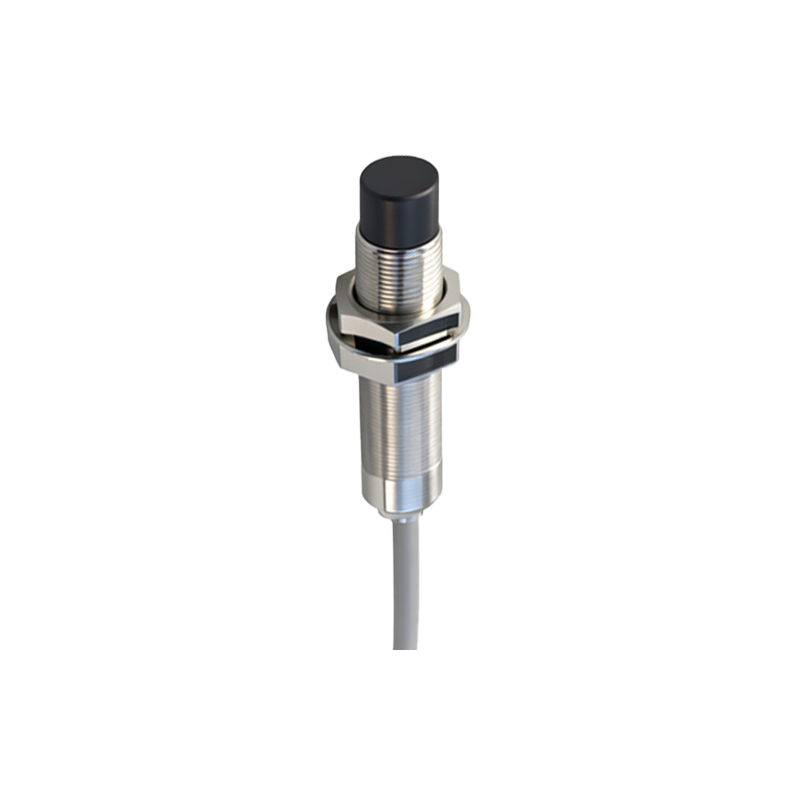
Wiring the E2B-M12N08 is straightforward due to its 3-wire design. The standard color coding is: Brown wire for the positive DC supply (+V), Blue wire for the common negative (0V), and Black wire as the switched output signal. In the NPN configuration, the black wire acts as a sinking output; when activated, it connects the load (e.g., a PLC input) to the common negative (0V). A status LED is usually integrated, providing visual confirmation of power and detection state, which is invaluable for troubleshooting.
The applications for this sensor are vast across factory floors. It is commonly employed for position verification of machine parts, such as confirming a cylinder is fully extended or retracted. It serves in counting metallic objects on conveyors, detecting the presence of tools in CNC machines, and ensuring safety interlock positions. Its M12 form factor with a standard Pg9 or M12 connector allows for quick connection and disconnection, facilitating easy maintenance and replacement.
Several advantages make the E2B-M12N08 a preferred choice. Its shielded design offers installation flexibility. The robust metal housing ensures longevity in harsh conditions. The consistent performance and high repeat accuracy contribute to process reliability. Furthermore, being part of Omron's extensive E2B series, it benefits from global availability and support, with a wide range of complementary accessories like cables and mounting brackets.
When selecting and installing this sensor, best practices must be followed. Ensure the power supply polarity is correct to prevent damage. For optimal performance, the target should be a square piece of mild steel (Fe 360) with a side length equal to or greater than the sensor's sensing face or three times the rated distance. Allow for a sufficient temperature drift margin, as extreme ambient temperatures can slightly affect the sensing distance. Regular maintenance involves checking for physical damage, buildup of metallic swarf or debris on the sensing face, and verifying the output signal under operational conditions.
In conclusion, the Omron E2B-M12N08 proximity sensor embodies the essential characteristics required for modern industrial sensing: robustness, precision, and ease of integration. Its design and performance parameters make it a versatile and reliable component in automated systems, from packaging and material handling to metalworking and assembly