Laser displacement sensors represent a critical category of non-contact measurement instruments widely utilized across manufacturing, automation, robotics, and quality control sectors. Their operational principle primarily relies on laser triangulation or time-of-flight (ToF) methods to achieve high-precision distance and position measurements. This article provides a detailed technical comparison of mainstream laser displacement sensor types, analyzing their performance parameters, application scenarios, and selection criteria to assist engineers in making informed decisions.
The most prevalent technology is laser triangulation. In this configuration, a laser diode projects a focused spot onto the target surface. The reflected light is captured by a receiving lens at a specific angle and imaged onto a position-sensitive detector (PSD) or a CMOS/CCD array. Displacement of the target alters the position of the light spot on the detector, enabling precise distance calculation via trigonometric relationships. Triangulation sensors excel in high-resolution measurements over short to medium ranges, typically from a few millimeters up to several hundred millimeters. Key performance indicators include linearity, resolution (often down to sub-micron levels), and repeatability. Their performance can be influenced by surface color, reflectivity, and texture; highly reflective or dark, absorbent surfaces may require specific calibration or the use of supplemental filters.
In contrast, Time-of-Flight (ToF) laser sensors measure distance by calculating the round-trip time of a laser pulse. They emit short laser pulses and use a high-speed receiver to detect the reflected signal. The distance is derived from the known speed of light. ToF sensors are suitable for long-range measurements, from a few meters to several hundred meters, though with generally lower resolution compared to triangulation sensors. They are less sensitive to surface characteristics but may be affected by ambient light interference. A key variant, phase-shift ToF, modulates the laser beam's intensity and measures the phase difference between emitted and received signals, offering improved accuracy for intermediate distances.
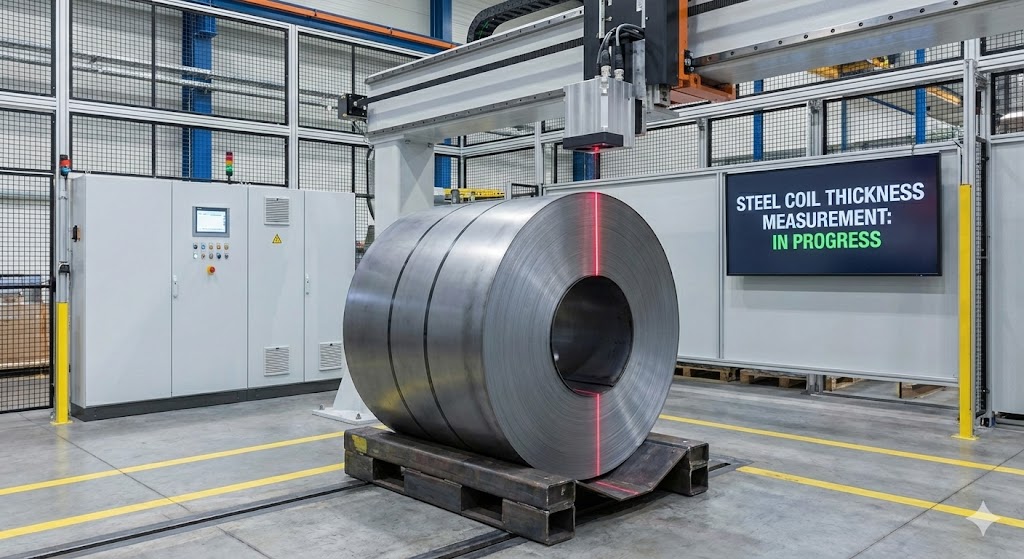
Another important distinction lies in point sensors versus profile (or line) sensors. A point sensor measures the distance to a single spot, ideal for monitoring thickness, vibration, or precise single-point positioning. A profile sensor projects a laser line instead of a point. A camera captures the deformation of this line, enabling the reconstruction of a 2D cross-sectional profile or even 3D contour mapping via scanning. This is invaluable for shape inspection, groove measurement, and surface defect detection.
Selection depends heavily on application requirements. For high-speed, high-precision measurements on production lines (e.g., electronic component placement, wafer thickness monitoring), a high-end triangulation point sensor with superior repeatability and fast response time is paramount. Environmental factors like dust, coolant mist, or strong ambient light necessitate sensors with adequate IP ratings, protective housings, and specialized optical filters. For robotics, such as bin picking or collision avoidance, ToF or long-range triangulation sensors provide the necessary working distance. In 3D scanning for reverse engineering or quality assurance, laser line profilers, often paired with precise motion systems, are the standard choice.
Communication interfaces also vary. Common outputs include analog (4-20 mA, 0-10 V), digital (RS-232, RS-485), and industrial Ethernet (EtherCAT, PROFINET, Ethernet/IP). The choice integrates the sensor into the broader control system. Programmability and built-in evaluation functions, like tolerance checking or peak detection, can simplify system design.
In summary, selecting a laser displacement sensor involves a careful trade-off between measurement range, accuracy, speed, target surface properties, environmental conditions, and integration needs. Triangulation sensors dominate where micron-level precision is critical at shorter ranges, while ToF sensors offer robust solutions for longer distances. Profile sensors unlock capabilities for dimensional and contour analysis. Understanding these core technologies and their performance boundaries is essential for deploying an effective and reliable measurement solution. As technology advances, sensors combining multiple principles, offering smarter onboard processing, and demonstrating enhanced robustness continue to expand the possibilities for precision metrology in industrial automation.