In industrial automation and control systems, proximity sensors are indispensable components for non-contact detection of metallic objects. However, a persistent and well-known challenge faced by engineers and maintenance personnel is the frequent failure of standard inductive proximity sensors to reliably detect objects made of stainless steel. This issue can lead to production stoppages, quality control failures, and safety concerns. Understanding the root causes and available solutions is critical for ensuring robust system performance.
The core principle of an inductive proximity sensor involves generating a high-frequency electromagnetic field from an oscillator coil. When a metallic object enters this field, eddy currents are induced on the surface of the object. These eddy currents draw energy from the sensor's oscillator, causing a change in its amplitude. This change is detected by the sensor's circuitry, which then triggers an output signal. The efficiency of this eddy current generation is directly tied to the electrical conductivity and magnetic permeability of the target material.
Stainless steel presents a unique problem due to its material composition. While it is a metal, many common grades, such as the austenitic series (304, 316), are essentially non-magnetic or have very low magnetic permeability. Magnetic permeability is a measure of how easily a material can support the formation of a magnetic field within itself. Standard inductive sensors are optimized for detecting ferromagnetic materials like mild steel, iron, and carbon steel, which have high permeability. The electromagnetic field from the sensor interacts strongly with these materials.
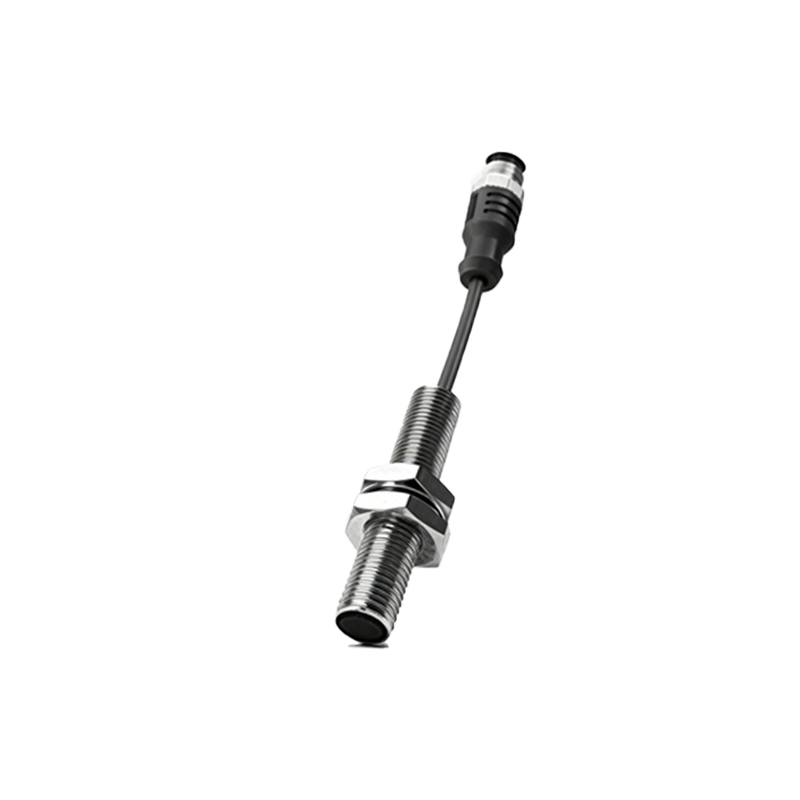
For non-magnetic stainless steel, the primary detection mechanism relies solely on its electrical conductivity. Although stainless steel is conductive, its conductivity is typically lower than that of metals like copper or aluminum. More importantly, the lack of high magnetic permeability significantly reduces the damping effect on the sensor's oscillator. The eddy currents generated are weaker, resulting in a much smaller change in the oscillator's amplitude. Consequently, the sensing distance for stainless steel can be reduced by 50% to 70% compared to the rated sensing distance for mild steel. In many cases, if the sensor is not specifically adjusted or selected, the signal change may be too faint to cross the detection threshold, leading to a complete failure to detect the object.
Several factors exacerbate this issue. The specific grade of stainless steel is crucial; a grade with some ferritic content (like 430) will be more detectable than a purely austenitic grade. The surface condition also plays a role; a rough, oxidized, or coated surface can further impede eddy current flow. Sensor mounting and the surrounding environment, including the presence of other metals, can also influence performance.
Fortunately, the industry has developed effective strategies to overcome this limitation. The most direct solution is to select sensors specifically designed or rated for non-ferrous metals, including stainless steel. These sensors often operate at a higher frequency, which can improve sensitivity to conductive but non-magnetic materials. Another common approach is to use a "Factor 1" sensor. Standard sensors have a reduction factor (often 0.3 to 0.5 for stainless steel), meaning their range is reduced. A Factor 1 sensor is designed so that its rated sensing distance is defined for a standard stainless steel target (typically AISI 304), eliminating guesswork.
For existing installations where sensor replacement is not immediately feasible, practical workarounds exist. One method is to attach a small ferrous metal tag (e.g., a mild steel washer) to the stainless steel object at the detection point. This provides a highly detectable target for the standard sensor. Alternatively, adjusting the installation by bringing the sensor closer to the target path can compensate for the reduced effective range, though this requires careful recalibration and consideration of mechanical tolerances.
In applications where even specialized inductive sensors are insufficient, switching sensor technologies may be necessary. Capacitive proximity sensors can detect both metallic and non-metallic materials based on dielectric constant and may work for stainless steel, though they are sensitive to environmental factors like moisture. Ultrasonic sensors offer another non-contact option, detecting objects based on sound wave reflection, independent of material properties. For precise positioning, photoelectric sensors can be used, though they require a clean environment and a reflective or opaque target.
When designing a new system intended to handle stainless steel components, it is prudent to conduct thorough testing with the actual material samples during the planning phase. Consulting sensor datasheets for precise reduction factors and technical specifications is mandatory. Proper sensor selection, considering not just the material but also the required sensing distance, environmental conditions (temperature, washdown), and output type, will prevent costly downtime and rework later.
In conclusion, the failure of standard proximity sensors to detect stainless steel is a well-understood phenomenon rooted in the material's low magnetic permeability. It is not a sensor malfunction but a mismatch between sensor technology and target material characteristics. By applying the correct knowledge—opting for sensors rated for non-ferrous metals,