Laser sensors have become indispensable tools across numerous industrial sectors, offering unparalleled precision for distance measurement, object detection, and positioning tasks. A fundamental parameter defining their performance is the sensing range, which dictates their applicability in various scenarios. This article delves into the technical aspects, influencing factors, and practical considerations of laser sensor sensing range.
At its core, the sensing range of a laser sensor refers to the minimum and maximum distances within which it can reliably detect a target or measure its position. This range is not a single fixed value but a spectrum defined by specifications such as the reference sensing distance, the minimum detectable object size, and the permissible background light interference. The operating principle typically involves emitting a focused laser beam—often from a laser diode—and analyzing the reflected light. Time-of-flight (ToF), triangulation, and phase-shift measurement are common methods used to calculate distance based on the light's return signal.
Several key factors directly impact the achievable sensing range. First and foremost is the laser's output power. A higher-power laser can generate a stronger beam that travels farther and returns a detectable signal from more distant or less reflective objects. However, safety regulations (like IEC 60825-1) strictly classify lasers and limit permissible exposure levels, capping the usable power for most industrial sensors. The wavelength of the laser is another critical factor. Common wavelengths include visible red (around 650 nm) and infrared (e.g., 850 nm or 905 nm). Infrared lasers often provide better performance in dusty or smoky environments due to less scattering and are less affected by ambient visible light.

The target's properties are equally decisive. Surface reflectivity, color, and texture dramatically influence the amount of light returned to the sensor's receiver. A matte white surface reflects diffusely and effectively, enabling a longer sensing range. In contrast, a shiny black or transparent surface may absorb or transmit most of the laser light, severely reducing the effective range or causing detection failures. The size and shape of the target also matter; a smaller target reflects less total energy.
Environmental conditions pose significant challenges. Ambient light, especially direct sunlight containing infrared components, can saturate the sensor's photodetector, creating noise that masks the weak return signal. High-quality sensors incorporate optical filters and modulated laser signals to mitigate this. Atmospheric conditions like fog, dust, or steam can scatter and attenuate the laser beam, reducing the effective range. Temperature fluctuations can affect the electronic components and the laser diode's output, potentially shifting calibration.
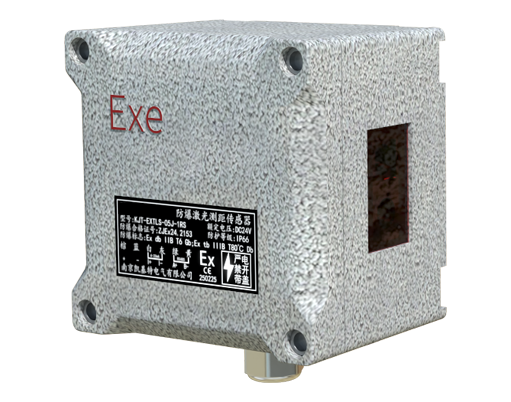
From an application standpoint, selecting a sensor with an appropriate sensing range is crucial. Engineers must consider not just the nominal distance to the target but also include a safety margin—typically 20-30%—to account for real-world variances in target reflectivity, environmental contaminants, and potential mechanical misalignment. For example, a packaging machine detecting boxes on a conveyor might use a sensor with a 0.1m to 2m range, while a vehicle detection system for automated guided vehicles (AGVs) may require a sensor effective from 0.5m up to 10m or more.
Modern laser sensors incorporate advanced features to maximize usable range and reliability. Background suppression technology allows the sensor to ignore objects beyond a set distance. High-speed digital signal processing helps filter out noise. Some models offer programmable sensing windows or teach-in functions to adapt to specific targets. Regular maintenance, such as keeping the lens clean from oil and dust, is essential for maintaining specified performance.
In conclusion, the sensing range of a laser sensor is a complex characteristic shaped by the interplay of the sensor's own specifications, the target's properties, and the operating environment. A thorough understanding of these factors enables engineers to make informed selections, ensuring robust and accurate sensor integration that enhances automation efficiency, safety, and quality control in demanding industrial settings.