Inductive proximity sensors are fundamental components in modern industrial automation, designed specifically for the non-contact detection of metallic objects. Operating on the principle of electromagnetic induction, these robust and reliable switches have become indispensable in manufacturing, packaging, material handling, and automotive assembly lines. Their core function is to detect the presence or absence of a metal target without any physical contact, thereby eliminating mechanical wear and enabling high-speed, precise operations.
The operational principle is elegantly simple yet highly effective. The sensor contains a coil wound around a ferrite core, which is part of an oscillator circuit. When an alternating current is applied, it generates a high-frequency electromagnetic field around the active face of the sensor. In the absence of a metallic target, this field remains stable, and the oscillator operates normally. When a ferrous or non-ferrous metal object enters this electromagnetic field, eddy currents are induced on the surface of the target. These eddy currents draw energy from the oscillator, causing a reduction in its amplitude. An integrated evaluation circuit monitors this amplitude change. Once the amplitude drop reaches a predetermined threshold—corresponding to a specific sensing distance—the circuit triggers a solid-state output switch, signaling the detection of an object.
Key performance characteristics define their application suitability. The sensing distance, or nominal range, is a critical specification, typically ranging from 1 to 60 mm for standard cylindrical models. It is important to note that this distance is calibrated for a standard mild steel target. For other metals, a reduction factor applies; for instance, stainless steel may reduce the effective range by 20-30%, while copper or aluminum can reduce it by 40-60%. Repeat accuracy, often within microns, ensures consistent triggering at the same point. Hysteresis, a built-in differential between the switch-on and switch-off points, prevents output chatter when a target is at the exact sensing limit. Furthermore, these sensors are celebrated for their resilience. Housed in robust materials like nickel-plated brass, stainless steel, or PBT plastic, they are inherently immune to environmental contaminants like dust, oil, and coolants. With no moving parts, they offer exceptionally long service life, often rated for tens of millions of operations.
The market offers several primary output configurations to interface with control systems like PLCs. The two-wire DC type simplifies wiring but requires a minimum load current. The three-wire DC type, the most common, provides separate power, ground, and switched output wires (either PNP, sourcing current, or NPN, sinking current). Four-wire versions combine both a normally open (NO) and a normally closed (NC) contact in one device. For AC power applications, two-wire AC/DC sensors are also available. Selecting the correct output type is paramount for proper integration with the controller.
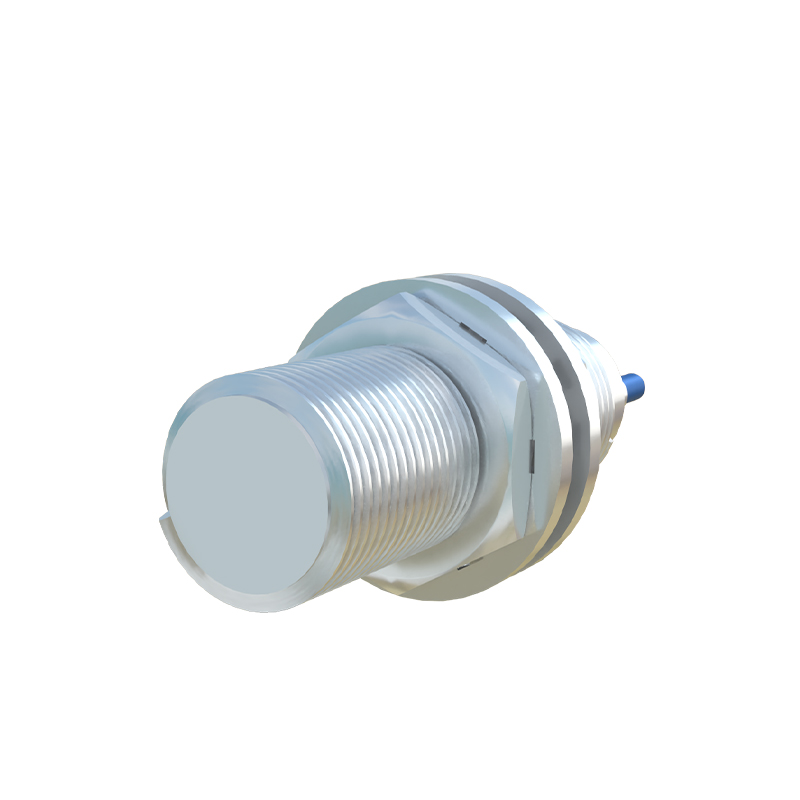
When integrating an inductive proximity sensor, several practical considerations are essential. Mounting is crucial; flush-mountable sensors can be installed without lateral clearance, while non-flush types require space around the sensing face for their extended field. Target material and size directly affect performance; the target should generally be larger than the sensor's face for maximum range. Environmental factors such as extreme temperatures, strong adjacent electromagnetic fields, or the presence of different metals in the mounting hardware can influence operation. Proper electrical considerations, including reverse polarity protection, short-circuit protection, and load current limits, must be observed to prevent damage.
Applications are vast and varied. They are used for position verification (is a part in place?), end-of-travel detection on linear actuators, counting metal objects on a conveyor, rotational speed monitoring via a gear tooth, and as a safety interlock to confirm a guard door is closed. In high-speed bottling lines, they detect metal caps. In robotic welding cells, they confirm the presence of a metal workpiece before an arc is struck.
In conclusion, inductive proximity sensors represent a perfect marriage of electromagnetic theory and practical engineering. Their ability to provide wear-free, high-speed, and reliable detection of metals in harsh environments makes them a cornerstone of industrial efficiency and automation reliability. Understanding their principle, specifications, and application nuances is key for engineers to design robust, maintenance-friendly, and highly productive automated systems.