Laser scanning and positioning sensors are pivotal components in modern industrial automation, offering unparalleled precision, speed, and reliability. These sensors operate by emitting a laser beam that scans across a target area. The reflected light is captured and analyzed to determine precise distances, dimensions, and positions of objects. This technology is fundamental in applications ranging from robotics and quality control to logistics and autonomous guided vehicles (AGVs).
The core principle involves time-of-flight (ToF) or triangulation methods. In ToF systems, the sensor calculates distance by measuring the time it takes for the laser pulse to travel to the target and back. This method is excellent for long-range measurements. Triangulation, on the other hand, uses a laser emitter, a receiver (like a CCD or CMOS array), and known geometric angles to compute position. It excels in high-accuracy, short to medium-range scenarios. The choice between these methods depends on specific application requirements such as range, resolution, environmental conditions, and cost.
In manufacturing, laser scanners are integral for dimensional gauging and defect detection. They can rapidly scan product surfaces, comparing the data against digital models to identify micron-level deviations. This ensures consistent quality and reduces waste. In robotic guidance, these sensors provide real-time 3D positional data, enabling robots to accurately pick, place, and assemble components with minimal human intervention. For instance, in automotive assembly lines, scanners guide robots to weld or apply sealants with exact precision along complex contours.
Logistics and warehousing have been revolutionized by laser positioning sensors. AGVs and autonomous mobile robots (AMRs) use them for navigation and pallet identification. By creating detailed maps of their surroundings, these vehicles can avoid obstacles and optimize routes dynamically. Furthermore, in inventory management, fixed scanners read barcodes or measure parcel dimensions at high speeds on conveyor belts, streamlining sorting and shipping processes.
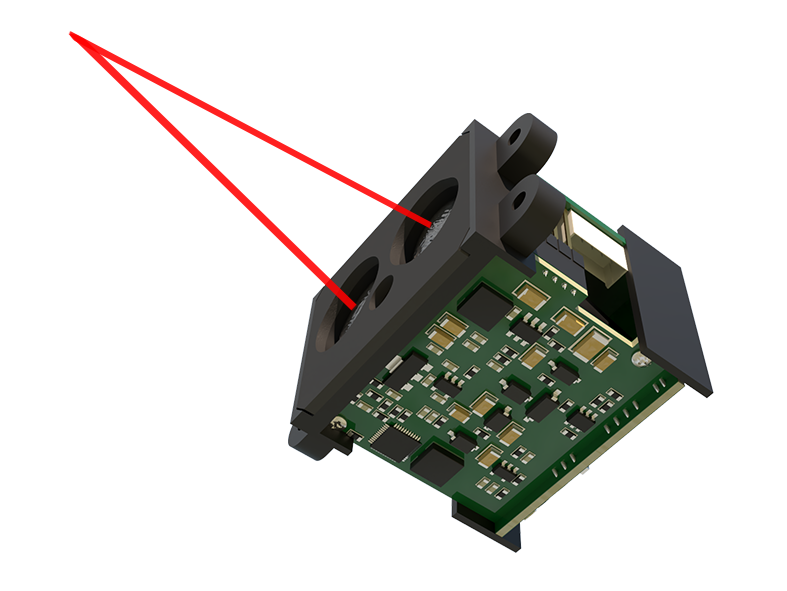
Environmental robustness is a key advantage. Modern laser sensors are designed to withstand harsh industrial environments—resistant to dust, vibrations, and variable lighting conditions. However, certain materials, like transparent or highly reflective surfaces, can pose challenges. Advanced models incorporate filtering algorithms and multiple echo evaluation to handle such difficult surfaces effectively.
Integration with Industry 4.0 frameworks is another significant trend. Laser scanners often feature Ethernet/IP, PROFINET, or IO-Link interfaces, allowing seamless data exchange with PLCs and higher-level systems like MES or SCADA. This connectivity enables predictive maintenance, where sensor data can forecast potential failures before they cause downtime.
Looking ahead, advancements in miniaturization, faster processing speeds, and enhanced software algorithms are pushing the boundaries. The integration of artificial intelligence for adaptive learning and decision-making at the edge is set to make these sensors even more intelligent and autonomous.
In conclusion, laser scanning and positioning sensors are indispensable tools driving efficiency and accuracy in automation. Their ability to deliver precise, real-time spatial data underpins smarter, more flexible, and more productive industrial operations. Engineers must carefully evaluate factors like measurement range, accuracy, scanning frequency, and environmental compatibility to select the optimal sensor for their specific application, ensuring maximum return on investment and operational excellence.