In the realm of industrial automation and precision measurement, high-precision laser distance sensors have emerged as indispensable tools. These sophisticated devices offer non-contact, rapid, and highly accurate distance measurement capabilities, revolutionizing processes across manufacturing, robotics, logistics, and quality control. Unlike traditional mechanical probes or ultrasonic sensors, laser sensors utilize the principle of optical triangulation or time-of-flight to achieve micron-level resolution with exceptional reliability.
The core operating principle of most high-precision laser sensors is optical triangulation. A laser diode projects a visible or invisible focused spot onto the target object. The light reflected from this spot is captured by a receiving lens at a specific angle and focused onto a position-sensitive detector, typically a CMOS or CCD array. As the distance to the target changes, the position of the reflected spot on the detector shifts linearly. This positional shift is analyzed by the sensor's internal processor to calculate the exact distance with extreme accuracy. For longer ranges, pulsed time-of-flight (ToF) principles are often employed, where the sensor measures the time delay between emitting a laser pulse and receiving its reflection.
The advantages of these sensors are manifold. Their non-contact nature eliminates wear and tear, prevents damage to delicate surfaces, and allows measurement of hot, moving, or inaccessible objects. They provide extremely high sampling rates, enabling real-time feedback for dynamic control systems. Modern sensors are equipped with advanced features like background suppression, which filters out ambient light and irrelevant background objects, and programmable measurement windows for targeting specific areas. Communication is facilitated through standard industrial interfaces such as IO-Link, analog outputs (4-20mA, 0-10V), and digital protocols like RS-232, Ethernet/IP, or PROFINET, ensuring seamless integration into PLCs and control networks.
Applications are vast and critical. In automotive assembly, they ensure precise gap and flush measurement between body panels. In electronics manufacturing, they verify component placement height and PCB warpage. Robotics rely on them for precise positioning, bin-picking guidance, and collision avoidance. In logistics, they measure package dimensions for volumetric weighing and sortation. They are also pivotal in roll diameter monitoring, wafer alignment in semiconductor fabrication, and thickness measurement of continuous materials like paper, glass, or metal sheets.
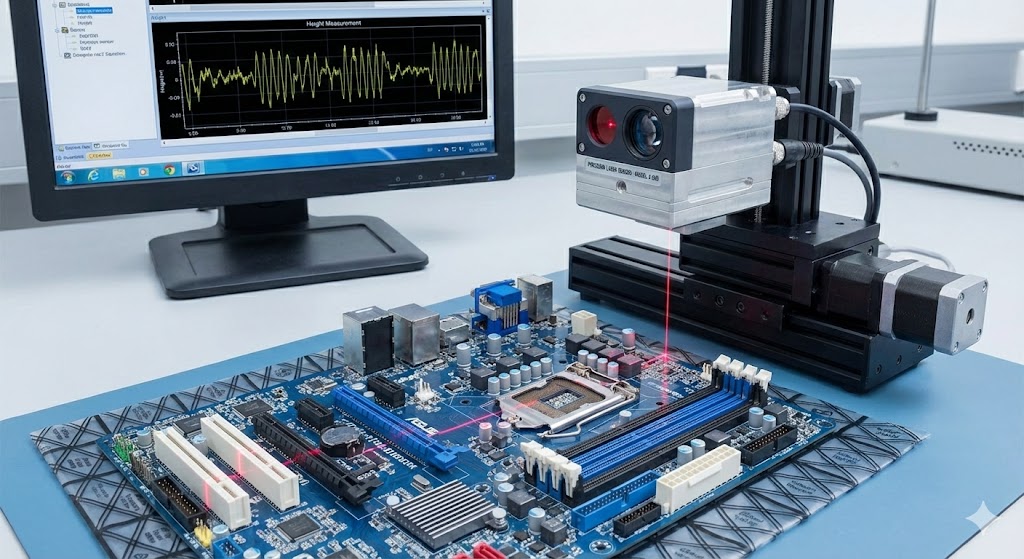
Selecting the right high-precision laser sensor requires careful consideration of several key parameters. Measuring Range defines the minimum and maximum distances the sensor can handle. Resolution indicates the smallest detectable distance change, critical for ultra-fine measurements. Linear Accuracy specifies the maximum deviation from the true distance across the entire range. Spot Size is crucial for measuring small features or textured surfaces; a smaller spot allows for higher precision on edges. Response Time or sampling rate determines how quickly the sensor can update its measurement, essential for high-speed production lines. Environmental factors like ambient light, temperature fluctuations, dust, and the target's surface properties (color, reflectivity, material) must also be evaluated. Many sensors offer automatic teaching functions to compensate for different surface colors and textures.
Installation and maintenance are straightforward but vital for optimal performance. Ensure the sensor is mounted securely to minimize vibration. The laser beam must be perpendicular to the target surface for accurate triangulation-based measurements. Keep the lens clean from dust and oil mist using appropriate compressed air or lint-free cloths. Regular calibration against a known reference, as recommended by the manufacturer, maintains long-term accuracy. Utilizing protective housings (IP67 rated) is advisable in harsh industrial environments.
The future of laser distance sensing is geared towards even smarter, more integrated solutions. Trends include miniaturization of sensor heads, enhanced connectivity for Industry 4.0 data acquisition, multi-point measurement in a single unit, and embedded intelligence for edge computing tasks like pass/fail decision-making. As tolerance requirements tighten and automation becomes more pervasive, the role of the high-precision laser distance sensor will only grow more central, driving efficiency, quality, and innovation in modern industrial operations.