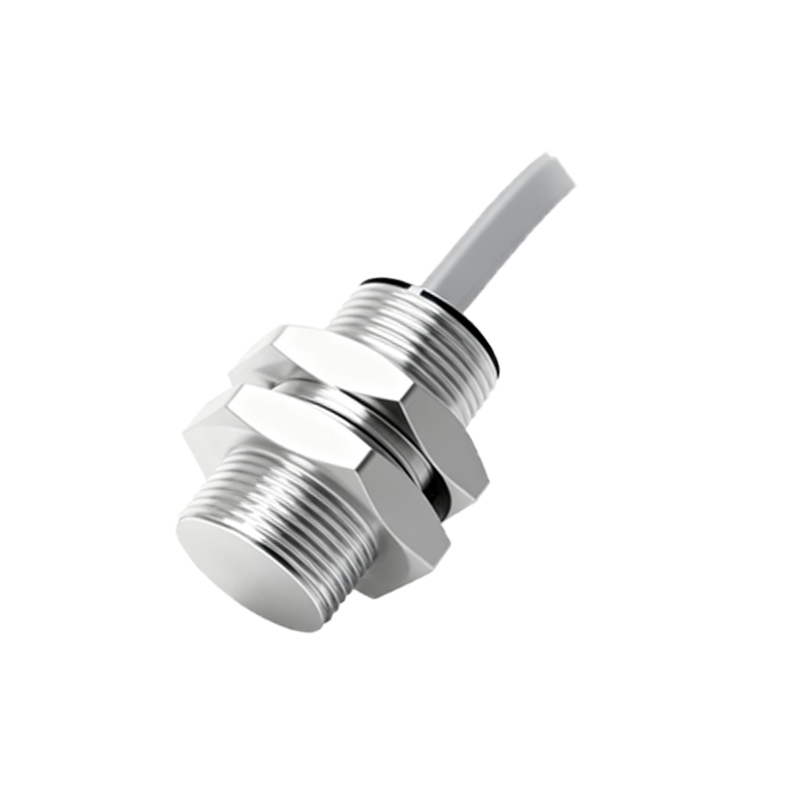
In industrial automation, robotics, and countless electronic devices, proximity sensors play a crucial role by detecting the presence or absence of an object within a specific range without physical contact. This non-contact detection offers significant advantages in terms of reliability, speed, and longevity. While there are many specific technologies, most proximity sensors can be broadly classified into three fundamental categories based on their underlying operating principles: inductive, capacitive, and photoelectric sensors. Understanding these categories is key to selecting the right sensor for any application.
The first and perhaps most common category in industrial settings is the inductive proximity sensor. These sensors are designed to detect metallic objects, primarily ferrous metals like steel and iron, though some specialized versions can detect non-ferrous metals. The core of an inductive sensor is a coil wound around a ferrite core, which forms part of an oscillator circuit. When an alternating current flows through this coil, it generates an oscillating electromagnetic field at the sensor's face. When a conductive metal object enters this field, eddy currents are induced on the surface of the object. These eddy currents draw energy from the sensor's oscillator, causing a change in its amplitude. The sensor's internal circuitry monitors this amplitude change and triggers a solid-state switch to signal the object's detection. Inductive sensors are highly valued for their robustness, resistance to environmental factors like dust, oil, and moisture, and their exceptional repeatability. They are typically used for tasks like counting metal parts, detecting piston position in cylinders, or as limit switches in machinery. Their main limitation is their exclusive sensitivity to metals.
To overcome the limitation of inductive sensors, the second category, capacitive proximity sensors, were developed. These sensors can detect virtually any material: metals, plastics, glass, wood, liquids, and granular substances. They operate on the principle of capacitance, which is the ability of a system to store an electrical charge. A capacitive sensor functions like an open capacitor. Its sensing surface consists of two conductive electrodes (often arranged concentrically) that generate an electrostatic field. When any object with a dielectric constant different from air enters this field, it alters the capacitance of the system. The sensor's circuitry is tuned to a specific threshold of capacitance change. When this threshold is exceeded—meaning an object is present—the sensor activates its output switch. The sensing distance can be influenced by the material's density and dielectric properties; for instance, water has a high dielectric constant and is easily detected. This makes capacitive sensors ideal for applications like liquid level detection in non-metallic tanks, monitoring presence of paper, wood, or plastic materials, and even detecting a human hand. They are, however, more susceptible to false triggers from humidity or contaminant buildup on the sensor face.
The third major category is photoelectric sensors, which use light to detect objects. This category offers the greatest variety and longest sensing ranges. The basic principle involves emitting a beam of light (usually infrared, visible red, or laser) from a transmitter and using a receiver to detect changes in the received light signal. Photoelectric sensors are further subdivided into three main operational modes. The first is through-beam, which consists of separate transmitter and receiver units placed opposite each other. Detection occurs when the object breaks the light beam. This mode offers the longest range and highest reliability. The second is retro-reflective, where the transmitter and receiver are housed in the same unit, and a reflector bounces the light beam back. An object is detected when it interrupts the beam to the reflector. The third and most common is diffuse (or proximity) mode, where the transmitter and receiver are again in one housing. The sensor detects light reflected directly off the target object itself. Advanced versions use background suppression or time-of-flight technology for precise distance-based detection. Photoelectric sensors can detect objects of almost any material, color, or surface finish, though performance varies with reflectivity. They are widely used in packaging, material handling, assembly line counting, and safety systems.
In summary, the world of non-contact detection is dominated by these three pillars. Inductive sensors are the specialists for metallic targets in harsh environments. Capacitive sensors are the generalists, capable of sensing a vast array of materials, including liquids. Photoelectric sensors are the versatile long-range experts, adaptable to countless scenarios with different light beam configurations. The choice between them depends entirely on the target material, required sensing distance, environmental conditions, and the specific demands of the application. By starting with this fundamental three-category framework, engineers and technicians can effectively navigate the vast selection of proximity sensing solutions available today.