Laser distance sensors have become indispensable in modern industrial automation, offering high precision, rapid response, and non-contact measurement capabilities. The core of these sensors lies in their sophisticated algorithms, which process raw optical data to deliver accurate distance readings. This article delves into the key algorithms used in laser distance sensors, exploring their principles, applications, and advancements.
The fundamental operation of a laser distance sensor involves emitting a laser beam toward a target and measuring the time it takes for the reflected light to return. This time-of-flight (ToF) method is widely adopted due to its simplicity and effectiveness. The basic ToF algorithm calculates distance using the formula: distance = (speed of light × time delay) / 2. However, real-world implementations require robust algorithms to handle noise, environmental interference, and varying surface properties. One common enhancement is the phase-shift method, where the laser beam is modulated with a sinusoidal wave. By comparing the phase difference between the emitted and reflected signals, the sensor can achieve sub-millimeter accuracy. This algorithm is particularly useful in applications like 3D scanning and robotic guidance, where precision is critical.
Another prominent algorithm is triangulation, often employed in short-range sensors. Here, the laser emitter, target, and receiver form a triangle. The receiver detects the position of the reflected laser spot on a sensor array, and geometric calculations determine the distance. Triangulation algorithms must account for lens distortions and calibration errors, often incorporating correction factors through iterative processing. This approach is favored in quality control systems, such as inspecting component dimensions on assembly lines, due to its high resolution at close ranges.
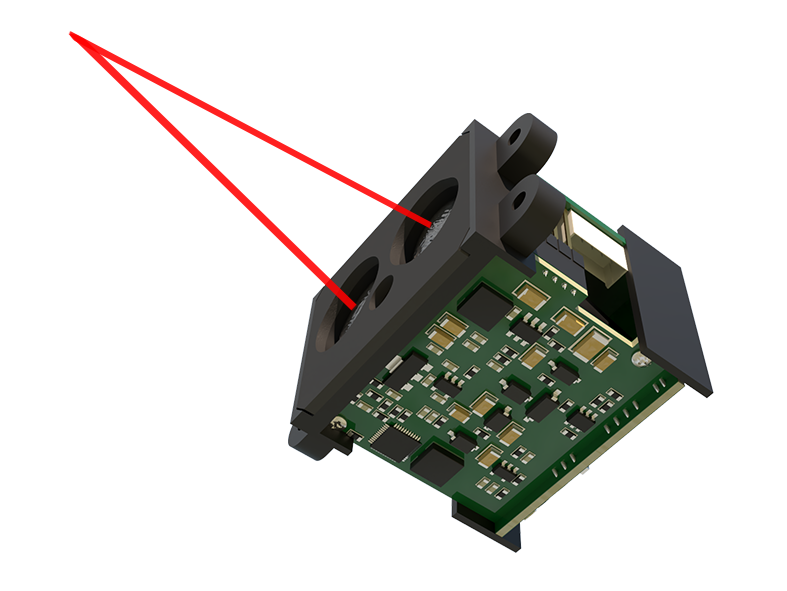
For environments with multiple targets or reflective surfaces, advanced algorithms like pulse modulation and frequency-modulated continuous wave (FMCW) are utilized. Pulse modulation algorithms use short, high-intensity laser pulses and precise timing circuits to distinguish between overlapping returns, enabling measurements in cluttered spaces. FMCW algorithms, on the other hand, modulate the laser frequency linearly over time and analyze the beat frequency between emitted and reflected waves. This allows for simultaneous distance and velocity measurements, making it ideal for dynamic applications like autonomous vehicle navigation and conveyor belt monitoring.
Machine learning and artificial intelligence are increasingly integrated into laser sensor algorithms to enhance adaptability. Neural networks can be trained to filter out ambient light interference or classify surface materials, improving reliability in unpredictable conditions. For instance, in logistics automation, AI-driven algorithms help sensors accurately measure parcel dimensions despite varying colors and textures. Additionally, real-time signal processing algorithms, such as Kalman filters, are used to smooth data streams and reduce jitter, ensuring stable outputs in vibrating industrial settings.
The choice of algorithm depends on factors like range, accuracy requirements, and cost. ToF algorithms are cost-effective for medium-range applications, while triangulation excels in high-precision, short-range tasks. FMCW offers versatility for complex scenarios but at a higher computational cost. As industries evolve toward smart manufacturing and IoT integration, algorithm development focuses on energy efficiency and interoperability. Future trends may include quantum-enhanced algorithms for ultra-precise measurements or hybrid models combining multiple techniques.
In summary, laser distance sensor algorithms are the backbone of their performance, transforming raw light signals into actionable data. From basic ToF to AI-enhanced systems, these algorithms enable diverse applications across manufacturing, robotics, and beyond. Engineers must select and optimize algorithms based on specific needs to harness the full potential of laser sensing technology, driving innovation in automation and measurement science.