In the rapidly evolving landscape of industrial automation, measurement, and safety systems, laser sensors have established themselves as indispensable tools. Among their varied specifications, the sensing range is a critical parameter that defines their applicability. Laser sensors with a 50-meter measurement range represent a significant category, bridging the gap between short-range proximity devices and ultra-long-range telemetry systems. This article delves into the technology, operational principles, key considerations, and diverse applications of these powerful 50m laser sensors.
At their core, 50-meter range laser sensors operate on the principle of time-of-flight (ToF) or phase-shift measurement for distance calculation. A laser diode emits a focused beam of coherent light toward a target. The sensor's photodetector then captures the light reflected back. By precisely measuring the time delay between emission and reception (ToF) or the phase difference in a modulated signal, the sensor's internal processor calculates the distance to the target with high accuracy. The achievement of a consistent 50-meter range requires careful engineering of the laser's power, the receiver's sensitivity, and advanced signal processing algorithms to filter out ambient light noise and handle varying surface reflectivities.
Several technical factors are paramount when selecting and deploying a 50m laser sensor. Accuracy and resolution are primary concerns. While capable of measuring up to 50 meters, the sensor's precision (e.g., ±10 mm) and resolution (the smallest detectable change in distance) are crucial for applications like positioning or profiling. The laser's wavelength, typically in the visible red or near-infrared spectrum, affects its visibility and performance in different environments. Beam quality and spot size are also important; a small, well-defined spot allows for precise measurement of small objects or edges. Furthermore, environmental robustness is essential. Industrial-grade sensors must feature high Ingress Protection (IP) ratings (e.g., IP67) to withstand dust, moisture, and often a wide operating temperature range. The response time, or measurement speed, determines how quickly the sensor can update its reading, which is vital for dynamic processes or high-speed automation.
The applications for 50-meter range laser sensors are vast and span multiple industries. In industrial automation and logistics, they are used for warehouse management, measuring the height of stacked goods on pallets, and guiding automated guided vehicles (AGVs) by detecting landmarks or obstacles at a distance. In the construction and mining sectors, these sensors facilitate volume measurement of bulk materials like gravel or coal in large stockpiles, as well as monitoring slopes and excavations for safety. Forestry and agriculture employ them for terrain mapping, tree height measurement, and monitoring crop growth. A growing application area is traffic management and vehicle safety, where they can be integrated into systems for vehicle counting, speed detection, and as part of the sensor suite for autonomous vehicle research, providing mid-range object detection.
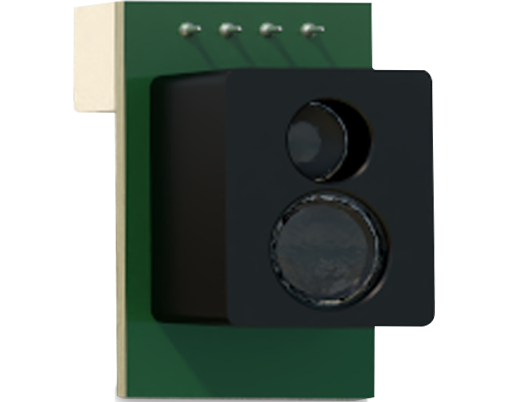
When integrating a 50m laser sensor into a system, practical considerations must be addressed. Alignment can be challenging over long distances; models with a visible laser spot or integrated alignment aids are highly beneficial. The reflectivity of the target surface significantly impacts performance. Dark, matte, or absorbent surfaces return less light, potentially reducing the effective range or requiring sensors with automatic gain control. For outdoor use, protection against direct sunlight, rain, and fog is necessary, and some sensors offer special filters or operating modes for such conditions. Finally, output interfaces (analog 4-20mA, 0-10V, or digital like RS-485, Ethernet, IO-Link) must be compatible with the existing control system for seamless data integration.
In conclusion, 50-meter range laser sensors are versatile, high-performance instruments that solve complex measurement and detection challenges across numerous fields. Their ability to provide precise, non-contact distance data over a substantial range makes them a key enabler for automation, safety, and data-driven operations. As laser and processing technologies continue to advance, we can expect these sensors to become even more accurate, robust, and intelligent, further expanding their role in shaping the future of industrial and technological ecosystems. Understanding their capabilities and limitations is the first step toward leveraging their full potential in any demanding application.