In the rapidly evolving landscape of industrial automation and precision engineering, variable pitch laser sensors have emerged as a cornerstone technology, enabling unprecedented levels of accuracy, flexibility, and efficiency. Unlike traditional fixed-configuration sensors, these advanced devices dynamically adjust their measurement pitch—the distance between successive measurement points—based on the target's surface characteristics, speed, and the required resolution. This adaptive capability is fundamentally transforming quality control, robotic guidance, and dimensional inspection across sectors from automotive manufacturing to semiconductor fabrication.
The core operational principle hinges on sophisticated laser triangulation. A laser diode projects a precise beam onto the target surface. The reflected light is captured by a high-resolution CMOS or CCD array at a known angle. By calculating the displacement of the laser spot on the sensor array, the system determines the exact distance to the target. What sets variable pitch sensors apart is their integrated processor and software algorithms, which analyze the initial scan data in real-time to optimize the pitch for subsequent measurements. For instance, when scanning a complex contour with both flat surfaces and sudden recesses, the sensor can automatically increase the point density (reduce pitch) in high-detail areas while using a sparser pitch (increase pitch) on uniform sections. This intelligent data acquisition maximizes detail where needed without generating redundant data, drastically reducing processing load and cycle time.
Key advantages are manifold. First, they offer exceptional versatility. A single variable pitch sensor can replace multiple fixed-pitch units, simplifying system design and reducing hardware costs. In automotive body-in-white inspection, this allows for comprehensive weld seam analysis, panel gap measurement, and surface flaw detection in one integrated pass. Second, they enhance measurement accuracy on challenging surfaces. By adapting to different reflectivities, colors, and textures—such as glossy paint, matte composites, or transparent films—they maintain consistent signal quality, minimizing errors common with static sensors. Third, they significantly boost throughput. In high-speed production lines, like bottling or electronics assembly, the sensor can switch to a larger pitch during stable phases to maintain speed, then instantly tighten the pitch to capture critical features, ensuring no compromise between speed and precision.
Implementation requires careful consideration. Integration with programmable logic controllers (PLCs) and industrial PCs is typically seamless via standard interfaces like Ethernet/IP, PROFINET, or IO-Link. However, engineers must calibrate the sensor's parameters—such as baseline pitch, adaptive thresholds, and filtering options—to match the specific application. Environmental factors like ambient light, vibration, and temperature fluctuations must also be mitigated, often through built-in compensation algorithms and protective housings rated to IP67 standards.
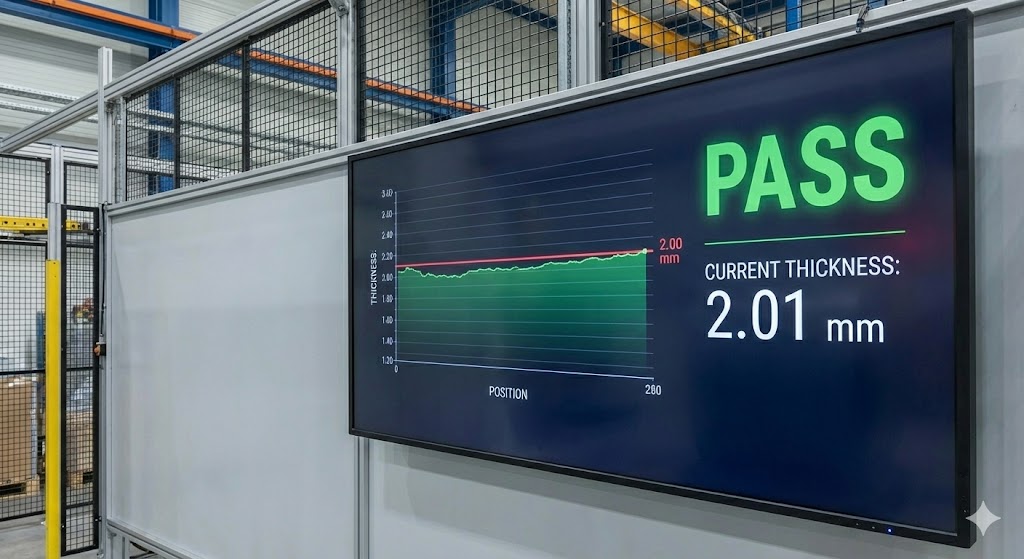
Looking ahead, the convergence of variable pitch technology with artificial intelligence and Industrial Internet of Things (IIoT) platforms is paving the way for predictive maintenance and autonomous optimization. Sensors can now learn from historical data to pre-adjust pitch patterns for known part geometries, further reducing setup times. As industries push toward tighter tolerances and smarter factories, variable pitch laser sensors stand as a pivotal enabler, offering the dynamic precision necessary to navigate the complexities of modern manufacturing. Their continued evolution promises even greater integration, making them indispensable tools for achieving the next frontier in quality and efficiency.