Single-shot laser sensors represent a critical advancement in precision measurement and detection technologies, widely utilized across manufacturing, automation, and quality control sectors. These sensors operate by emitting a single, focused laser pulse toward a target, capturing the reflected signal to determine parameters such as distance, position, thickness, or presence of an object. Unlike continuous-wave lasers, single-shot lasers provide discrete, high-energy pulses that minimize interference from ambient light and reduce thermal effects on both the sensor and target, making them ideal for dynamic or high-speed environments.
The core mechanism involves time-of-flight (ToF) or triangulation principles. In ToF-based sensors, the time delay between the emitted pulse and its return is calculated to measure distance with micron-level accuracy. Triangulation methods, on the other hand, use the angle of reflection to determine position, offering high resolution for surface profiling. Key components include a laser diode for pulse generation, a photodetector for signal reception, and a processor for real-time data analysis. This design ensures rapid response times—often in microseconds—enabling applications in robotics alignment, conveyor belt monitoring, and semiconductor inspection where speed and precision are paramount.
Advantages of single-shot laser sensors include their immunity to environmental factors like dust or vibration, thanks to the pulsed nature reducing signal degradation. They also consume less power compared to continuous emission systems, enhancing longevity in industrial setups. However, challenges persist, such as sensitivity to highly reflective or absorbent surfaces, which may require calibration or complementary sensors. Modern iterations integrate smart features like adaptive pulse tuning and IoT connectivity, allowing for predictive maintenance and integration into Industry 4.0 frameworks.
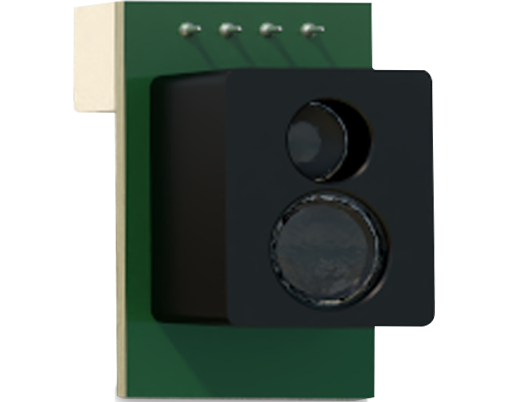
In practice, these sensors are deployed in automotive assembly lines for gap detection, in packaging industries for fill-level checks, and in aerospace for component alignment. Case studies show that implementing single-shot sensors can reduce error rates by up to 30% in production workflows. As technology evolves, trends point toward miniaturization, enhanced wavelength ranges for material versatility, and AI-driven analytics for anomaly detection. Engineers selecting these sensors must consider factors like target material, required accuracy, and environmental conditions to optimize performance. Overall, single-shot laser sensors are indispensable tools driving efficiency and innovation in modern industrial ecosystems, bridging the gap between manual oversight and fully automated precision.