In the landscape of industrial automation, sensors are the fundamental components that bridge the physical world with control systems. Among the diverse sensor technologies available, retro-reflective laser sensors stand out for their precision, long-range capability, and reliability in demanding environments. This article delves into the operational principles, key advantages, common applications, and critical selection factors for these sophisticated devices.
At its core, a retro-reflective laser sensor operates on a straightforward optical principle. The sensor unit houses both a laser light emitter and a receiver. The emitter projects a focused, coherent laser beam towards a specifically designed retro-reflector, often a corner-cube prism or a specialized reflective tape. This reflector is engineered to return the incident light beam directly back to its source along a parallel path, regardless of the angle of incidence within a specified range. The receiver in the sensor head continuously monitors for this returned signal. An object passing between the sensor and the reflector interrupts this beam, causing a detectable drop in the received light intensity, which triggers the sensor's output.
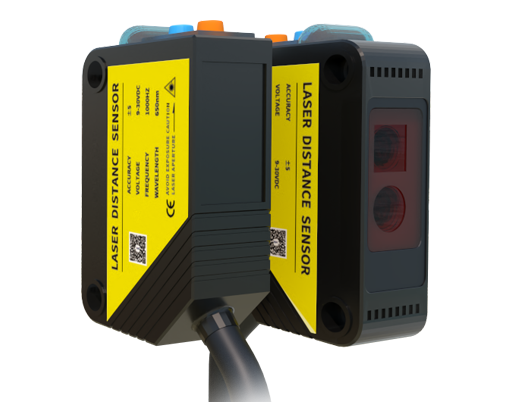
The primary advantage of this configuration over through-beam sensors (which require separate emitter and receiver units) is simplified installation and alignment. Only one device needs to be wired and mounted, with the passive reflector placed opposite. Compared to diffuse reflective sensors, which detect light reflected directly off the target object, retro-reflective laser models offer significantly longer sensing distances—often ranging from several meters to over tens of meters—and are less susceptible to variations in the target object's color, texture, or surface finish. The laser's coherent light provides a sharp, visible beam for easy alignment and allows for precise detection of small objects.
Key performance specifications define a retro-reflective laser sensor's capability. Sensing distance, the maximum operable range between the sensor and reflector, is paramount. Beam spot size, extremely small with lasers, enables high-resolution detection. Response time, typically in the microsecond range, allows for high-speed counting or positioning tasks. Many advanced models incorporate background suppression technology or adjustable sensitivity to ignore distant background objects and the reflector itself, focusing detection only within a defined "window." Additionally, features like programmable logic, teach-in functions for setting thresholds, and robust housing ratings (IP67, IP69K) are common in industrial-grade units.
The applications for retro-reflective laser sensors are vast across manufacturing and logistics. They are indispensable in packaging lines for detecting the presence of products on conveyors, verifying case sealing, or counting items. In material handling, they control palletizing and depalletizing robots by providing precise position feedback. They serve as safety components in automated guided vehicle (AGV) systems for obstacle detection or docking guidance. In automotive assembly, their precision is leveraged for gap and flush measurement between body panels. Furthermore, they are used in warehouse automation for high-bay storage retrieval system positioning and door control systems.
Selecting the appropriate retro-reflective laser sensor requires a careful analysis of the application parameters. First, determine the required sensing distance and ensure the chosen model's specification includes a sufficient margin. The size and nature of the target object are critical; very small or transparent objects may require sensors with higher sensitivity or specialized laser wavelengths. Environmental conditions cannot be overlooked. Factors such as ambient light (sunlight, welding arcs), dust, fog, steam, or temperature extremes can affect performance. Sensors with polarized filters can mitigate interference from shiny surfaces, while rugged housings are necessary for washdown or outdoor use. Finally, the required output type (PNP/NPN, analog, IO-Link) must be compatible with the existing control system.
In conclusion, retro-reflective laser sensors represent a powerful and versatile solution for non-contact detection in industrial settings. Their combination of long range, high precision, and operational stability makes them a preferred choice for tasks where reliability is non-negotiable. By understanding their working principle and meticulously matching sensor specifications to the application's specific demands—sensing distance, object characteristics, and environmental challenges—engineers and system integrators can optimize automation processes, enhance quality control, and ensure robust system performance. As automation evolves towards greater intelligence and flexibility, these sensors will continue to be a foundational element in the smart factory ecosystem.