In the realm of industrial automation, robotics, and precise measurement, laser distance sensors have emerged as indispensable tools. These devices offer non-contact, high-speed, and highly accurate distance measurement capabilities, revolutionizing processes across numerous sectors. For engineers and technical professionals, a deep understanding of their operating principles, key specifications, and application nuances is crucial for successful integration and optimal performance.
At its core, a laser distance sensor operates by emitting a focused beam of coherent light—typically from a laser diode—towards a target object. The sensor then analyzes the reflected light to calculate the distance. The two most prevalent measurement principles are Time-of-Flight (ToF) and triangulation. The Time-of-Flight method measures the time delay between the emission of a laser pulse and the detection of its reflection. Given the constant speed of light, this time interval is directly proportional to the distance traveled. ToF sensors are excellent for long-range measurements, often up to several hundred meters, with typical accuracies in the millimeter to centimeter range. They are widely used in applications like vehicle LiDAR, warehouse inventory management, and large-scale surveying.
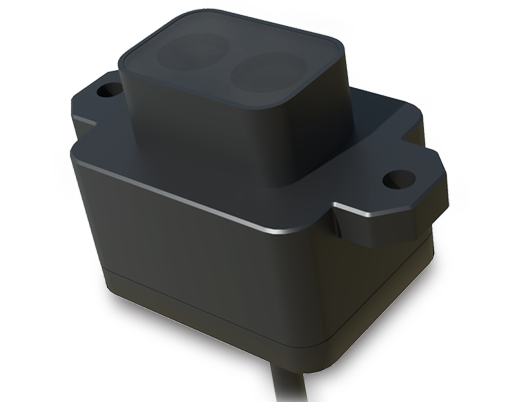
The triangulation principle, on the other hand, is preferred for short to medium-range measurements requiring high precision. Here, the laser emitter, the reflected spot on the target, and a receiving lens/CCD array form a triangle. By knowing the fixed baseline distance between the emitter and receiver and measuring the angle of the reflected beam, the sensor's internal processor calculates the distance with remarkable accuracy, often down to the micrometer level. This makes triangulation sensors ideal for tasks such as checking part thickness, monitoring vibration or deformation, and guiding assembly robots.
Key performance parameters demand careful consideration during sensor selection. Measurement Range defines the minimum and maximum distances over which the sensor can operate reliably. Accuracy and Resolution are often confused; accuracy refers to the closeness of the measurement to the true value, while resolution is the smallest change in distance the sensor can detect. Repeatability indicates the sensor's consistency in returning the same value for the same distance under unchanged conditions. The Response Time or sampling rate is critical for dynamic applications, determining how quickly the sensor can update its measurement output. Furthermore, environmental factors like ambient light, target surface properties (color, reflectivity, texture), and the presence of dust or steam can significantly impact performance. Modern sensors incorporate features like background suppression and specialized filters to mitigate these challenges.
The application landscape for laser distance sensors is vast and growing. In industrial automation, they are pivotal for precise positioning of robotic arms, conveyor belt monitoring, and fill level control in tanks or silos. In the automotive industry, they are integral to advanced driver-assistance systems (ADAS) and assembly line quality checks. The construction sector utilizes them for alignment, volume calculation, and monitoring structural distances. Even in consumer electronics, they enable features like autofocus enhancement and gesture recognition.
When selecting a laser distance sensor for a specific project, engineers must conduct a thorough requirements analysis. Start by defining the required measurement range, accuracy, and speed. Evaluate the target characteristics: Is it dark, shiny, transparent, or at an angle? Assess the operating environment for temperature extremes, humidity, or potential contaminants. The output interface (analog voltage/current, digital protocols like IO-Link, Ethernet/IP, or PROFINET) must be compatible with the existing control system. Finally, consider mechanical aspects such as housing material (often IP67-rated for industrial durability), mounting options, and cable connections.
Looking ahead, advancements in laser technology and signal processing continue to push the boundaries. Sensors are becoming smaller, more energy-efficient, and smarter with integrated diagnostics and connectivity for Industry 4.0 frameworks. The integration of multi-pixel ToF sensors is enabling not just distance measurement but also 3D profiling and scene analysis. For the engineering community, staying abreast of these developments is key to leveraging the full potential of laser distance sensing technology, driving innovation, and enhancing precision in an increasingly automated world.