In the realm of industrial automation and precision measurement, laser sensors have become indispensable tools due to their high accuracy, non-contact operation, and reliability. Designing a laser sensor, while often perceived as complex, can be approached through a simplified methodology that balances performance with practicality. This article outlines a straightforward design framework suitable for engineers and technicians seeking to implement laser sensing solutions in various industrial settings.
The core of a laser sensor design revolves around three fundamental components: the laser source, the detection system, and the signal processing unit. For the laser source, selecting an appropriate type is critical. Common choices include visible red lasers (e.g., 650 nm wavelength) for alignment and basic detection, or infrared lasers (e.g., 850 nm or 905 nm) for applications requiring less ambient light interference. Diode lasers are widely preferred due to their compact size, low power consumption, and cost-effectiveness. A key consideration is the output power, which must comply with safety standards (e.g., Class 1 or Class 2 under IEC 60825) to ensure eye safety in industrial environments. The laser beam is typically collimated using a simple lens system to maintain a focused spot over the desired measurement range, reducing divergence and enhancing accuracy.
The detection system captures the laser light after it interacts with the target. For reflective-based sensors, a photodetector—such as a photodiode or phototransistor—is positioned to receive the reflected beam. The choice between analog and digital detection depends on the application. Analog sensors provide continuous output proportional to the received light intensity, useful for distance measurement or contrast detection. Digital sensors, on the other hand, offer a binary output (on/off) ideal for object presence detection or counting tasks. To improve signal-to-noise ratio, especially in environments with ambient light, optical filters matching the laser wavelength can be incorporated. Additionally, a basic housing with alignment features ensures stable mounting and protects components from dust, moisture, and mechanical shocks.
Signal processing is where raw data transforms into usable information. A simple microcontroller (e.g., an Arduino or PIC-based system) can be employed to handle tasks like analog-to-digital conversion, threshold comparison, and output generation. For instance, in a proximity sensor design, the microcontroller monitors the photodetector's voltage. When the voltage exceeds a set threshold—indicating an object within range—it triggers a digital output signal. Calibration is essential here; by adjusting the threshold based on real-world testing, one can account for variations in target reflectivity or environmental conditions. Power management is another aspect: incorporating voltage regulators and low-power modes can extend sensor lifespan in battery-operated setups.
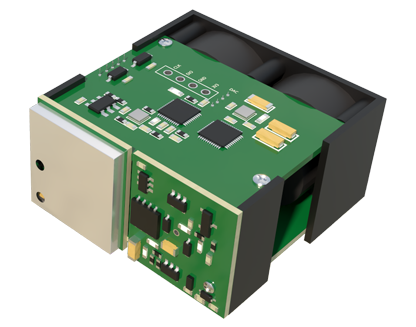
Practical implementation often involves iterative testing. Start by prototyping on a breadboard, using off-the-shelf laser modules and detector boards. Evaluate performance under typical operating conditions—consider factors like target material (e.g., metal, plastic), surface finish (glossy vs. matte), and ambient lighting. For example, a sensor designed for conveyor belt object detection might require shielding from overhead lights to prevent false triggers. Documentation of test results helps refine the design, perhaps leading to adjustments in lens focal length or detector sensitivity.
In summary, a simplified laser sensor design emphasizes modularity and adaptability. By focusing on these core elements—laser source selection, robust detection, and efficient signal processing—engineers can develop custom sensors tailored to specific industrial needs without delving into overly complex optics or electronics. This approach not only reduces development time but also lowers costs, making laser technology accessible for applications ranging from manufacturing quality control to automated packaging systems. As industries continue to embrace smart automation, mastering such foundational designs empowers professionals to innovate and optimize their processes effectively.