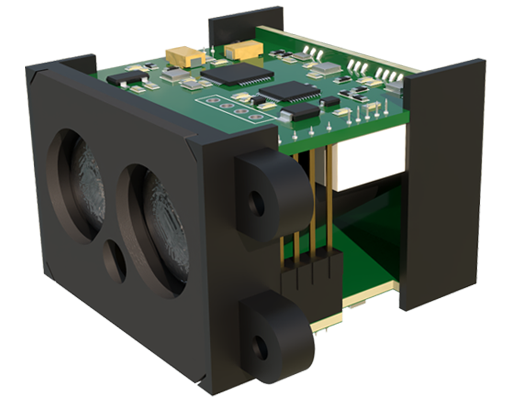
In the rapidly evolving landscape of industrial automation, measurement, and safety systems, the laser sensor has established itself as a cornerstone technology. Among its various performance metrics, range is a critical parameter. The emergence of laser sensors with a 60-meter operational range represents a significant advancement, enabling applications previously limited to more cumbersome or less precise technologies. This article delves into the operational principles, key applications, and essential selection criteria for 60-meter laser sensors, providing a comprehensive guide for engineers and system integrators.
At its core, a laser sensor operates by emitting a focused beam of coherent light—typically from a laser diode—towards a target. The sensor then detects the reflected light. For distance measurement, two primary methods are prevalent: time-of-flight (ToF) and phase-shift measurement. Time-of-flight sensors calculate distance by measuring the time interval between the emission of a laser pulse and the reception of its reflection. Given the constant speed of light, this time delay is directly proportional to twice the distance to the target. Achieving a stable and reliable 60-meter range requires highly precise timing circuitry, a sensitive photodetector, and often sophisticated signal processing algorithms to filter out ambient light noise and weak return signals. Phase-shift sensors, on the other hand, modulate the intensity of the continuous laser beam at a known frequency. The phase difference between the emitted and reflected modulated signal is measured, which correlates to the distance. This method can offer high precision at longer ranges but may have limitations with very fast-moving objects.
The extended 60-meter range unlocks a diverse array of applications across multiple sectors. In industrial automation and logistics, these sensors are indispensable for large-scale warehouse management. They enable precise positioning of automated guided vehicles (AGVs) and crane systems in vast storage facilities, ensuring efficient inventory handling and spatial awareness over long aisles. In the construction and civil engineering fields, 60-meter laser sensors facilitate high-precision surveying, monitoring structural deformations of bridges or buildings, and guiding heavy machinery for earthmoving and grading over large sites. The security and perimeter protection sector heavily relies on this technology for creating long-range intrusion detection zones, where the sensor can detect movement or the presence of objects at a considerable distance, providing early warning. Furthermore, in agricultural automation, such sensors can be used for monitoring crop levels in large silos or guiding autonomous tractors across extensive fields.
Selecting the appropriate 60-meter laser sensor for a specific application necessitates careful consideration of several technical parameters beyond just the maximum range. Accuracy and resolution are paramount; understand the difference between the sensor's absolute accuracy (deviation from true distance) and its resolution (smallest detectable change). For precise positioning tasks, sub-millimeter resolution may be required. The laser's spot size increases with distance due to divergence; a smaller divergence angle is preferable for targeting small objects at long range. The target's properties significantly influence performance. A sensor must compensate for varying reflectivity—a retro-reflective target returns a strong signal, while a dark, matte, or angled surface absorbs or scatters light, potentially reducing the effective range. Environmental robustness is non-negotiable for industrial use. Look for sensors with high Ingress Protection (IP) ratings (e.g., IP67) for dust and water resistance, wide operating temperature ranges, and resistance to vibrations. The output interface (analog 4-20mA, 0-10V, or digital protocols like RS-485, IO-Link, Ethernet/IP) must be compatible with the existing control system. Finally, consider form factor, mounting options, and the availability of configurable software for setting measurement windows, filtering, and output conditioning.
In conclusion, the 60-meter laser sensor is a powerful tool that bridges the gap between short-range precision devices and very long-range but often less accurate systems like radar. Its adoption is driven by the need for reliable, non-contact measurement over medium to long distances in challenging environments. By thoroughly understanding the underlying technology—primarily time-of-flight and phase-shift principles—and meticulously evaluating application requirements against sensor specifications for accuracy, target type, and environmental durability, engineers can effectively leverage this technology to enhance automation, safety, and efficiency in large-scale operations. As laser and detector technologies continue to advance, we can anticipate even greater ranges, higher accuracy, and more compact form factors, further solidifying the laser sensor's role in the future of industrial sensing.