Proximity sensors are fundamental components in automation, robotics, consumer electronics, and industrial safety systems. At their core, these devices detect the presence or absence of an object within a specific range without physical contact. While the underlying technology varies—including inductive, capacitive, ultrasonic, and optical methods—the operational principles can often be distilled into mathematical relationships or "formulas" that govern their sensing range, sensitivity, and output.
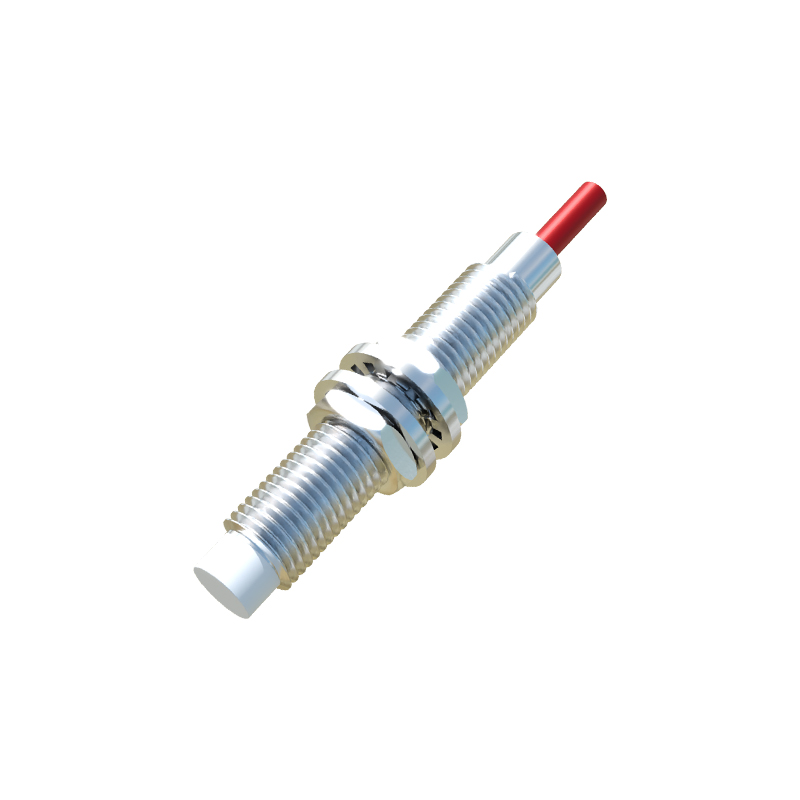
The concept of a single, universal "proximity sensor formula" is a simplification. Instead, each sensor type relies on distinct physical principles, each describable by its own set of equations. For inductive sensors, which detect metallic objects, a key relationship involves the change in oscillation amplitude within an LC tank circuit. The effective sensing distance (S) can be influenced by factors like the target material's permeability and conductivity, often summarized in adjustment factors. A basic representation for nominal range might be:S_effective = S_nominal × k_material × k_temperature, wherek factors represent corrections for specific conditions. The core electromagnetic induction is governed by Faraday's Law and the effect of eddy currents, but the practical sensing threshold is set by the circuit's ability to detect a sufficient drop in oscillation amplitude.
Capacitive sensors, used for both metallic and non-metallic targets, operate on the principle of capacitance change. The capacitance (C) between two plates is given by the formulaC = ε (A/d), where ε is the permittivity of the dielectric, A is the plate area, and d is the distance between plates. When an object enters the electric field, it alters the effective dielectric constant (ε) and thus the capacitance. The sensor triggers when this change (ΔC) exceeds a predefined threshold. The effective sensing range here is highly dependent on the target material's dielectric constant.
Ultrasonic sensors calculate distance using the time-of-flight principle. The formula is straightforward:Distance = (Speed of Sound × Time of Flight) / 2. The speed of sound in air is approximately 343 meters per second at 20°C, but it varies with temperature, humidity, and air pressure, necessitating calibration for high-precision applications. The division by two accounts for the round trip of the sound wave from the transmitter to the target and back to the receiver.
Optical proximity sensors, like infrared (IR) types, often use the inverse-square law for light intensity:I = P / (4πd²), where I is the intensity at the receiver, P is the emitted power, and d is the distance. In practice, these sensors measure the intensity of reflected light. The received signal strength is proportional to1/d² and the target's reflectivity (albedo). A sharp drop or rise in the received signal indicates an object within the detection window.
Beyond these theoretical models, practical implementation relies on embedded algorithms and hysteresis to ensure stable switching and avoid false triggers from noise. The output is typically a digital signal (ON/OFF) or an analog voltage/current proportional to distance. Key parameters derived from these formulas include:
Nominal Sensing Range (Sn): The rated operating distance under standardized conditions.
Hysteresis (H): The difference between the switch-on and switch-off points, crucial for clean signal transitions.
Repeatability: The precision with which the sensor can detect the same point under identical conditions.
Understanding these mathematical relationships is not about memorizing complex equations but about grasping the variables that affect sensor performance. For instance, knowing that capacitive sensor range changes with material permittivity explains why it detects a plastic bottle but not a dry wooden block as effectively. Similarly, the temperature dependence of the speed of sound is critical for accurate ultrasonic ranging.
In application, engineers select sensors by first defining the target material, required range, environmental conditions (like dust or moisture), and needed response time. The relevant "formula" then informs adjustments and calibrations. For example, an inductive sensor's range for aluminum will be shorter than for steel due to different conductivity, a factor embedded in its operational model. In programmable logic controllers (PLCs) and embedded systems, the analog distance signal might be processed using scaling functions likeScaled_Value = (Raw_Input - Offset) × Gain, translating sensor output into engineering units.
In conclusion, the "proximity sensor formula" is best understood as a family of physical principles translated into workable engineering models. These models empower designers to predict behavior, troubleshoot issues, and integrate these versatile devices seamlessly into systems that require reliable, non-contact detection. From the automatic doors in supermarkets to the collision avoidance systems in robots and the touchless faucets in public restrooms, the silent operation of these sensors is guided by these elegant, if often unseen, mathematical