In the realm of industrial automation and control systems, proximity sensors play a pivotal role in enabling non-contact detection of objects. Among the diverse types available, the cylindrical proximity sensor, often colloquially referred to as a "barrel" or "round" sensor, stands out for its robustness, versatility, and widespread adoption. This article delves into the operational principles, key technologies, common applications, and critical factors for selecting the right cylindrical proximity sensor for your needs.
At its core, a cylindrical proximity sensor is a device that detects the presence or absence of a target object without physical contact. It achieves this by emitting an electromagnetic field, a beam of electromagnetic radiation (like infrared light), or an ultrasonic sound wave. The sensor's internal circuitry then monitors changes in this emitted field or signal. When a target object enters the detection zone, it causes a measurable disturbance—such as a change in oscillation amplitude, capacitance, or reflected signal strength. This change is converted into an electrical output signal, typically a solid-state switch (PNP or NMP transistor) that changes state, signaling the object's presence to a programmable logic controller (PLC) or other control unit.
The most prevalent technologies embodied in cylindrical housings are inductive, capacitive, and photoelectric sensors. Inductive proximity sensors are the workhorses of metal detection. They generate an oscillating electromagnetic field from a coil at the sensing face. When a conductive metal target enters this field, eddy currents are induced in the target, which dampens the oscillation. The sensor detects this damping and triggers its output. These sensors are ideal for detecting ferrous and non-ferrous metals and are highly resistant to environmental factors like dust, oil, and moisture. Common cylindrical inductive sensors offer detection ranges from a few millimeters to several tens of millimeters.
Capacitive proximity sensors, on the other hand, can detect both metallic and non-metallic materials, including liquids, plastics, glass, and wood. They function by generating an electrostatic field. Any object with a dielectric constant different from air entering this field alters the capacitance of the sensor's circuit, triggering the output. This makes them perfect for applications like level detection in tanks or detecting filled packages on a conveyor line. Their sensing range is generally shorter than inductive sensors.
While less common in a purely cylindrical form factor than inductive types, cylindrical photoelectric sensors are also available. They use a light transmitter (usually LED) and a receiver. In the through-beam variant, the cylindrical housing contains either the emitter or receiver, and detection occurs when an object breaks the beam between two separate units. In the diffuse reflective type, both emitter and receiver are in one housing, detecting light reflected directly from the target. These are excellent for long-range detection and sensing non-metallic objects.
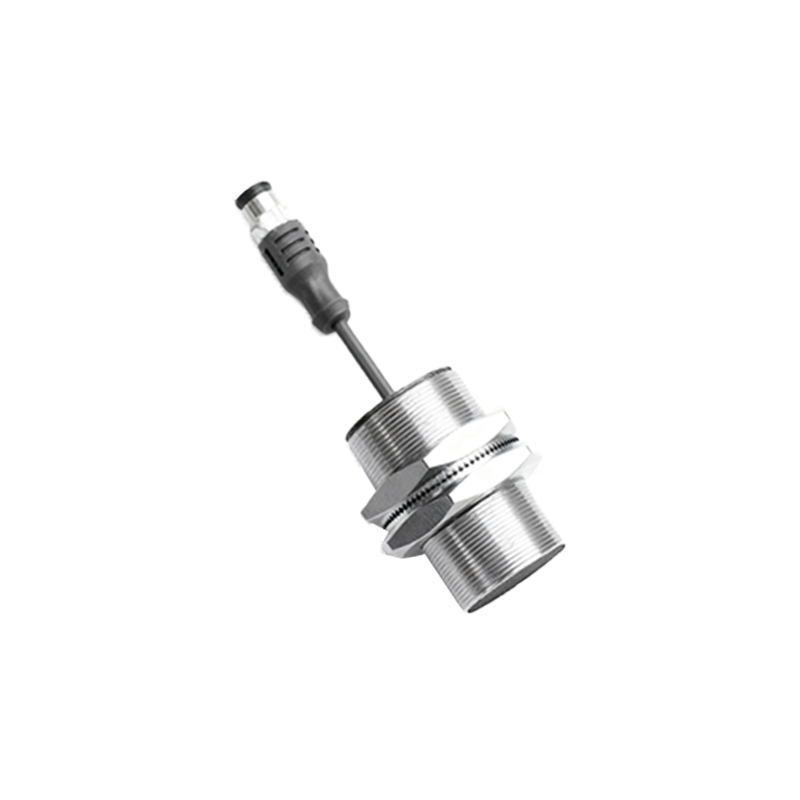
The cylindrical design offers significant engineering advantages. Its shape is inherently strong and easy to install, typically requiring just a single mounting hole. Many models feature threaded barrels (e.g., M8, M12, M18, M30 standard metric threads) for secure fastening with locknuts. This design also facilitates good sealing, leading to high Ingress Protection (IP) ratings like IP67 or IP69K, which denote resistance to dust and temporary or high-pressure water immersion—crucial for harsh industrial environments.
Applications for cylindrical proximity sensors are virtually limitless across manufacturing, packaging, material handling, and automotive industries. They are used for precise position sensing of machine parts, counting objects on a production line, verifying the presence of a component in an assembly fixture, monitoring bin levels, and ensuring safety by confirming guard doors are closed. Their reliability and speed make them indispensable for high-cycle automation tasks.
Selecting the appropriate cylindrical proximity sensor requires careful consideration of several parameters. First, identify the target material to choose the correct sensing technology (inductive for metals, capacitive for broader materials). The required sensing distance, or nominal range, is critical and must be specified with a safety margin, as it can vary with target material and size. The sensor's housing material (often nickel-plated brass or stainless steel) must withstand the chemical and physical environment. Electrical characteristics are paramount: the operating voltage (commonly 10-30V DC), output type (PNP normally open/closed, NPN), and current rating must match the control system. Finally, consider the connection method—pre-wired cables or quick-disconnect connectors—and any special requirements like weld-field immunity for sensors near welding equipment or high-temperature variants for oven applications.
In conclusion, the cylindrical proximity sensor is a fundamental component in modern industrial automation. Its simple yet effective design, coupled with advanced sensing technologies, provides reliable, maintenance-free operation in demanding conditions. By understanding the principles outlined here and meticulously matching sensor specifications to application requirements, engineers and technicians can ensure optimal system performance, enhanced efficiency, and improved operational safety. As automation continues to evolve, these