In the realm of precision measurement and industrial automation, laser pulse ranging sensors have established themselves as a cornerstone technology. Their ability to deliver accurate, non-contact distance measurements at high speeds makes them indispensable across a diverse range of applications, from robotics and manufacturing to surveying and autonomous systems. This article delves into the operational principles, key performance parameters, and practical considerations for engineers tasked with integrating these sophisticated devices.
At its core, a laser pulse ranging sensor, often referred to as a LiDAR (Light Detection and Ranging) sensor in its broader form, operates on the Time-of-Flight (ToF) principle. The sensor emits a short, intense pulse of laser light towards a target. A high-speed photodetector within the sensor then captures the reflection of this pulse. An internal precision clock measures the elapsed time between the emission and the detection of the reflected pulse. Since the speed of light (c) is a known constant (approximately 3×10^8 m/s), the distance (d) to the target can be calculated using the fundamental equation: d = (c × t) / 2, where t is the measured time of flight. The division by two accounts for the round-trip journey of the light pulse.
Several critical specifications define the performance and suitability of a laser pulse rangefinder for a given task. Measurement Range is paramount, varying from short-range sensors for robotic pick-and-place (e.g., 0.1m to 10m) to long-range units for topographic mapping (exceeding 1000m). Accuracy and Resolution are distinct yet related. Accuracy refers to the closeness of the measured value to the true distance, often specified in millimeters or centimeters. Resolution is the smallest change in distance the sensor can reliably detect. Measurement Rate or sampling frequency, measured in Hertz (Hz), determines how quickly the sensor can take consecutive readings, which is crucial for tracking fast-moving objects. Finally, the Laser Class (per IEC 60825-1) is a vital safety consideration, with Class 1 and Class 2 being common for industrial sensors, indicating they are safe under normal operating conditions.
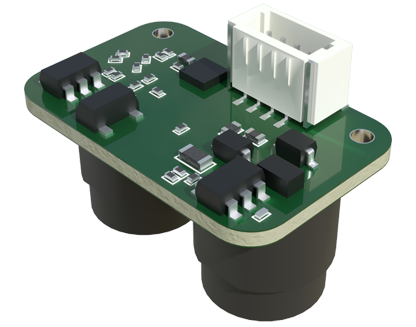
The choice of laser wavelength is a significant design factor. Near-infrared (NIR) lasers around 905 nm are prevalent due to their good balance of performance, component availability, and eye-safety considerations. For longer-range or higher-precision applications, sensors may use 1550 nm lasers, which are considered safer for the human eye at higher power levels, allowing for increased signal strength. The sensor's optics, including the laser diode and receiver lens, along with advanced signal processing algorithms for noise filtering and pulse discrimination, are what transform the basic ToF principle into a robust and reliable measurement tool.
Applications are vast and growing. In industrial automation, these sensors provide precise positioning for robotic arms, conveyor belt monitoring, and dimensional gauging of parts. In the automotive sector, they are a key enabler for Advanced Driver-Assistance Systems (ADAS) and autonomous vehicles, creating real-time 3D point clouds of the vehicle's surroundings. Surveying and construction benefit from their speed and accuracy for volume calculations, terrain modeling, and structural monitoring. Even in agriculture, they are used for yield estimation and canopy management.
Selecting the right sensor requires a careful analysis of the application environment. Engineers must consider factors such as the target's surface properties (highly reflective or absorbent materials can affect signal return), ambient light conditions (sunlight can introduce noise), the presence of dust or fog, and potential interference from other optical sources. The required interface (analog voltage, current loop, RS-232, Ethernet, or fieldbus protocols like PROFINET) must align with the existing control system architecture. Robust housing with an appropriate Ingress Protection (IP) rating is essential for harsh industrial environments.

In conclusion, laser pulse ranging sensors offer a powerful solution for non-contact distance measurement. Their continued evolution, driven by advancements in semiconductor lasers, detector technology, and computational power, is expanding their capabilities while reducing size and cost. For the engineering professional, a firm grasp of their operating principles, performance metrics, and application-specific challenges is essential for leveraging this technology to enhance system accuracy, efficiency, and intelligence. As Industry 4.0 and the Internet of Things (IoT) progress, the role of these precise optical measurement devices will only become more central.