Laser displacement sensors are non-contact measurement devices that utilize laser triangulation or time-of-flight principles to determine the distance between the sensor and a target object with high precision. These sensors emit a focused laser beam onto the target surface. The reflected light is captured by a receiving element, such as a position-sensitive detector (PSD) or a CMOS/CCD array. By calculating the angle or the time difference between the emitted and reflected light, the sensor's internal processor computes the exact displacement or distance. This fundamental principle enables micron-level accuracy, making them indispensable in modern automation and quality control.
The core technology behind most high-precision models is laser triangulation. In a typical setup, the laser emitter, the receiving lens, and the detector are arranged at specific angles. When the target distance changes, the position of the laser spot on the detector shifts proportionally. This shift is analyzed to output a precise distance value. For longer ranges, time-of-flight (ToF) sensors, which measure the round-trip time of a laser pulse, are often employed. Each technology has its optimal application range: triangulation sensors excel in short to medium ranges with ultra-high resolution, while ToF sensors are better suited for longer distances, albeit with slightly lower resolution.
Several key types dominate the market. 2D Profile Sensors scan a laser line across an object, capturing a complete cross-sectional profile for dimensional inspection and shape analysis. Confocal Chromatic Sensors use white light and spectral analysis to measure displacement, particularly effective on transparent, glossy, or multi-layered surfaces where standard lasers might struggle. Diffuse Reflection Type sensors are common for general-purpose use, measuring distance to most solid surfaces. Thru-Beam Type sensors, with separate emitter and receiver units, are used for precise edge detection or presence sensing. Selecting the correct type depends on factors like target material, surface finish, required accuracy, measurement range, and environmental conditions.
The advantages of laser displacement sensors are manifold. Their non-contact nature eliminates mechanical wear and prevents damage to delicate targets. They offer exceptionally high sampling speeds, often in the kilohertz range, enabling real-time process monitoring. Furthermore, they provide outstanding linearity and resolution, down to sub-micron levels for specialized models. These characteristics make them superior to traditional contact probes or ultrasonic sensors in demanding applications.
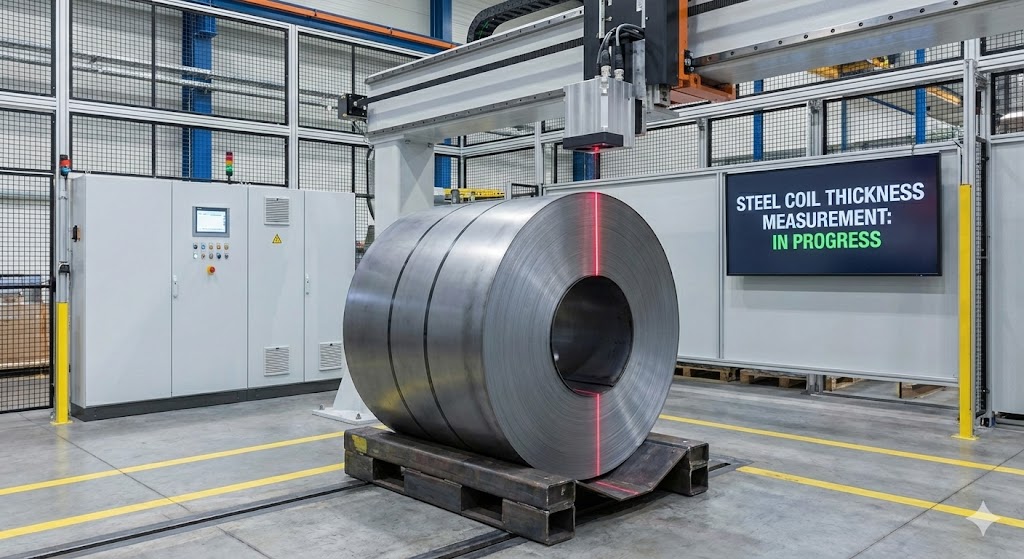
Industrial applications are vast and critical. In automotive manufacturing, they measure component gaps, panel thickness, and engine part dimensions. In electronics, they inspect solder paste height, chip placement, and PCB warpage. Robotics rely on them for precise positioning and guidance. In metal processing, they monitor roll gap, sheet flatness, and thickness. Pharmaceutical packaging lines use them for fill level control and cap inspection. Essentially, any process requiring fast, accurate, and reliable dimensional feedback is a candidate for laser sensor integration.

When integrating a laser displacement sensor, engineers must consider several practical factors. The speckle noise effect on rough surfaces can reduce accuracy, which may require averaging or specialized filters. Target surface properties—such as color, transparency, and reflectivity—drastically affect performance; a highly reflective or black matte surface often necessitates sensor model adjustment or specific calibration. Environmental disturbances like ambient light, dust, oil mist, or vibration must be mitigated through protective housings, optical filters, or robust mounting. Proper alignment and a stable mechanical setup are paramount for repeatable measurements.
Looking ahead, trends point towards miniaturization, enhanced connectivity (IO-Link, Ethernet-APL), and smarter sensors with embedded edge computing for preliminary data analysis. Integration with AI and machine vision systems is also accelerating, allowing for more complex inspection tasks beyond simple distance measurement. As Industry 4.0 and smart factories evolve, the role of the laser displacement sensor as a critical data acquisition node will only become more pronounced, driving further innovations in speed, accuracy, and application versatility.
In conclusion, laser displacement sensors are powerful tools that translate optical principles into precise dimensional data. Understanding their operating principles, types, and application considerations is essential for engineers to leverage their full potential in enhancing product quality, optimizing processes, and enabling advanced automation across countless industries.