Line profile laser sensors, also known as line lasers or laser profilers, have become indispensable tools in modern industrial automation and quality control. Unlike traditional point or single-spot laser sensors, these devices project a continuous, thin line of laser light onto a target surface. This line is then captured by a high-resolution camera, typically positioned at a known angle to the laser source. The resulting image is processed to generate a precise 2D or 3D profile of the object's surface, capturing height, depth, and contour information across the entire line in a single measurement. This fundamental principle enables high-speed, non-contact inspection of complex geometries, making them superior for applications requiring detailed cross-sectional analysis.
The core components of a line profile laser sensor system include the laser line generator, the camera (usually a CMOS or CCD sensor), and sophisticated processing software. The laser line generator is engineered to produce a line of consistent intensity and thickness, which is crucial for measurement accuracy. The camera captures the deformation of this laser line as it strikes the object. Any variation in the object's surface—a scratch, a bulge, a gap, or a complex shape—causes the straight laser line to bend or shift in the captured image. The software uses triangulation algorithms to analyze these distortions pixel by pixel, converting them into highly accurate dimensional data. This data can be used for real-time analysis or fed into a control system for automated decision-making.
The applications of line profile laser sensors are vast and transformative across numerous sectors. In automotive manufacturing, they are deployed for weld seam inspection, verifying the integrity and geometry of welds in real-time. They meticulously measure gap and flushness between body panels, ensuring perfect fit and finish. In electronics, these sensors inspect solder paste volume and component coplanarity on printed circuit boards (PCBs), preventing costly defects. The packaging industry relies on them to verify fill levels in bottles and containers, check seal integrity, and inspect package dimensions. Furthermore, they are critical in robotics for precise guidance and bin-picking operations, where they help robots identify and locate randomly oriented parts.
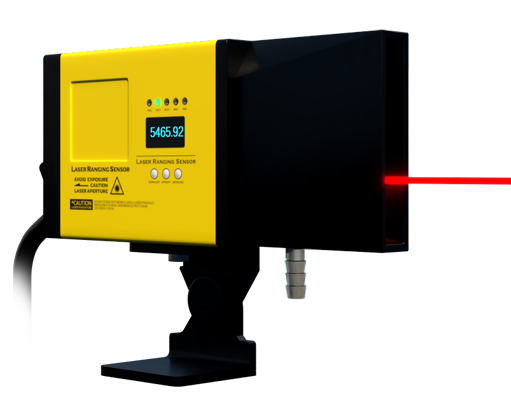
One of the most significant advantages of line profile sensors is their ability to perform high-speed, 100% inline inspection. By capturing an entire profile with each scan, they eliminate the need for mechanical scanning or multiple point measurements, drastically increasing throughput. This capability is essential in fast-moving production lines where every millisecond counts. Their non-contact nature also means there is no wear and tear on the sensor or risk of damaging delicate products. They can measure a wide range of materials, from reflective metals to dark, absorbent plastics, though sometimes requiring specific laser wavelengths or optical filters to handle challenging surfaces.
When selecting a line profile laser sensor, engineers must consider several key specifications. Measurement range and resolution are paramount; a sensor with a 50mm field of view and 10-micron resolution is suited for precision micro-measurements, while one with a 300mm range might be used for larger objects like tires. The scanning rate, measured in profiles per second (Hz), determines how fast moving objects can be measured without blurring. Environmental robustness is another critical factor. Industrial-grade sensors are housed in rugged enclosures with high IP ratings to withstand dust, moisture, vibration, and temperature fluctuations common in factory settings.
Integration and software are where the raw data transforms into actionable intelligence. Modern sensors come with powerful, user-configurable software suites. These platforms allow users to set up measurement routines—such as edge detection, height measurement, or blob analysis—without deep programming knowledge. They can define pass/fail tolerances, generate statistical process control (SPC) charts, and trigger alarms or reject mechanisms when a part falls out of specification. Seamless communication via standard industrial protocols like Ethernet/IP, PROFINET, or TCP/IP ensures easy integration into existing PLC and SCADA systems.
Looking ahead, the evolution of line profile laser sensors is closely tied to advancements in vision technology and artificial intelligence. The integration of AI and machine learning algorithms is enabling these sensors to not only measure dimensions but also classify defects and learn from process variations, moving towards predictive quality control. Furthermore, the development of blue laser technology offers improved performance on organic and shiny surfaces by reducing speckle noise and improving light absorption. As Industry 4.0 and smart factory concepts mature, these sensors will play an even more central role as critical data-generating nodes in the interconnected industrial IoT ecosystem, providing the detailed digital twin data necessary for optimizing entire production processes.