In the rapidly evolving landscape of industrial automation, proximity sensors have become indispensable components for detecting the presence or absence of objects without physical contact. The latest advancements in sensor technology have led to the development of innovative structural designs that enhance performance, reliability, and adaptability. This article delves into the detailed structural diagram of a new-generation proximity sensor, highlighting its key components and operational principles.
The core of the modern proximity sensor comprises several integral parts: the sensing element, oscillator circuit, signal processing unit, and output stage. The sensing element, typically based on inductive, capacitive, or photoelectric principles, is engineered to detect metallic or non-metallic targets within a specified range. In inductive sensors, a coil generates an electromagnetic field that interacts with metallic objects, causing changes in oscillation amplitude. The oscillator circuit, integrated with advanced microcontrollers, ensures stable frequency generation and minimal drift under varying environmental conditions.
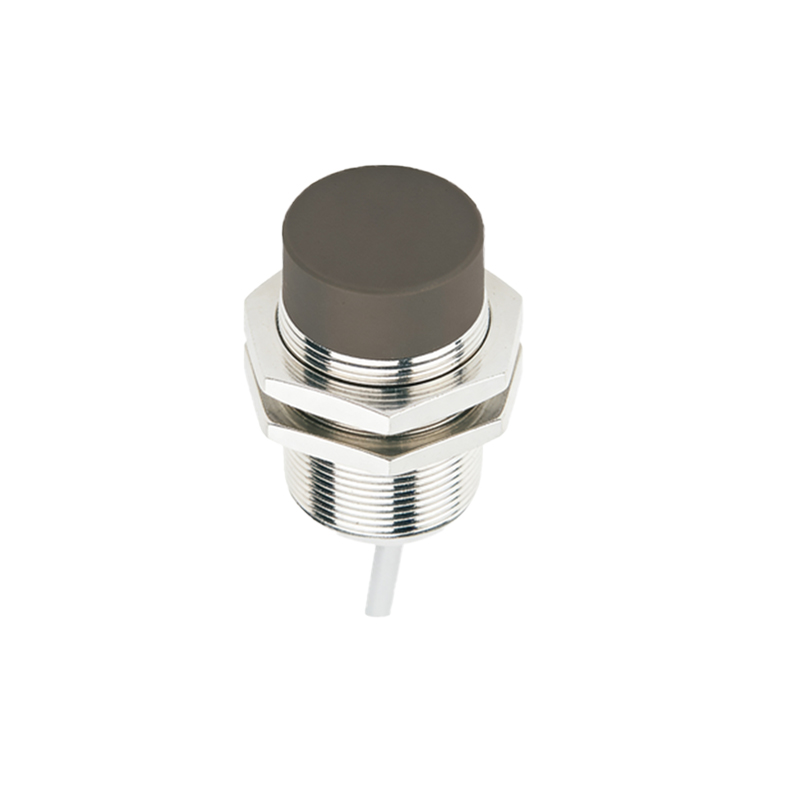
A critical innovation in the new structural design is the incorporation of a shielded or unshielded housing configuration. Shielded sensors feature a metallic surround that concentrates the electromagnetic field axially, allowing for flush mounting in metal surfaces without interference. Unshielded sensors, with an extended sensing range, are ideal for applications requiring broader detection zones. The structural diagram illustrates these housing types with precise dimensional tolerances, emphasizing their impact on installation flexibility and sensing accuracy.
The signal processing unit employs digital algorithms to filter noise and compensate for temperature fluctuations, ensuring consistent output signals. This unit is connected to an output stage that provides switching capabilities, such as NPN or PNP transistor outputs, relay contacts, or analog voltage signals. The diagram details the wiring connections and pin assignments, facilitating seamless integration into control systems like PLCs (Programmable Logic Controllers).
Furthermore, the sensor's housing is constructed from durable materials like PBT (Polybutylene Terephthalate) or stainless steel, offering IP67 or higher ingress protection ratings for harsh industrial environments. LED indicators for power and output status are strategically positioned for visual diagnostics, as shown in the structural diagram. The compact form factor and modular design enable easy replacement and scalability in automated assembly lines, robotics, and packaging machinery.
In summary, the structural diagram of this new proximity sensor exemplifies a synergy of robust engineering and smart technology. By optimizing component layout and material selection, manufacturers achieve higher switching frequencies, reduced hysteresis, and extended operational lifespans. Industry professionals can leverage these insights to select appropriate sensors for specific applications, driving efficiency and innovation in automation projects.